
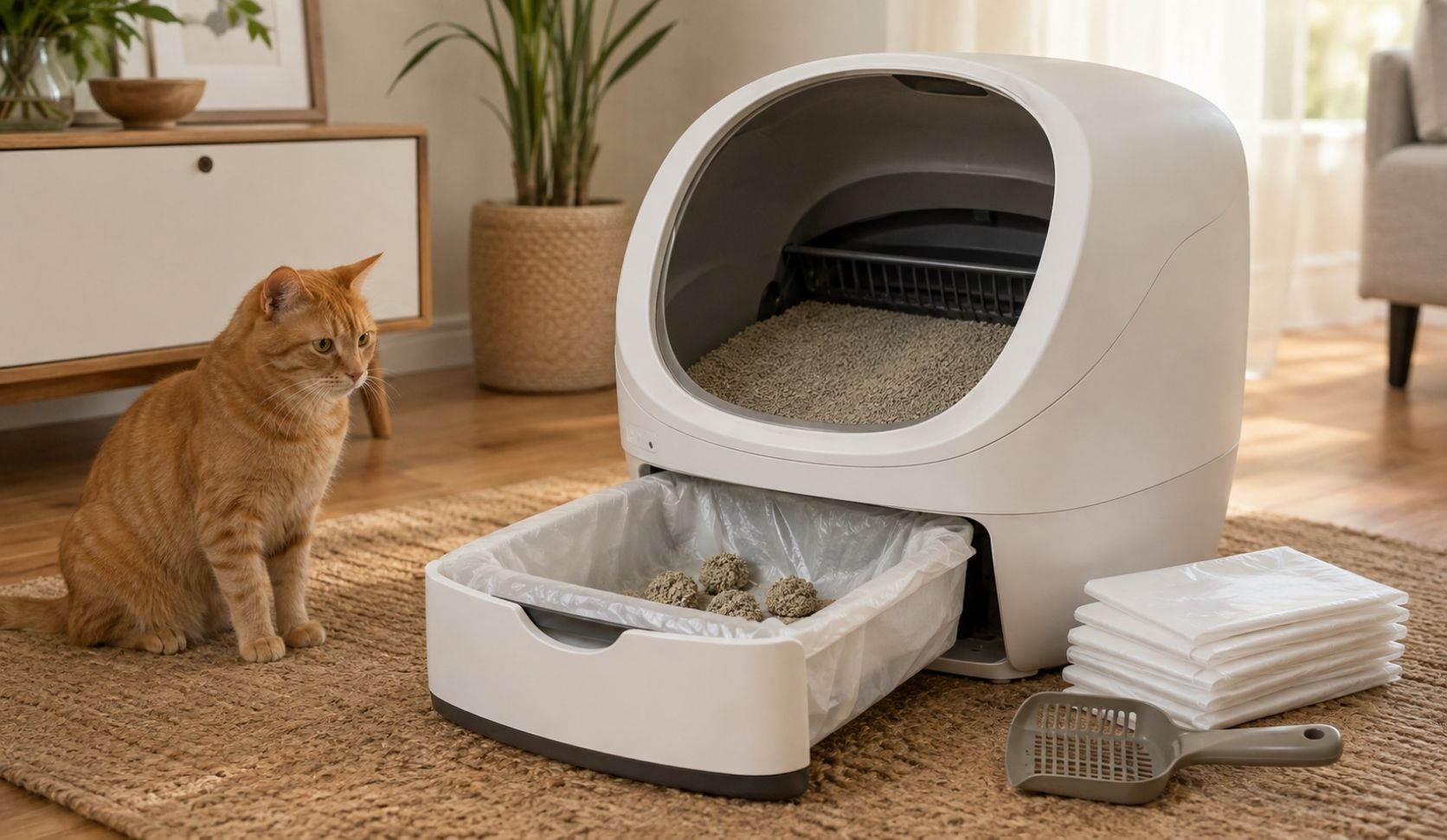
I've run automatic litter boxes for five years in a three-cat home with Mao, Leo, and Deo. A liner in one of these boxes changes exactly one thing: how the waste drawer gets cleaned, not how the litter gets sifted or separated from clumps. It saves you from scraping dried residue out of the drawer each time you empty it. Whether that trade is worth it depends on how much you mind the small stuff, a liner riding up at the edge, an occasional tear, a bit of repositioning, not on liners being inherently good or bad.
That's the real decision, and it's smaller than most pages make it sound, and it's a recurring one since liners get bought again and again, not a one-time pick. Nobody selling liners frames it as optional; nobody dismissing them mentions there's a real, mechanical reason to check fit first, and the fit question below is the one worth answering before you buy a box of them.
What an Automatic Litter Box Liner Actually Changes
An automatic litter box does its work in two separate places: the tray, where a rake or ball rotates the litter and sifts waste out, and the drawer, where that separated waste ends up. A liner sits in the second place, not the first.
That matters because the liner never touches the sifting step. The mechanism does the actual separating, clumps rise out of the litter and drop into the drawer, exactly the same whether a liner is there or not. What the liner changes is what happens after: instead of scraping dried clumps and stray litter grains off bare plastic, you lift the liner out, tie it, and drop a new one in, the same motion as taking out a kitchen trash bag.
On a maintenance schedule built around emptying the drawer every few days, that's a real difference in effort over a year. It's not a difference in how clean the litter itself stays, and it's not a substitute for the deeper teardown clean the whole unit still needs periodically.
Where Liners Can Go Wrong Mechanically
This is the question nobody selling liners wants to slow down for: can a liner interfere with the mechanism itself?
I checked manufacturer documentation directly rather than guess. PetSafe's own troubleshooting guide for its ScoopFree SmartSpin box lists a blocked infrared sensor as an error code, and one of the listed causes is a waste bin liner sitting over the sensor window. That's a real, sourced warning, but a narrow one: it's about the drawer sensor specifically, not about the rake or spinning mechanism that does the sifting.
I did not find any manufacturer statement warning that a liner interferes with the sifting or rotation movement itself. If that risk exists, no brand documents it publicly, so I won't invent one.
What I have seen in five years of drawers: a loose liner can bunch at a corner, and a thin one can tear if litter clumps drag against it while the drawer slides. Neither breaks the unit. Both mean checking the liner is seated flat and below the sensor line before you close the drawer, every time.
The Households Where Liners Make Sense (and Where They Don't)
Effort is the right lens here, not price. A liner is worth trying if scraping the drawer is the maintenance step you resent most. In a three-cat house like mine, the drawer fills faster than in a one-cat home, so the scraping-versus-lifting tradeoff shows up more often, and a liner that holds up saves more repeated effort than it would for a single cat.
It makes less sense in a house where a cat digs aggressively enough to shred whatever lines the tray or drawer, since a shredded liner does not save a step, it adds one: fishing torn plastic out before you can empty anything. It also makes less sense if litter tracking outside the box is already a problem, since a bunched or torn liner edge can catch and drag more litter along with it. That connects directly to the separate litter-tracking question, which is really about airflow and paw contact, not liners. The underlying question is the same for any consumable here: does it remove a task, or just move it somewhere else.
What to Check Before You Try One
Skip the brand comparisons and check fit against your own drawer first. Automatic litter box drawers are shaped differently from the flat, open pans manual litter boxes use, deeper on one side, curved at a seam, sized to a specific model, so a liner cut for a generic pan will not sit right in one.
Before using any liner, check three things: that it lies flat against the drawer floor with no wrinkle over the sensor, that it fits the drawer's actual depth without ballooning up past the rim, and that it holds up under a house cat's normal digging, not just a photo on a packaging label. A liner sized for an open, flat pan is not the same shape as one built for a boxed drawer, and swapping them is a common reason a liner disappoints on the first try.
None of this requires trusting one brand over another. It requires checking the fit the way I check everything else about this device, the same habit that keeps the multi-cat setup running after five years: verify, don't assume.
FAQ
Do automatic litter box liners actually stop odor?
No liner blocks odor on its own. It only changes how fast the drawer gets emptied, and a liner that makes emptying easier means the drawer is more likely to actually get emptied on schedule. Odor control still comes down to how often the drawer is emptied and how well the whole unit gets cleaned, not what lines the drawer, and that's the actual lever, not anything printed on the liner packaging.
Can I use a liner made for a manual litter box in an automatic one?
Not reliably. Manual pan liners are cut for flat, open trays, and an automatic box's drawer has a different shape, depth, and sometimes a sensor window built into one wall. A liner that does not match the drawer's actual shape is exactly the kind that bunches, tears, or rides up over the sensor. Forcing a mismatched liner in is how you end up checking the sensor more often than you would like.
Will a liner damage my automatic litter box?
I have not found any manufacturer statement warning that liners damage the sifting or rotation mechanism, and I checked rather than assumed. The one documented risk I found is narrower: a liner blocking the drawer's sensor, which triggers an error code rather than damage, and checking the fit before closing the drawer avoids it. That single documented case is worth taking seriously precisely because it is the only one on record.
How often should I change the liner?
On the same rhythm as the drawer itself, whenever it would otherwise need scraping. In a multi-cat home that is usually every few days, matching the emptying schedule rather than a fixed calendar date, and matching whichever cat is using the box most that week. There is no fixed manufacturer interval to follow, since the right cadence tracks your own drawer, not a package label.
Do liners work with clumping litter?
Yes. The liner sits below the litter and only catches what the mechanism has already separated, so it does not change how the litter clumps or sifts. It only changes what happens to the waste after it lands in the drawer. It is the sifting mechanism doing the separating either way, with or without a liner underneath.