
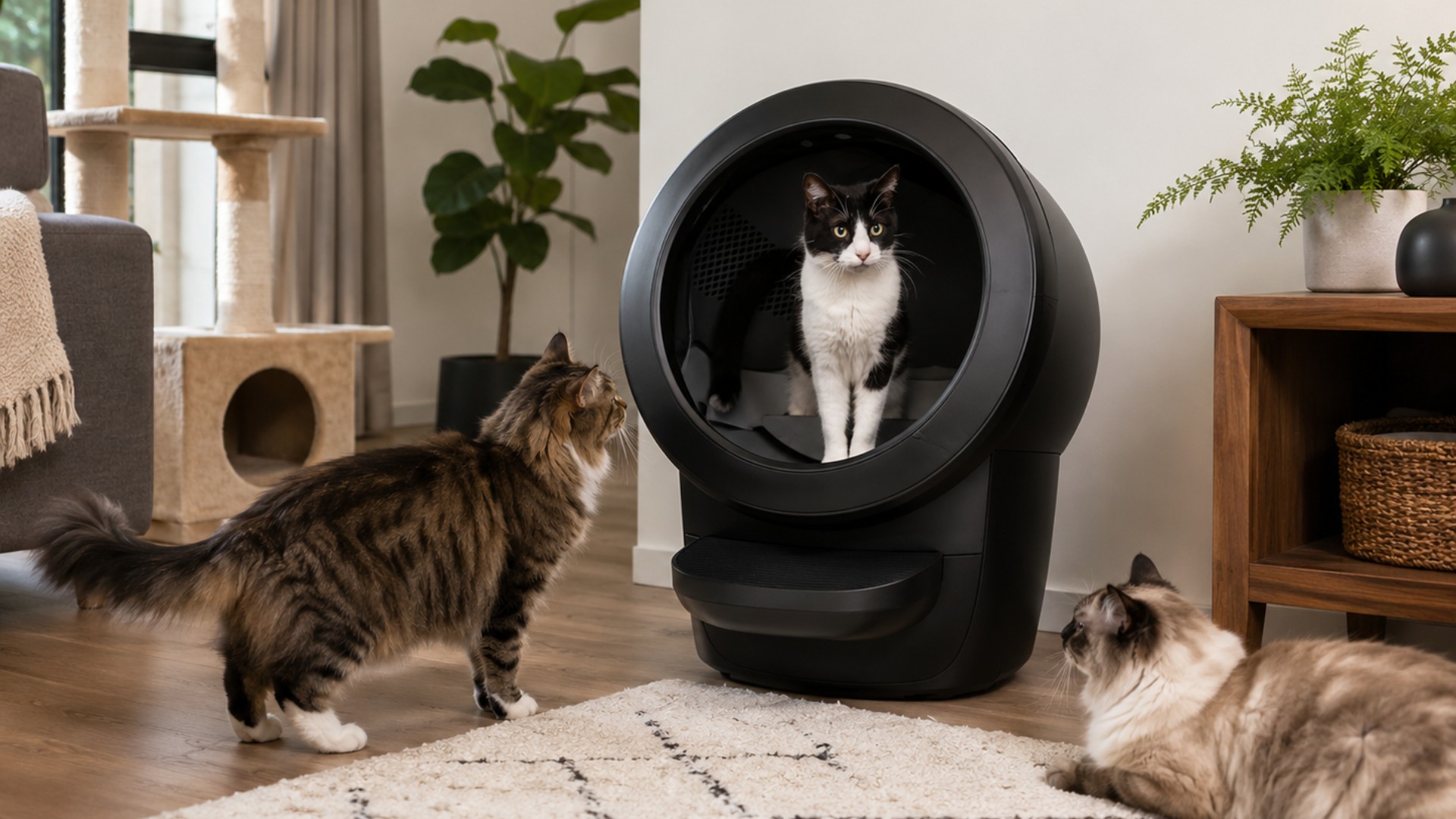
A few years ago I had to leave the city on short notice. It was urgent, the kind of trip you cannot plan around. I had two cats then and a plain manual litter box, and I came home to exactly what you would expect. That trip changed how I thought about litter. I stopped treating it as a chore I would eventually get to, and started treating it as a system that had to run whether I was standing over it or not.
That is how I ended up living with self-cleaning litter boxes in a three-cat household. Mao, Leo, and Deo have now been part of my home together for five years. I work from home, so I have watched this machine run through thousands of cycles, most of them at close range. I have cleaned it when it was easy and when it was not. I have paid for the parts nobody warns you about.
This is the account I wish I had found before buying. Not the spec sheet. The lived-in version: what holds up, what wears out, what a multi-cat home does to the math, and who should honestly skip the whole category.
The Short Version, If You Read Nothing Else
- A self-cleaning box removes the daily scoop. It does not remove cleaning. You still get hands-on every week or two.
- One automatic box can serve two, sometimes three cats. Three is the edge the marketing quietly glosses over.
- The unit price is the smallest number in the equation. Litter and replacement parts over the years are where the real cost sits.
- Cat acceptance is the entire game. A box your cat refuses to use is worse than no automatic box at all.
- If your cat is very small, very nervous, or you are on a tight budget, a disciplined manual routine can beat a mediocre automatic one.
Everything below is the long version of those five lines.
The Promise Versus What Actually Happens
The pitch is simple and genuinely appealing. The box detects when a cat has used it, waits a few minutes, then sifts or rotates the waste into a sealed compartment. Clumps disappear on their own. Odor stays trapped. You empty a drawer every so often instead of bending over a scoop twice a day.
Most of that is true. The part the pitch leaves out is that “automatic” describes the scooping, not the ownership. The machine handles the repetitive motion. You still handle everything it cannot: the deep cleans, the litter top-ups, the sensor wipe-downs, the occasional stuck cycle, and the judgment calls about whether your cats are actually happy with it.
So here is the honest framing. A self-cleaning box buys back your time and lowers the odor floor of your home. It does not turn litter into someone else’s problem. Go in expecting a hands-off appliance and you will feel cheated. Go in expecting a very good assistant and you will be satisfied.
Year One Was Mostly Me Getting It Wrong
My first mistake was not the machine. It was the model I chose and how I introduced it.
The Covered Box My Cat Refused
Early on I bought a covered, enclosed unit because the reviews loved how it hid everything. Mao took one look and refused to step inside. Some cats are fine in a covered box. Some feel trapped, especially with a motor attached to the enclosure. I had chosen for my own aesthetic preferences, not for the animal who had to use it. That unit sat idle while I went back to the drawing board.
The lesson stuck. Buy for the cat’s temperament first and your convenience second. A confident, curious cat will accept almost anything. A cautious one needs open sightlines, a low entry, and a slow introduction.
The Introduction I Rushed
Even with the right box, I plugged it in and expected instant adoption. Two cats obliged. One circled it for days. What finally worked was boring and slow. I ran the new box next to the old manual one, kept the automatic cycling switched off for the first week so it stayed silent and still, let the cats use it as an ordinary box, and only then turned on the automation once it was familiar. Rushing the introduction is the most common reason people conclude “my cat hates it,” when the real problem was pace.
What a Multi-Cat Home Does to the Math
This is the part most reviews skip, because most reviewers test with a single cat.
The One Box Per Cat Rule Does Not Disappear
The standard guidance is one litter box per cat, plus one spare. A self-cleaning box does not repeal that rule. It bends it. Because the box scoops itself after every visit, each cat tends to find a clean surface, which stretches how far a single unit can go. In practice, across five years, one good automatic box has comfortably served two cats and managed three with some care.
If you have four or more cats, plan for the box plus at least one backup, manual or automatic. You want somewhere for a cat to go when the main unit is mid-cycle, jammed, or simply occupied.
Queuing and Cycle Timing
An automatic box needs a few minutes after each use to run its cycle. In a single-cat home, that pause is invisible. In a three-cat home, you occasionally get a small traffic jam where a cat wants in while the machine is resetting. Cats mostly handle this by waiting or wandering off, but a second option nearby removes the risk of an accident entirely.
Can It Tell Your Cats Apart?
Some units log activity and, with setup, estimate which cat is using the box by weight. This is genuinely useful for catching health changes early, like a cat suddenly going far more or far less often. Treat it as a helpful trend line, not a medical instrument. It pointed me toward a vet visit once by flagging a shift in one cat’s pattern, and that alone paid for a chunk of the box. But it is a prompt to look closer, not a diagnosis.
The Things Reviews Gloss Over
Noise
A self-cleaning box makes a mechanical sound when it cycles. It is not loud, but it is not silent, and in a quiet room at 3 a.m. you will hear it. My confident cats stopped noticing within days. A nervous cat may need longer, or may need the box placed away from where they sleep. If anyone in your home is a light sleeper, do not put the unit in or beside a bedroom.
Odor Over Months, Not Days
Out of the box, odor control is excellent, because waste gets sealed away quickly. The honest caveat is that it degrades if you slack on the deep cleans. The sealed drawer keeps smells down for a while, then reminds you it exists. Every few weeks the whole unit needs a proper wash, not just a drawer empty. Skip that and the “no odor” promise quietly expires.
Litter Compatibility
Most rotating and sifting boxes are built around standard clumping clay litter, and they are fussy about substitutes. Lightweight litters, crystal litters, and some natural litters can clump poorly or fail to sift, which leaves residue the machine drags around. I stopped experimenting. Find the clumping litter your machine likes, and stay with it.
It Is Self-Cleaning, Not No-Cleaning
Here is my actual maintenance rhythm after five years:
- Every one to three days: empty the waste drawer.
- Weekly: top up litter, wipe the entry and sensors, glance at the app for anything odd.
- Every few weeks: a full teardown clean of the removable parts.
- Occasionally: clear a cycle that stalled because a clump stuck or litter ran low.
None of this is hard. But if you imagined zero contact with cat waste, adjust that picture now.
The App
The app is useful in small, specific ways. Usage trends are the best feature. Low-litter and full-drawer alerts save you from surprises. Beyond that, most notifications are noise you will eventually mute. And you should know what happens when the connection drops, because it will at some point. On a well-designed unit, the box keeps doing its core job offline. The scheduling and monitoring pause, the scooping does not. If a box you are considering stops cleaning when the Wi-Fi hiccups, that is a real mark against it.
Replacement Parts and Wear
This is the cost nobody quotes you. Over five years, the moving and sealing parts wear. Depending on the model, you may replace items like carbon filters or odor pods on a schedule, and eventually a mechanical part or a liner. None of it is dramatic, but it is recurring, and it belongs in your budget from day one, not as a surprise in year three.
What Five Years Actually Cost
Here is the framing that matters. The sticker price is the down payment on a running expense, not the whole expense.
- The unit itself: a one-time cost, and the number most people fixate on. Around $700 at current pricing.
- Litter: the largest ongoing line for a multi-cat home, because three cats go through a lot. Roughly $300 a year across three cats.
- Filters, pods, and replacement parts: smaller but steady. Roughly $100 a year.
- Electricity: negligible. These units draw very little power, a few dollars a year at most.
So, the total running cost per year is $400.
Put together, across five years and up to three cats, my all-in cost (Litter unit- $700 + running cost- $2000 for five years) has come to roughly $2,700, which works out to about $45 a month. Set against the daily time it returned and the odor it kept out of a small home where I work all day, it has been worth it for me. Your math depends on how much you value that time and how many cats are feeding the workload.
Who Should Buy One, and Who Should Not
Buy one if you have one to three cats, you are short on time or you travel, odor control matters to you, and you can absorb the running cost without wincing. It rewards busy homes and homes where nobody wants litter to be a daily conversation.
Think twice if your cat is very small (some units have a minimum weight for the sensors to trigger correctly), extremely nervous about sound or motion, or if your budget is tight enough that the recurring litter and parts cost would sting. In those cases, two well-placed manual boxes and a firm twice-a-day scooping habit will serve you better than a self-cleaning box you resent paying to feed.
What I Would Do Differently
If I started over, I would choose an open, low-entry design from the beginning instead of the covered unit I wasted money on. I would introduce it with the automation switched off for the first week, every time, without exception. And I would budget the litter and parts on day one, so the ongoing cost never felt like a surprise. Everything else, I would do again.
If this helped, you can subscribe to the CatVerge newsletter for new hands-on guides as they publish, or reach me through the contact page with a question about your own setup.
Frequently Asked Questions
For two cats, comfortably yes. For three, yes with a backup box and attention to litter choice and cleaning rhythm. Past three cats, one automatic unit is not enough on its own.
They lower odor sharply by sealing waste quickly, but only if you keep up the periodic deep cleans. The sealing buys time, it does not replace washing the unit.
They make a mechanical cycling sound that most cats ignore within days. It is audible in a quiet room, so keep the unit away from bedrooms if anyone is a light sleeper.
On a well-built unit, the box keeps scooping. You lose the monitoring and scheduling until it reconnects, not the core function. Verify this before buying, because cheaper units sometimes fail here.
No. Most rotating and sifting boxes are designed for standard clumping clay litter and misbehave with lightweight, crystal, or some natural litters. Pick a compatible clumping litter and stay with it.
No. It removes the daily scoop. You still empty the drawer, top up litter, and deep clean the unit every few weeks.
Author’s Note
I am Sarowar Parvej, founder and author of CatVerge. I have lived with cats for over ten years and currently share my home with three: Mao, Leo, and Deo. Because I work from home, I test cat-care gear the way people actually live with it, over months and years, not a single weekend. CatVerge covers the practical side of smart cat care: setup, daily maintenance, real running costs, and what tends to go wrong after the first week. One boundary I hold to: I write about equipment and routines, not medicine. For anything involving your cat’s health, please talk to your vet. Learn more about my journey.