
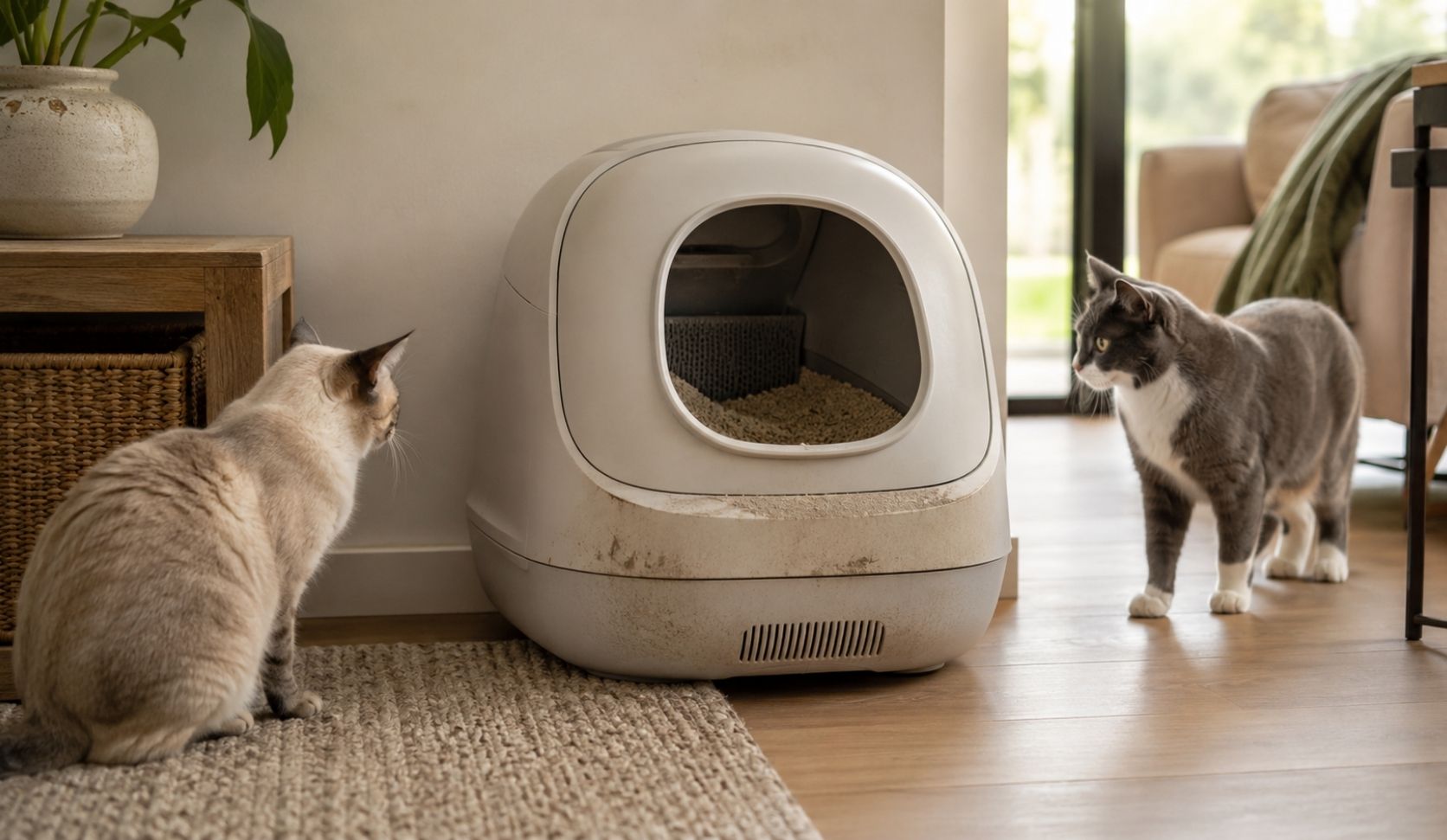
If your self-cleaning litter box is not working right or the room still smells, the machine is usually fine. In most homes the cause is a maintenance gap, not a mechanical failure, and in a multi-cat home the order you check things in matters. Start with the parts that fill up fastest: the waste drawer, then the carbon filter, then the litter itself. Only after those come up clean should you suspect a sensor, the rake, or an actual defect. And if the smell is coming from your cat's waste rather than the box, that is a vet question, not a maintenance one.
That last point is the one most troubleshooting guides skip, so we put it up front. The rest of this article walks each cause in the order a busy multi-cat household should actually check them.
Start here: is it volume or a malfunction?
Before you open a manual or file a support ticket, answer one question: has anything about your setup changed, or has your cat count or usage gone up?
A self-cleaning box that ran clean for a year and then started smelling has almost never "broken." What has usually changed is the load on it. A cause that is a minor once-a-year annoyance in a single-cat home becomes a recurring monthly problem at two or three cats, because the drawer fills faster, the filter saturates faster, and the litter gets used up faster. The hardware did not fail. It hit a volume it was never being maintained for.
Use this quick triage to point yourself at the right section. It is ordered by how common each cause is in a multi-cat home, not alphabetically.
| Symptom | Most likely cause | Where to look |
|---|---|---|
| Smell but the box cycles normally | Full drawer or saturated filter | Waste drawer, then filter |
| Smell right after your cat uses it | Ammonia released before the cycle runs | Litter type and cycle timing |
| Clumps breaking apart, wet residue left behind | Wrong or low-quality litter | Litter type |
| Box stops mid-cycle or will not start | Sensor obstruction or overfilled litter | Sensor and fill line |
| Grinding, jamming, or a cycle that stalls | Clogged rake or hardened litter | Rake mechanism |
| Strong, unusual smell from the waste itself | Possible cat-health issue | See a vet, not the box |
Work down from the top. The higher a row sits, the more likely it is your actual problem, and the faster it is to fix.
Cause 1: the waste drawer is fuller than you think
This is the single most underestimated cause in multi-cat homes, so it goes first. Automatic boxes remove waste from the litter bed on every cycle, which makes it easy to forget that the drawer they push it into is still just a bin that fills up. Once that drawer is near capacity, sealed clumps sit closer to the opening, the lid struggles to close over a heaping load, and odor escapes every time the box cycles.
Manufacturers often quote drawer capacity in "days," but those estimates assume one cat. Divide the rating by your number of cats and you are closer to reality. If a drawer is rated for roughly a week with one cat, plan on emptying it every two to three days with two cats, and potentially every other day with three. Do not wait for the full indicator. In a multi-cat home the smell arrives before the light does.
A liner that is bunched or not seated flush against the drawer walls also leaves gaps where waste settles outside the sealed area. Reseat it fully each time you empty.
Cause 2: the carbon filter is saturated
Carbon and charcoal filters trap odor by adsorption, and they have a finite capacity. Once that capacity is used up, the filter does nothing, and a spent filter looks identical to a fresh one. There is no visual warning that it has stopped working.
Two things exhaust a filter faster than the box's manual assumes: more cats, and a warm or humid room. Heat and moisture accelerate odor release, so a filter that lasts a stated interval in a cool single-cat home can be effectively dead well before that in a warm multi-cat one. If you are replacing filters on the box's default schedule and still smell ammonia, shorten the interval before you assume anything mechanical is wrong.
There is a mechanism worth understanding here, because it explains a smell that no filter can fully solve. Ammonia is released the moment urine hits the litter, minutes before the next cleaning cycle runs. The box's filter treats air leaving the sealed drawer, not the fresh air in the room at the moment your cat steps out. So a whiff right after use is normal physics, not a fault. Faster cycle timing and a heavier, faster-clumping litter reduce it far more than a filter swap does.
Cause 3: the litter is the problem, not the machine
Automatic boxes are mechanically fussy about litter, and the wrong type causes both smell and jams at the same time. This is the honest answer a lot of owners do not want to hear: you may not have a hardware problem, you may have a litter problem.
Light, crumbly, or non-clumping litter falls apart under the mechanical force of a rake or a rotating globe. Instead of forming a firm clump that lifts cleanly into the drawer, it breaks into wet fines that settle at the bottom and bake in. That residue is a permanent smell source, and it is also what hardens around a rake and causes the stalls people mistake for a motor failure.
For most automatic boxes, a heavier sodium bentonite clumping clay, or a quality clumping plant-based litter specifically rated for automatic use, holds together under the mechanism and drops cleanly. Check your box's manual for the type it is built around and match it. Switching litter is the cheapest fix on this list and resolves a surprising share of "not working right" complaints. If you are still choosing gear or setting expectations for a two-cat household, our companion piece on whether an automatic box is worth it for two cats (publishing soon) covers how litter cost scales with cat count.
Cause 4: sensors and the rake
If the box actually stops working, stalls, or refuses to start a cycle, now you are in genuine mechanical territory, and most of it is still owner-fixable.
Sensors. Most automatic boxes use weight or motion sensors to know when the cat has left and when the box is safe to run. Litter dust, stray clumps, or a fill level above the max line can confuse them, and the box responds by pausing, flashing an error, or skipping cycles. Wipe the sensors gently with a dry cloth, confirm the litter is at or below the fill line, and make sure nothing is resting against the box. Overfilling is one of the most common self-inflicted "malfunctions."
The rake or globe. Grinding, jamming, or a cycle that stalls partway is usually hardened litter or a large clump wedged in the mechanism, not a dead motor. Power the unit down fully before you touch anything moving, then clear the path by hand and remove any cemented residue. This is exactly the residue that the wrong lightweight litter creates, which is why Cause 3 and Cause 4 are so often the same root problem showing up as two symptoms.
If the mechanism is clean, the litter is correct, and it still jams or throws a motor error, that is one of the few cases where it is genuinely the machine, and a support call or a replacement part is warranted rather than more troubleshooting.
The maintenance gap most people never close
Here is the pattern behind the majority of these problems: the box was set up once and then treated as fully hands-off. Automatic does not mean maintenance-free. It means less frequent maintenance, not none.
A box on a real upkeep routine almost never reaches the "not working right" stage, because filters get changed before they saturate, the drawer gets emptied before it overflows, and the globe or bin gets a full wash every couple of months before residue builds into a permanent smell source. Multi-cat homes need every one of those intervals shortened. We keep a full breakdown in our multi-cat maintenance schedule (publishing soon), which is the thing to run through before you conclude anything is defective. If you have followed that schedule and the problem persists, then the troubleshooting above is your next step.
When it is not the box at all: the health check nobody sells you
This is the section manufacturer and vendor guides leave out, because it points away from buying a part or a new machine.
Sometimes the box is doing its job and the smell is still worse than it should be, because the smell is coming from your cat's waste, not the equipment. A sudden, unusually strong or sharp ammonia smell from fresh urine, or urine that suddenly smells sweet or fruity, can be a sign of a health problem rather than a maintenance one. Concentrated urine from dehydration, a urinary tract infection, kidney issues, or diabetes can all change how strong or how different your cat's waste smells, and no filter or litter change will fix a medical cause.
The tell is timing and context. If nothing about your box or your maintenance changed but the smell got noticeably stronger or different, especially alongside other changes like drinking or urinating more, going outside the box, hiding, or eating differently, treat that as a reason to call your veterinarian, not a reason to buy a new box. CatVerge is not a medical resource and we do not diagnose. We are only flagging the one scenario where troubleshooting the machine is the wrong response entirely. When in doubt, a vet visit is the right call.
A related note for anxious owners: a cat that suddenly avoids an automatic box may also be reacting to the box itself rather than to a fault. If the issue is avoidance rather than odor, our guide on helping a nervous cat accept an automatic box (publishing soon) is the better starting point.
Quick-reference: symptom to fix
- Smells but cycles fine: empty the drawer more often, then replace the filter. Shorten both intervals for every extra cat.
- Smells right after use: expect some ammonia at the moment of use; speed up cycle timing and switch to a heavier clumping litter.
- Clumps falling apart, wet residue: wrong litter. Move to a heavier bentonite clay or an automatic-rated clumping litter.
- Stops or errors mid-cycle: clean the sensors, drop the litter to or below the fill line, make sure nothing leans on the box.
- Grinding or jamming: power off, clear hardened litter and stray clumps from the rake or globe by hand.
- Strong or unusual smell from the waste itself: see your veterinarian.
FAQ
Can a bad litter box smell ever be a health issue and not a maintenance issue?
Yes. If the box is clean and maintained but your cat's fresh urine suddenly smells much stronger, sharper, sweet, or fruity, that can point to dehydration, a urinary tract infection, kidney issues, or diabetes. No filter or litter change fixes a medical cause. If the smell changed without any change to your setup, or comes with drinking, urinating, or behavior changes, call your veterinarian.
How do I know if a jam actually damaged the motor?
Power the box down, clear any hardened litter or wedged clumps from the mechanism by hand, then run a cycle. If it completes normally, the jam was the problem, not the motor. If it still stalls, grinds, or throws a motor error with a clean, correctly loaded mechanism and the right litter, that is one of the few cases where a support call or replacement part is justified.
Why does my automatic box smell more now than when it was new?
Usually because the load on it went up or the upkeep intervals never got shorter to match. Filters saturate, drawers fill, and residue builds faster with more cats or in a warm, humid room. Shorten every maintenance interval before assuming the hardware degraded.
What litter works best in an automatic litter box?
A heavier sodium bentonite clumping clay or a quality clumping plant-based litter rated for automatic use. These hold together under the rake or globe and drop cleanly into the drawer. Light, crumbly, or non-clumping litter breaks apart, leaves smelly residue, and causes many of the jams owners mistake for mechanical faults. Always check your box's manual for the type it is designed around.
How often should I empty the waste drawer with multiple cats?
Take the manufacturer's day rating, which usually assumes one cat, and divide it by your cat count. For most two-cat homes that means every two to three days, and for three cats often every other day. Do not wait for the full indicator, because in a multi-cat home the odor arrives before the light does.