
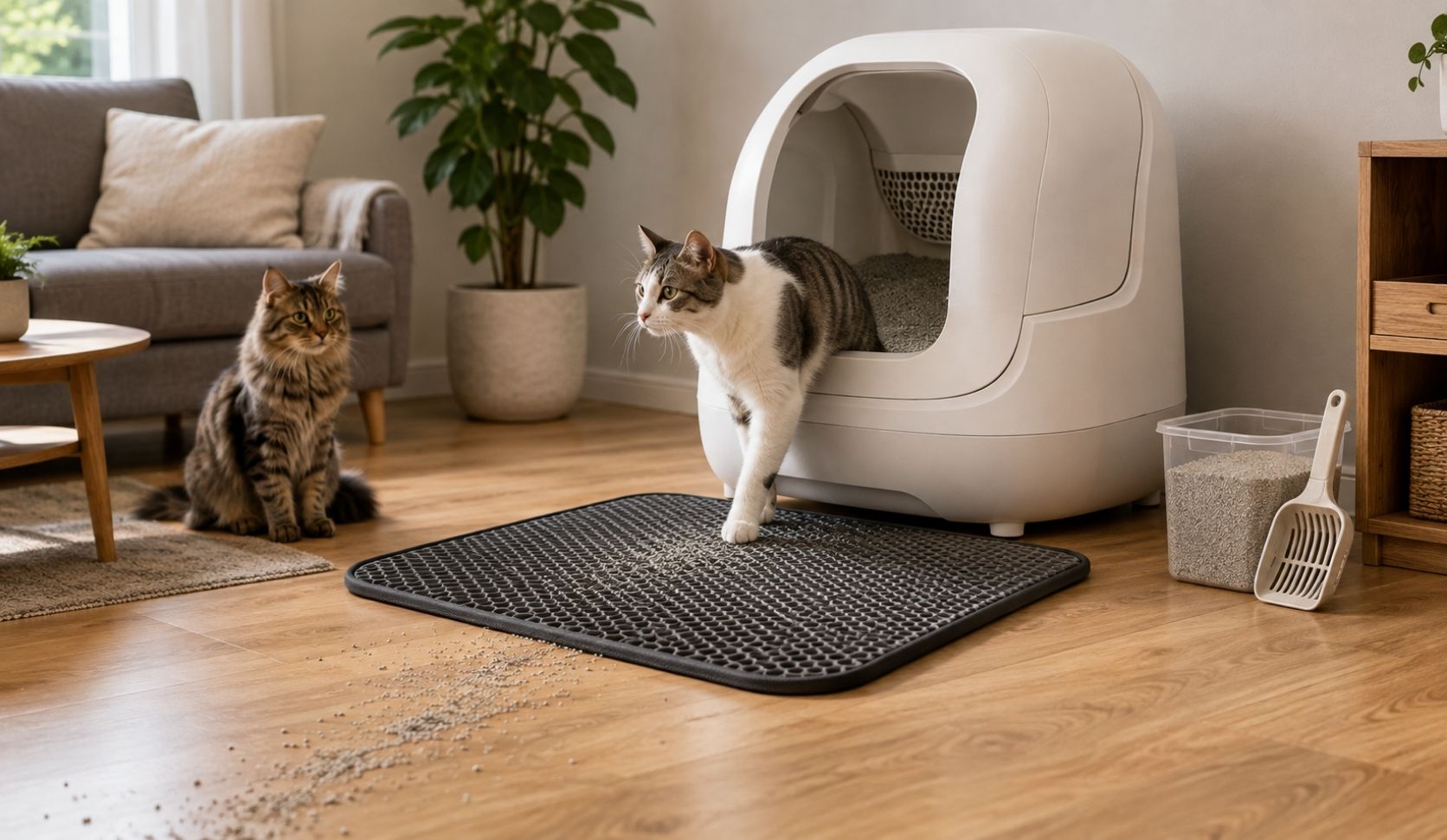
If your automatic litter box is tracking litter everywhere, three things do most of the work, in this order: put a dual-layer mat directly in front of the unit and never underneath it, switch to a low-dust litter with heavier granules, and stop filling above the fill line. Mat placement matters most, and it is the one thing almost every guide gets wrong.
I have run automatic boxes for five years with three cats, Mao, Leo and Deo, and I have read the same fourteen-item tracking listicle in about nine different fonts. Nothing on those lists is a lie, but they are flat: every tip at the same weight, no indication of which one changes your floors and which one changes nothing. Worse, the tip that appears first on nearly all of them is the one that can stop your machine.
The mat trap nobody names
Here is the conflict. Every page ranking for litter tracking tells you to buy a litter mat, usually as tip number one. Meanwhile, Litter-Robot's own troubleshooting documentation for a unit that will not cycle lists placement as a primary cause: the unit must not be sitting on a litter mat, a power cord, or a grout line, no side should touch a wall or another surface, the base must be level, and all four feet must move freely.
Their support page states it directly: if you use a litter mat, place it completely in front of the unit, not partially underneath. So the universal tracking fix, applied carelessly, is a documented cause of stalling. A soft mat under the feet lifts the base off level and interferes with the sensing the machine relies on.
The resolution is placement, not abandonment. The mat goes in front, never under, and "mostly in front" does not count. If yours has already been stalling, that is a separate diagnostic sequence, and step one is looking at what the feet are standing on.
The fixes, ranked by what they actually change
Ordering matters more than length here. Four of the commonly listed fixes genuinely move the amount of litter on your floor, and they do not move it equally.
| Rank | Fix | How much it actually does |
|---|---|---|
| 1 | Dual-layer mat, fully in front of the unit | Largest single change, and the only one that also removes a stall risk |
| 2 | Low-dust litter, larger and heavier granules | Large. Reduces how much leaves the box at all |
| 3 | Fill to the line, never above it | Moderate. Overfilling adds digging and scattering |
| 4 | Interior space and entry geometry | Moderate, but mostly decided at purchase |
| 5 | Vacuuming, paw trims, moving the box | Cleanup and edge cases, not prevention |
1. A dual-layer mat, positioned in front
A dual-layer mat is the one worth paying for. The top layer has openings that granules fall through, and the lower layer traps them out of paw reach, so what your cat carries out is captured rather than pushed around and re-tracked. Single-layer mats catch some of it, then hand it back the next time a paw crosses.
Placement is the multiplier. Every granule that leaves an automatic box leaves through one opening, so the mat has only one place to be, and it must be long enough that a cat takes two or three steps on it before reaching your floor. A small mat tucked half under the unit gets you the stall risk without the coverage. Some newer units, including the Litter-Robot EVO, ship with a built-in carpet tray inside the footprint: the manufacturer solving the same problem without putting anything under the feet.
2. Granule size, weight and dust
This is the second lever, and in some households it beats the mat. Low-dust litter reduces tracking and airborne dust at the same time, because the fine particles that coat paws are the same ones that hang in the air after a cycle. Larger, heavier granules are less able to lodge between toes, and they drop off sooner when they do.
Lightweight litters are the counterexample. Light is the entire selling point, and light granules travel further on paws. I cover how each non-clay substrate behaves in a sifting box separately, but for tracking, weight is the property to look at. If you are still choosing, the granule and dust decisions are worth making deliberately rather than defaulting to whatever bag is nearest.
3. Fill level
The cheapest fix here, and the one people skip because it feels too small to matter. Filling above the fill line causes extra digging and scattering. A deeper bed invites more excavation, and the surplus sits closer to the rim, where it goes over the edge instead of staying in the tray.
There is a second reason to respect the line in an automatic box. Excess litter is excess weight for the mechanism to move on every cycle, and units that sense load treat a high bed as an abnormal condition. So overfilling costs you twice: more granules on the floor, more strain on the machine. Fill to the line, check it when you top off, and top off more often in smaller amounts.
4. Interior space and entry geometry
Adequate interior space means less litter kicked over the edge, because a cat that can turn and dig without hitting a wall is not pushing litter toward the opening. In a multi-cat home this compounds, which is one reason sizing the unit for the household is not only about capacity.
Entry geometry is the part owners blame their cats for. Many boxes have flat openings and shallow edges, so litter travels straight from the tray to the floor with no lip to stop it. That is a design problem, not a behavior problem, and no amount of retraining fixes it. You can compensate with a taller step-over or an accessory that raises the lip, but be honest that you are working around the box.
Why an automatic box tracks differently
A manual box sits still. An automatic box tumbles or rakes the entire bed after use, and every cycle agitates the litter, breaks fine particles loose, and redistributes dust across the surface. The bed a cat steps onto is freshly stirred rather than settled.
That is why granule weight and dust content matter more here than in a static tray. A heavy, low-dust litter in a manual box is a mild preference. In a machine that stirs the bed several times a day, it is the difference between a visible line of grit down your hallway and the occasional stray granule.
It also means tracking is not evidence that anything is broken. A box that cycles correctly and still tracks is behaving normally, which is worth knowing before you troubleshoot a machine that has nothing wrong with it.
The tips that do not survive contact with an automatic box
Some standard advice survives in listicles because it sounds sensible, not because it works.
"Use a covered box." Meaningless here. Your automatic unit is already an enclosure. Tracking happens at the exit, on paws, not from litter flying over an open rim.
"Vacuum more often." Cleanup, not prevention. It changes how long litter stays on your floor, not how much arrives. Useful, but it belongs at the bottom of this list, not the top.
"Move the box to a low-traffic area." This relocates where you notice the problem. The granules still leave on paws and still get distributed along whatever route the cat walks.
"Trim the fur between the paw pads." Genuinely helps long-haired cats and does nothing for short-haired ones. Mine are short-haired. If you do try it, ask your vet or groomer first.
"Buy a bigger mat." Size without structure is just a larger surface holding loose litter. Type first, then size.
Frequently asked questions
Should I put a litter mat under my automatic litter box?
No. Litter-Robot's troubleshooting guidance says the unit must not sit on a mat, and that a mat belongs completely in front, not partially underneath. The four feet must be free and the base level.
What kind of mat actually reduces tracking?
A dual-layer one. Granules fall through the top layer and are trapped underneath instead of sitting on the surface to be re-tracked.
Does low-dust litter really make a difference?
Yes, on two fronts. It reduces tracking and airborne dust together, because the fine particles that stick to paws are the same ones that stay suspended after a cycle.
Why does my automatic box track more than my old open tray did?
Because the bed is agitated every cycle rather than sitting undisturbed. Freshly stirred litter has more loose fine material at the surface, so more of it leaves on paws.
Is tracking a sign that something is wrong with the unit?
Usually not. A correctly cycling box still tracks. If it is also stalling, look at what the feet are standing on before anything else.