
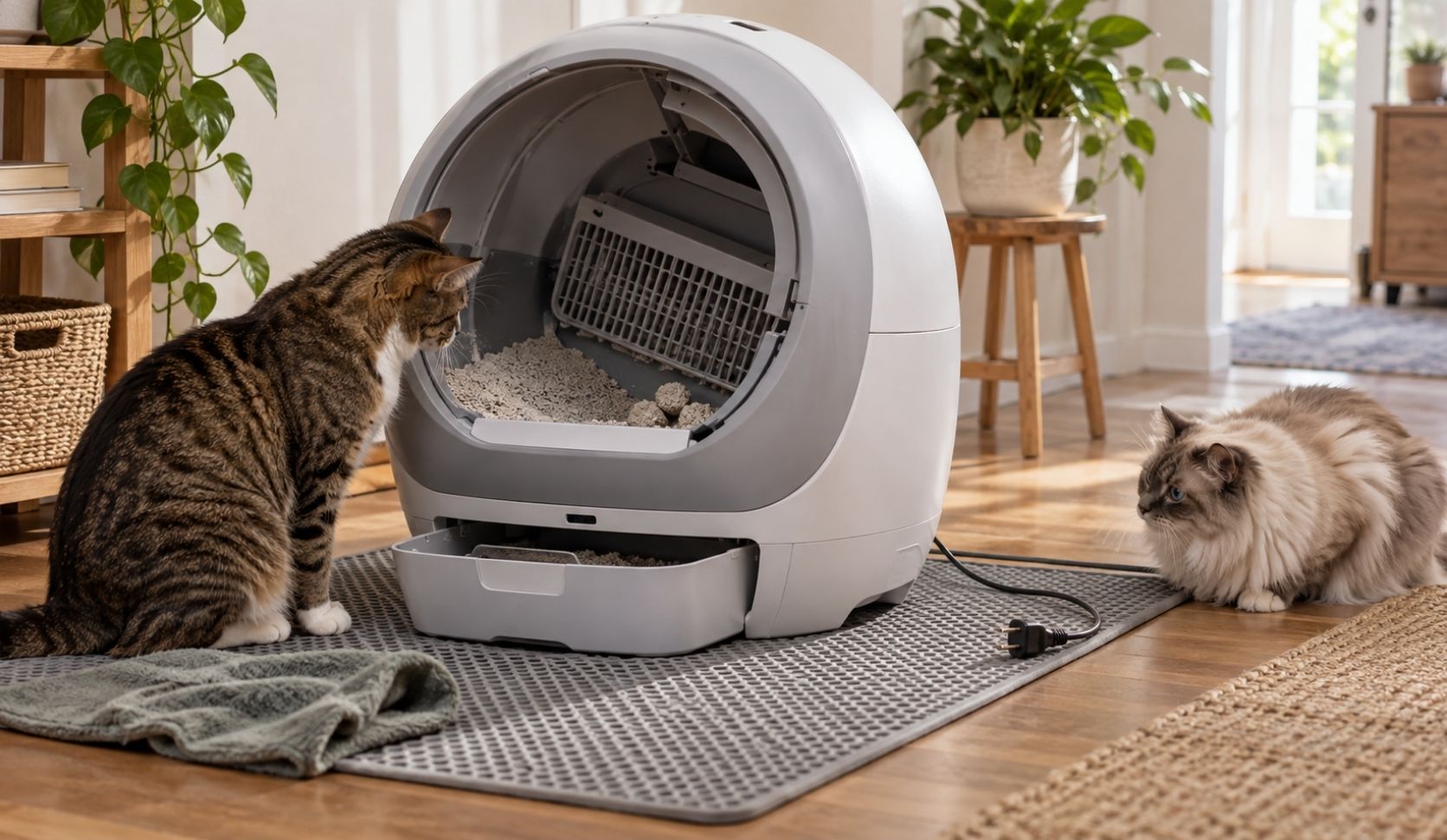
If your automatic litter box is stuck mid cycle, switch it off and unplug it before you reach inside. Never clear a jam on a powered unit. Then work in this order: power cycle it, check that all four feet sit level and free, look for an obstruction in the globe or waste drawer, break up any cemented clump, and zero the weight scale. Most stalls stop at one of those five.
I am Sarowar. I have run automatic litter boxes for five years in a house with three cats, Mao, Leo and Deo, and I have stood over a frozen globe at eleven at night more often than I would like. What I got wrong for the first two years was the sequence. I went straight for whatever looked broken instead of whatever was most likely and least destructive.
The five minute reset, and why it comes first
Litter-Robot's own "not cycling" support articles start the same way for the Litter-Robot 4, the Litter-Robot 5 and the EVO: switch the unit off, unplug it from the wall, wait five minutes, plug it back in, switch it on. Other makers publish different unplug windows, so treat five minutes as Litter-Robot's figure and check your own manufacturer's support page.
This goes first not because it fixes the most stalls, but because it is the only step where your hands stay outside the machine. A controller that latched a fault mid-rotation will sometimes clear on a cold start, and if it does, you have solved the problem without touching a moving part, a clump or a sensor.
Unplugging is not a formality you get to skip once the reset fails. Everything after this involves reaching into a unit with a motor and a heavy rotating globe, so it stays unplugged for the rest of this article.
The check order that finds most stalls
Every guide on the first page of results lists the same causes. Almost none of them put those causes in an order, and that matters, because the causes are not equally likely and they are definitely not equally safe to poke at. Here is the sequence I use, from least invasive to most:
- Power cycle (above)
- Feet, level and clearance
- Physical obstruction in the drawer or globe
- A cemented clump under the rake or on the floor of the unit
- Zeroing the weight scale
Work down the list. Stop at the first step that changes the behavior. Do not skip ahead to the mechanism just because the mechanism is where the visible drama is.
Feet, level and clearance
Litter-Robot's troubleshooting is specific here, and this is the step most owners skip. All four feet must move freely and be clear of litter and debris. None of the four may rest on top of a power cord or sit in a grout line. No side of the unit should touch a wall or any other surface. And the floor underneath has to be level.
That last one is the quiet killer. An uneven base can stop the motor mid cycle, because the unit shifts as the globe rotates. Carpet, a thick mat, or the lip where tile meets wood will do it.
Kneel down and rock the unit gently with the flat of your hand. If it moves at all, you have found something worth fixing before you take anything apart.
Obstruction in the drawer or the globe
Open the waste drawer and look at the litter build-up inside it. Then look into the globe for clumps, stray litter or anything that does not belong, and check that nothing is blocking the waste port. This is the least glamorous step and it accounts for a lot of stalls in my house, usually because I let the drawer go a day longer than I should have.
With the unit still unplugged, rotate the globe by hand. You are answering one question: is this thing mechanically stuck, or is it electrically refusing to move? If it turns freely, the jam is not physical and you can move on. If it binds, you have located the problem, and you should keep looking in that exact spot rather than power cycling again and hoping.
The cemented clump
A stuck rake is very commonly caused by a heavy urine clump cementing itself to the floor of the unit. The rake pushes, the clump does not move, and the cycle halts. The published fix is undramatic: with the unit unplugged, scrape the clump off manually and clear the gear tracks of debris.
If you hit this repeatedly, the residue is telling you the gap between deep cleans is too long for your household. That is a maintenance problem rather than a fault, and I have written up how I actually deep clean the unit separately.
One thing I will not do is interpret the clumps. A sudden change in how large, how wet or how frequent your cat's urine clumps are is a question for a veterinarian, not for someone who writes about hardware. I am not a vet and this site is not a medical resource.
Zero the weight scale last
Weight is what tells most of these machines whether a cat is inside, and a reading that has drifted can hold a cycle in place. On the Litter-Robot 5, a short press of the Cancel button from the Home position zeroes the weight scale, and that same press is what Litter-Robot points you to if the unit is stuck during a cycle. On the Litter-Robot 3 and 4 the equivalent control is the Reset button, so check the support article for your model.
This step is last for a reason. Zeroing a scale on a unit that is physically obstructed just changes the number the machine is confused by. Clear the mechanism first, then give the sensor a clean baseline to read against.
The litter mat trap
Here is the conflict nobody on the results page connects. Litter-Robot's placement guidance says the unit must not sit on a litter mat, and its mat instruction is explicit: place the mat completely in front of the unit, not partially underneath it. A mat under the feet is a documented cause of the unit shifting during a cycle.
Now open any article about litter tracking. Every one of them tells you to put a mat under the box. Both pieces of advice are reasonable on their own terms, and together they produce a box that tracks less and stalls more.
The resolution is boring and it works: mat entirely in front, hard level floor under all four feet. Tracking is a real problem worth solving, but not by parking the machine on a soft surface it was told not to stand on.
Stall, queue, or sensor fault
Three different problems look identical from across the room.
| What you see | Actual cause | Where to go |
|---|---|---|
| Globe frozen partway through a rotation | Physical stall | This article |
| No cycle in an hour, nothing stuck | Cycle delay restarted by another cat | Cycle timing |
| Cycle refuses to start, fault shown | Sensor or error state | Sensor errors |
A queue is not a stall. In a multi-cat house the wait after one cat leaves restarts when the next cat walks in, so the machine can sit idle all evening while working exactly as designed.
Sensors are their own category. Dust and cat fur on the waste drawer and bezel sensors cause inaccurate level readings and false cat detections, and the guides describe wiping them with a soft cloth lightly dampened with rubbing alcohol on an unplugged unit.
If your symptom does not match any row above, start at the general self-cleaning litter box troubleshooting guide and come back once you have narrowed it to a physical stall. Also confirm your firmware is current in the manufacturer's app.
Frequently asked questions
Can I just push the globe past the stuck point?
Rotate it by hand only with the unit unplugged, and only to learn whether it binds. Forcing it past resistance risks the gear tracks. If it will not turn easily, find what is blocking it instead.
Why does mine stall in the same spot every time?
A repeatable stopping point usually means something physical and repeatable: a clump cemented in one place, debris in the gear tracks, or a foot that drops into a grout line at the same stage of rotation.
Does an uneven floor really matter that much?
Litter-Robot says yes, plainly. An uneven base can stop the motor mid cycle. It is the cheapest thing on this list to check and the one most owners never look at.
Nothing here worked. What now?
Contact your manufacturer's support with the exact point in the rotation where it stops and which of these steps you have already done. That detail shortens the conversation, and it keeps you out of sealed housings you should not be opening.