
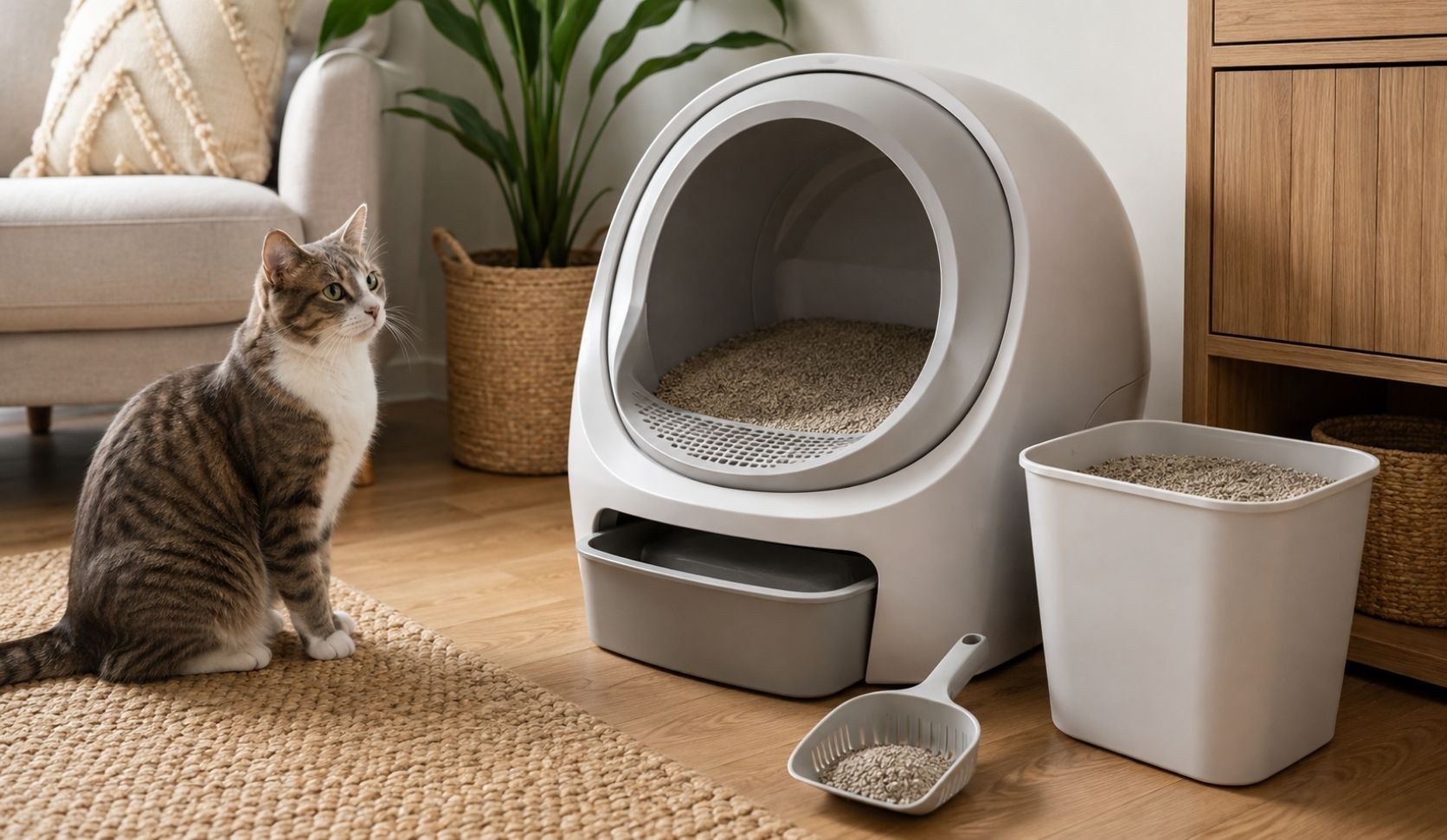
Automatic litter boxes want hard-clumping clay litter, in a medium granule size, with as little dust as possible. That is the answer, and it is one of the few places in this subject where manufacturer advice and long-term ownership completely agree. What almost nobody explains is why, and the reason is worth two minutes, because once you understand it you can predict how any litter will behave in these machines without looking anything up.
The short version: the machine is a sieve. Sieves have requirements.
The machine is a sieve
Strip away the app, the sensors and the enclosure, and every automatic litter box does the same physical job. It separates solid waste from clean litter by passing the whole bed through a screen, rotating it, raking it, or tipping it, depending on design, so that loose granules fall through and anything solid does not.
That single mechanical fact generates every rule that follows.
The machine cannot identify waste. It has no idea what it is lifting. It only knows that some things pass through the screen and some things do not, so waste has to be more solid than litter is for the separation to work at all. Urine only becomes separable if it forms a clump firm enough to survive being lifted, tumbled or raked. If it does not clump, or the clump breaks apart during the cycle, the urine simply redistributes through the bed and stays there.
That is the difference between a box that works and one that smells despite cycling perfectly. Nothing is broken. The sieve had nothing to catch.
The three properties that matter
Everything the SERP recommends reduces to three physical properties, and each one has a specific failure attached.
| Property | What it needs to be | What happens when it is wrong |
|---|---|---|
| Clump hardness | Firm enough to hold together when lifted and tumbled | Clumps break up mid-cycle, urine redistributes through the bed, odor returns despite normal cycling |
| Granule size | Medium, small enough to pass the screen freely, large enough not to behave like dust | Oversized granules or pellets jam the mechanism; undersized ones pack and drift |
| Dust level | As low as available | Dust coats sensor windows, causing misreads, and settles across the room |
The third one is the property people discount, and it is the one that quietly costs you. These machines depend on sensors to know whether a cat is present, and sensors covered in fine clay dust are sensors that are guessing. It shows up as a box that cycles when it should not, or does not when it should, and it gets diagnosed as a fault long before anyone thinks about litter. Keeping sensor surfaces clean is part of the ordinary maintenance rhythm for exactly this reason.
Where vendor advice and long-term experience agree
I am usually the person pointing out that manufacturer guidance is written by people with something to sell. This is the exception, and it is worth saying plainly.
Litter-Robot, Neakasa, Boxie, Meowant, Arm & Hammer and the independent review sites covering this question all land in the same place: hard clumping clay, medium granule, low dust. Five years of running these machines in a three-cat home puts me in the same place. When a vendor's recommendation happens to be constrained by physics rather than by margin, it tends to be reliable, and this is one of those cases, the sieve does not care which brand made the litter.
Where I would add a caution: "clumping clay" is a category with a wide quality range inside it. Two litters can both be sold as hard-clumping and behave very differently after twelve hours in a bed that is being tumbled twice a day. The property that matters is how the clump holds up under mechanical handling, which is not something you can read off a bag. It takes a couple of weeks of watching whether the mechanism is lifting whole clumps or leaving crumbs behind.
What this rules out, briefly
If hard clumping is the requirement, then anything that does not form a firm clump is a problem, and that covers most of the alternatives people ask about, crystal and silica, pine and wood pellets, paper, tofu, corn and wheat, and the lightweight blends.
They do not all fail the same way, though, and a couple of them are workable in narrow circumstances. Rather than compress that into a list here, I have written it out properly: what actually happens when you put crystal, pine, tofu or lightweight litter in an automatic box, substrate by substrate.
One exception worth flagging: a few units are sold with their own substrate, designed around it. That is a fact about that machine, not a general permission, it does not mean the substrate works in other units, and it is not a reason to assume yours will cope.
If your box has recently started leaving waste behind, smelling, or cycling oddly and you changed litter in the same period, start with the litter rather than the hardware, the troubleshooting sequence lists substrate among the first things to check for exactly this reason. And if you are still choosing a machine at all, the five-year multi-cat account covers litter alongside everything else.
Frequently asked questions
What litter should I use in an automatic litter box?
Hard-clumping clay, in a medium granule size, with low dust. This is the consistent recommendation across manufacturers and independent guides, and it follows directly from the fact that the machine separates waste by sieving.
Why does clumping matter so much?
Because the machine cannot identify waste, it only separates by what passes through a screen. Urine is only removable if it forms a clump firm enough to survive being lifted or tumbled. If clumps break apart, the urine stays in the bed.
Does litter dust actually matter?
Yes, more than most people expect. Dust settles on the sensors these machines use to detect a cat, which causes misreads that get mistaken for hardware faults.
Are expensive clumping litters better in an automatic box?
Not reliably by price. What matters is how well the clump holds up under mechanical handling, which is not printed on the bag. Watch whether the mechanism lifts whole clumps or leaves crumbs behind over a couple of weeks.
My unit came with its own litter. Does that change the rules?
It means that machine was designed around that substrate. It does not mean the substrate works in other machines, or that your machine will tolerate substrates it was not designed for.