
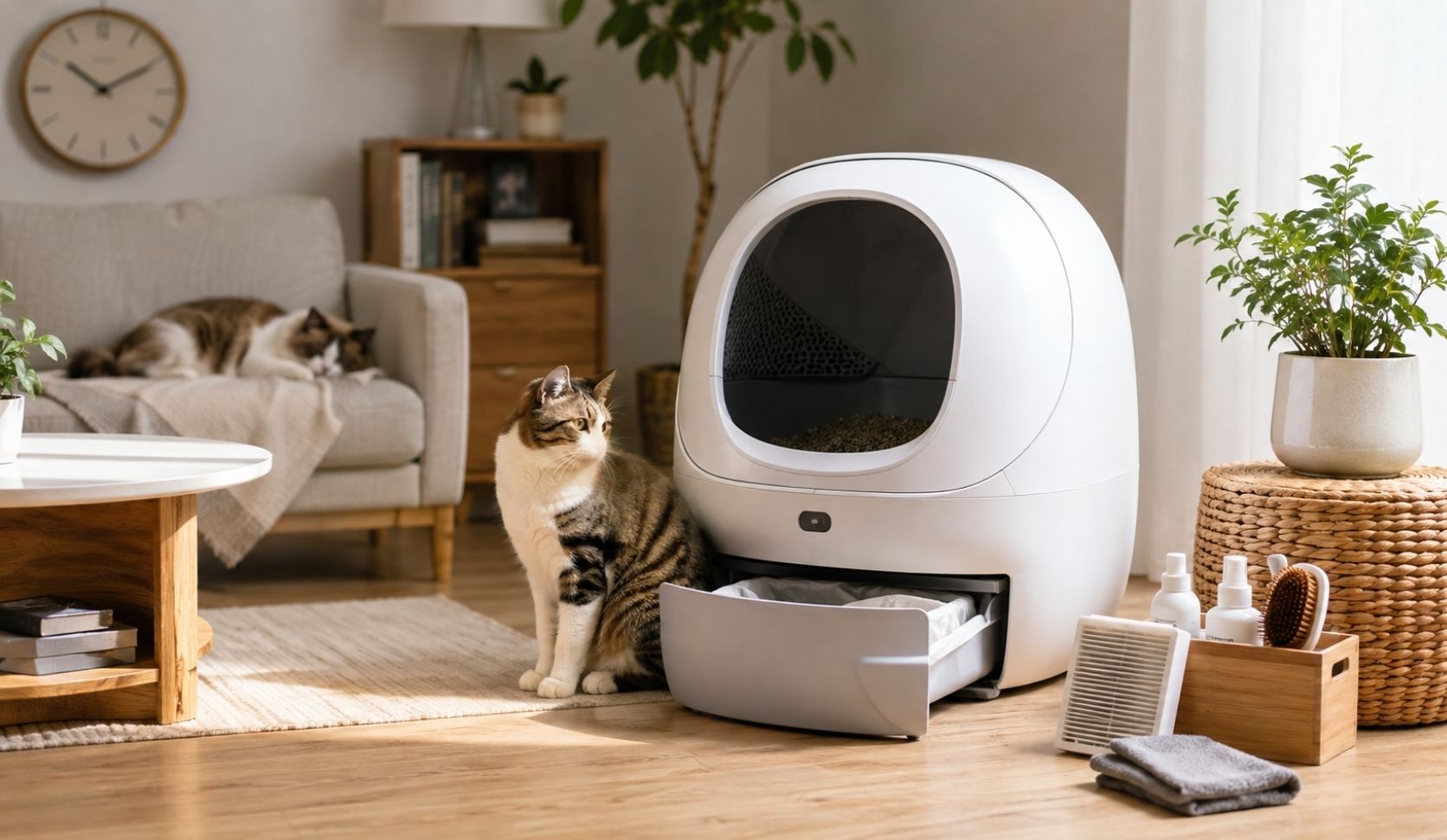
Yes, automatic litter boxes save time, and they save the worst kind of time. Daily scooping disappears. But the work does not go away, it changes shape: a waste drawer every one to two days, a deep clean every two to six weeks, filters on their own rhythm, and the occasional stall. Less time overall, on a less forgiving schedule.
Every automatic litter box is sold on the same promise: never scoop again. I have run these units for five years in a house with three cats, Mao, Leo and Deo, and I write about what fails, not just what to buy. So here is the work inventory: the tasks, and how often they arrive. No invented hours saved, because nobody honestly has that number.
What actually disappears from your week
The daily scoop goes. That is the real headline, and it is true. Manual scooping in my house was never a once-a-day job. It was a morning pass and an evening pass, and a third one if I had been at my desk all day and heard traffic. A unit that cycles after each visit absorbs all of it.
The second thing that goes is the odor window. A manual box is fine right after a scoop and slowly stops being fine until the next one. An automatic unit seals waste into a closed drawer soon after it lands, so a room does not have a good half of the day and a bad half.
The third thing is the one no spec sheet lists: the remembering.
The mental load is the part you notice first
Scooping is a small job attached to a large obligation. You have to notice, decide and act, several times a day, forever, including the days you are ill, home late, or simply not in the mood. Skipping it has consequences: a litter surface that turns to crust, and a cat that starts going beside the box instead of in it.
An automatic box moves that obligation off your attention and onto a schedule. Within about a week of switching the automation on, I stopped checking the boxes hour by hour. That shift is real and I would defend it. What I would not defend is the idea that nothing arrives to replace it.
The automation is not doing less work than you did. It just does not ask you first.
What appears in its place
Three new jobs arrive on the first day, and a fourth arrives later.
The waste drawer. In my three-cat home it needs emptying every one to two days. That is not a scoop, it is a liner change: open, lift, tie, replace, close. Fewer repetitions than scooping, but each one is a bigger action, and a drawer does not wait politely. A full drawer under a unit that keeps cycling pushes waste where it should not go.
Litter top-ups. Every cycle carries a little clean litter out along with the clump. The bed drops below the depth the rake and the sensors expect, and you usually notice it as poor clumping before you notice it as a low level.
Filters. Carbon filters are consumable and run on a rhythm the unit sets, not your week.
The deep clean is the job manual owners never have
Then there is the task that changes the arithmetic: the full teardown. Every two to six weeks depending on load, the unit comes apart, the chamber is emptied and washed, and the parts have to dry before it all goes back together. Three cats keep me at the frequent end of that range. This is the honest counterweight to the daily scoop you stopped doing.
I wrote the procedure up in full in how to deep clean an automatic litter box, and the cadence for everything else, drawer, filters and litter changes, lives in the self-cleaning litter box maintenance schedule. A manual box has no equivalent job. You rinse the tray at litter changes, and it is one piece of plastic.
Automatic litter boxes save time, but the work changes shape
Here is the distinction nobody drew for me before I bought in. Manual litter work is frequent, short and interruptible. You do it while the kettle boils. Automatic litter work is infrequent, longer and not interruptible. A deep clean is a job you start and finish, with wet parts drying on a towel in between.
That trade suits some households and not others. If your week is a run of small gaps, frequent-and-short may genuinely fit you better. If your week is empty in blocks, the automatic pattern fits. Here is the inventory side by side.
| Task | With an automatic box | With a manual box |
|---|---|---|
| Daily scooping | None, the unit cycles after use | Once or twice daily |
| Waste drawer | Every one to two days with three cats | Not applicable |
| Litter top-up | Ongoing, litter leaves with every clump | Ongoing |
| Deep clean | Every two to six weeks, load dependent | Rinse the tray at litter changes |
| Filter change | On the unit's own rhythm | None |
| Sensor wipes, stalls and errors | Unscheduled, as they happen | None |
Scheduled time and unscheduled time are not the same
Everything in that table is planned work. The category that caught me out is the unplanned kind. A cycle stalls on a clump wedged at the rake. A sensor misreads because the rim is dirty. The app sends a notification that turns out to mean nothing, then one that turns out to mean something.
None of this happens often once a unit is settled. All of it arrives without asking. Unscheduled work takes more out of you than scheduled work does, because it interrupts something else. When owners tell me their automatic box takes more time than the old tray did, this is almost always what they mean. They are not counting hours. They are counting interruptions.
When a disciplined manual routine genuinely wins
I would not put an automatic box in every home.
A low cat count. With one cat, a manual box may need one honest scoop a day, and the automatic upside shrinks toward the deep clean you have just taken on. I work that trade through properly in self-cleaning litter box for one cat. With three cats it is not close, because manual scooping scales with the number of cats while the machine's routine mostly does not, the case I make in the pillar on self-cleaning litter boxes for multiple cats.
A very small cat. Weight-triggered units need enough cat to register reliably. If yours sits near the floor of that range, you will spend your saved time managing sensors and false readings instead.
Nervous cats, and people who do not mind scooping
A nervous cat is the third case, and the most demanding of the three in time. If the unit frightens your cat, you now run two systems: the automatic box the cat avoids and the manual box the cat uses. That is more work than either alone, and it can last weeks. Mao took to ours straight away. Deo needed the automation switched off for the whole first week.
The last case is the plainest. Some people do not mind scooping. If the daily pass is a quick ritual you barely register, automation is not removing pain, it is swapping a habit you have already absorbed for a maintenance routine you have not. A disciplined manual routine, done on time, beats a mediocre automatic box in a low-traffic house. It just does not beat a good one in mine.
Frequently asked questions
Do automatic litter boxes really mean you never scoop again?
No. The daily scoop goes, but you pick up a waste drawer every one to two days, litter top-ups, filter replacements on the unit's own rhythm, and a deep clean every two to six weeks depending on load.
How often do you have to empty the waste drawer?
In my three-cat home, every one to two days. Fewer cats stretch the interval out. Cat count sets it, not the brochure, and a drawer left past full is the most common reason an otherwise healthy unit starts to smell.
What is the biggest time cost new owners miss?
The deep clean. A manual box has no equivalent. Every two to six weeks the unit comes apart, gets washed, and has to dry before reassembly. It is a block of work you schedule, not something you squeeze in.
Is a manual routine ever less work than an automatic box?
Yes, in a low-traffic house. With one cat, a very small cat, or a cat that dislikes the machine, a disciplined manual routine can beat a mediocre automatic one. With three cats in mine, it is not close.