
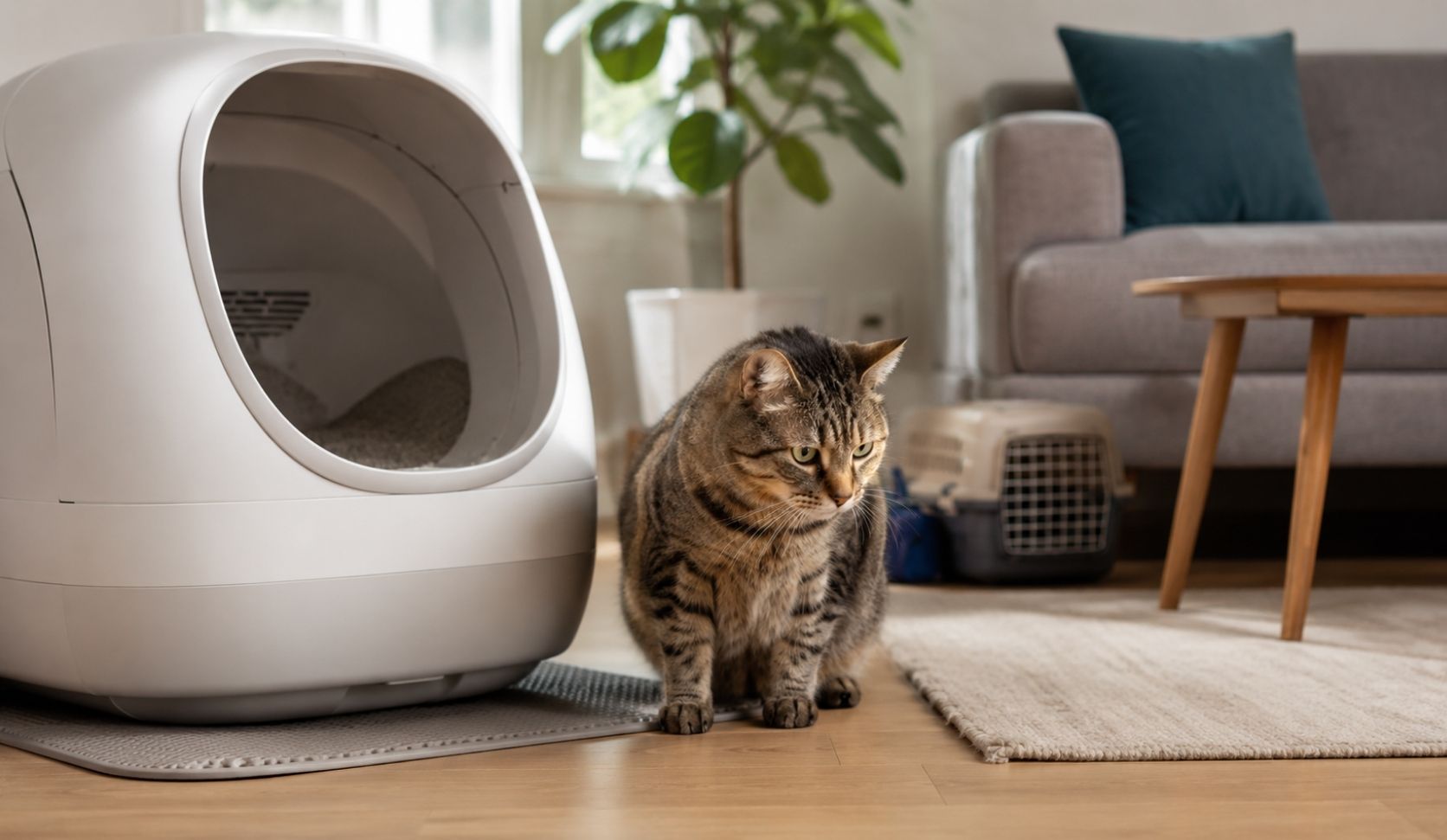
Read this first. If your cat is straining in the litter box and producing little or no urine, stop reading and get to a veterinarian now, including out of hours. MSPCA-Angell states that any cat straining in the litter box should be brought to a veterinarian for evaluation. PetMD calls a urinary blockage a life-threatening emergency and says any cat suspected to be blocked should be evaluated by a veterinarian immediately. Do not finish this article first.
I am Sarowar. I have run automatic litter boxes in a three-cat home for years, and I write about what fails. I am not a veterinarian, and CatVerge is not a medical resource. Every medical statement on this page is attributed in the text to a named veterinary organization, so you can go and read it yourself. On this one topic, my experience is worth nothing next to an exam.
The red flags, and what to do about each
Here is the list. The action column is identical all the way down, and that is the point. There is no row where the correct response is something you do at home.
| What you are seeing | What to do |
|---|---|
| Straining in the box with little or no urine produced | Emergency veterinary care now |
| Frequent trips to the box | Emergency veterinary care now |
| Crying or vocalizing in pain | Emergency veterinary care now |
| Licking at the hind end | Emergency veterinary care now |
| Lethargy | Emergency veterinary care now |
| Vomiting | Emergency veterinary care now |
| Hiding | Emergency veterinary care now |
Those signs are not mine. MSPCA-Angell lists increased vocalization, frequent trips to the litter box, licking more at the hind end, and straining unproductively in the litter box as early signs of a urethral obstruction, which it defines as a life-threatening blockage of the lower urinary tract. PetMD gives the defining sign as straining to urinate with no urine production or only a few drops produced, alongside vocalizing in pain, lethargy, vomiting, and hiding. Metropolitan Veterinary Associates describes the same picture: getting into position repeatedly and straining with little to no urine coming out, crying or yowling, and hiding. International Cat Care describes affected cats straining to pass urine, visiting the tray frequently, passing only a little urine or none at all, and becoming lethargic and very unwell.
The clock is why none of this can wait. PetMD states that the inability to urinate lets toxins from the kidneys build up, that after 24 hours those toxins can start to affect other body systems, and that death from untreated obstruction may occur in as little as 24 to 48 hours. Metropolitan Veterinary Associates says the same: without immediate treatment, a blocked cat can die within 24 to 48 hours. International Cat Care states that untreated obstruction can cause kidney failure and can be fatal within 2 to 3 days. MSPCA-Angell states that if left untreated for 24 hours or more, a cat can rapidly deteriorate and begin to show systemic illness including vomiting, lethargy, dull mentation, or inability to stand up.
You will read that male cats are more vulnerable. That is true, and it is anatomical: MSPCA-Angell explains that the male urethra is longer and narrower than in females, and PetMD says the male urethra is skinnier and more prone to blockage. Do not turn that into a filter. MSPCA-Angell's instruction is not written about male cats. It is written about any cat that is straining in the litter box. If you own a female cat and she is straining, that instruction names her too.
Metropolitan Veterinary Associates settles the timing question in one line worth repeating: this is not a wait-and-see-until-morning problem, and straining at 2 AM is a 2 AM emergency.
Why a litter box site is telling you this
Here is the honest reason this page exists.
The veterinary coverage of urinary blockage is genuinely good. All four organizations above have published clear, careful pages about it. But those pages get found by people who already suspect a medical problem. They searched something with the word urinary or blocked in it, and they were handed exactly what they needed.
The people in the most danger never search that. They search a litter box question. They search the machine, the litter, the smell, the app, the new unit. They think they have a hardware problem, so they land in a corner of the internet that treats a cat avoiding a box as a product story, an acclimation story or a behavior story. Manufacturers write a great deal of that content, and they have an obvious incentive to keep the conversation on the device.
This site sits in that corner of the internet. That is exactly why the handoff belongs here. If you arrived troubleshooting a box and recognized something in the table above, this page has done its only job. Go.
What is safe to look at only after a vet has cleared your cat
This section is for one reader and one reader only: the person whose cat has actually been examined, and whose own veterinarian has told them this is not a medical problem.
If that appointment has not happened yet, this section is not for you yet. Nothing in it is more urgent than the table above, and reading it now is how a person talks themselves into waiting. Close the page and make the call.
Cleared? Good. Now the setup and behavior questions become fair game:
- Is one specific cat the holdout while the others adapted fine? That is a different problem from a whole-household refusal. I wrote it up in one cat refusing the box in a multi-cat home.
- Is the unit itself misbehaving, cycling badly, or holding odor? Start with what to check when a self-cleaning litter box is not working.
- Is the number of boxes, the placement, or the unit's fit for the household wrong? The self-cleaning litter box guide for multiple cats is the longer account of what I got wrong.
None of those links appear before this heading. That ordering is the whole design of this page.
Why the automatic box may be how you noticed
There is one real advantage to owning a machine that logs visits.
A manual box tells you nothing until you look in it. A unit that counts cycles or weighs the cat gives you a trend line, and a trend line can move before you consciously notice anything. A cat making many more trips than last week shows up in that data days before it registers with a tired human. With three cats sharing units, as I have with Mao, Leo and Deo, that signal can be the only thing standing between noticing and not.
Be precise about what that data is, though. A change in visit counts or weight is a prompt to call a veterinarian, not a diagnosis. I said the same when I wrote about reading weight tracking data from an automatic litter box, and it matters more here than anywhere. Your app cannot tell you whether urine was actually produced. It counts that your cat went in. It does not know that nothing came out, and "nothing came out" is the sign every source above leads with. Worse, a self-cleaning unit clears away the physical evidence you would otherwise have seen in the litter.
Treat the trend line as an alarm, not an answer. It gets you to the phone faster. It never replaces the appointment.
Frequently asked questions
My cat is straining but some urine is coming out. Is that still an emergency?
Treat it as one and go. The veterinary sources describe straining with little or no urine, and you cannot measure "little" from across a room, least of all in a self-cleaning unit that clears the evidence. Partial output is not a reason to wait.
Is this only a problem for male cats?
No. Male anatomy is why MSPCA-Angell and PetMD both flag higher vulnerability in males, but MSPCA-Angell's instruction is written about any cat that is straining in the litter box. A female cat straining is the same trip to the same clinic.
It is the middle of the night. Should I go now, or first thing in the morning?
Now. Metropolitan Veterinary Associates states plainly that this is not a wait-and-see-until-morning problem, and that straining at 2 AM is a 2 AM emergency. Find an emergency clinic rather than waiting for your regular practice to open.
My cat is peeing outside the box but is not straining. Do I still call?
Call your veterinarian today and describe exactly what you have seen. The absence of one sign is not clearance, and a phone call costs you nothing. This page cannot examine your cat, and neither can your litter box.
Could it just be the new automatic litter box?
That is a real question with real answers, but the order is fixed: veterinarian first, hardware second. Nothing on this site, and nothing you can see from your living room, can tell the difference. Once your cat has been examined and cleared, the setup section above is where to start.
Sarowar writes CatVerge from a three-cat home. He is not a veterinarian and CatVerge is not a medical resource. If your cat is straining in the litter box, close this page and call a veterinarian.