
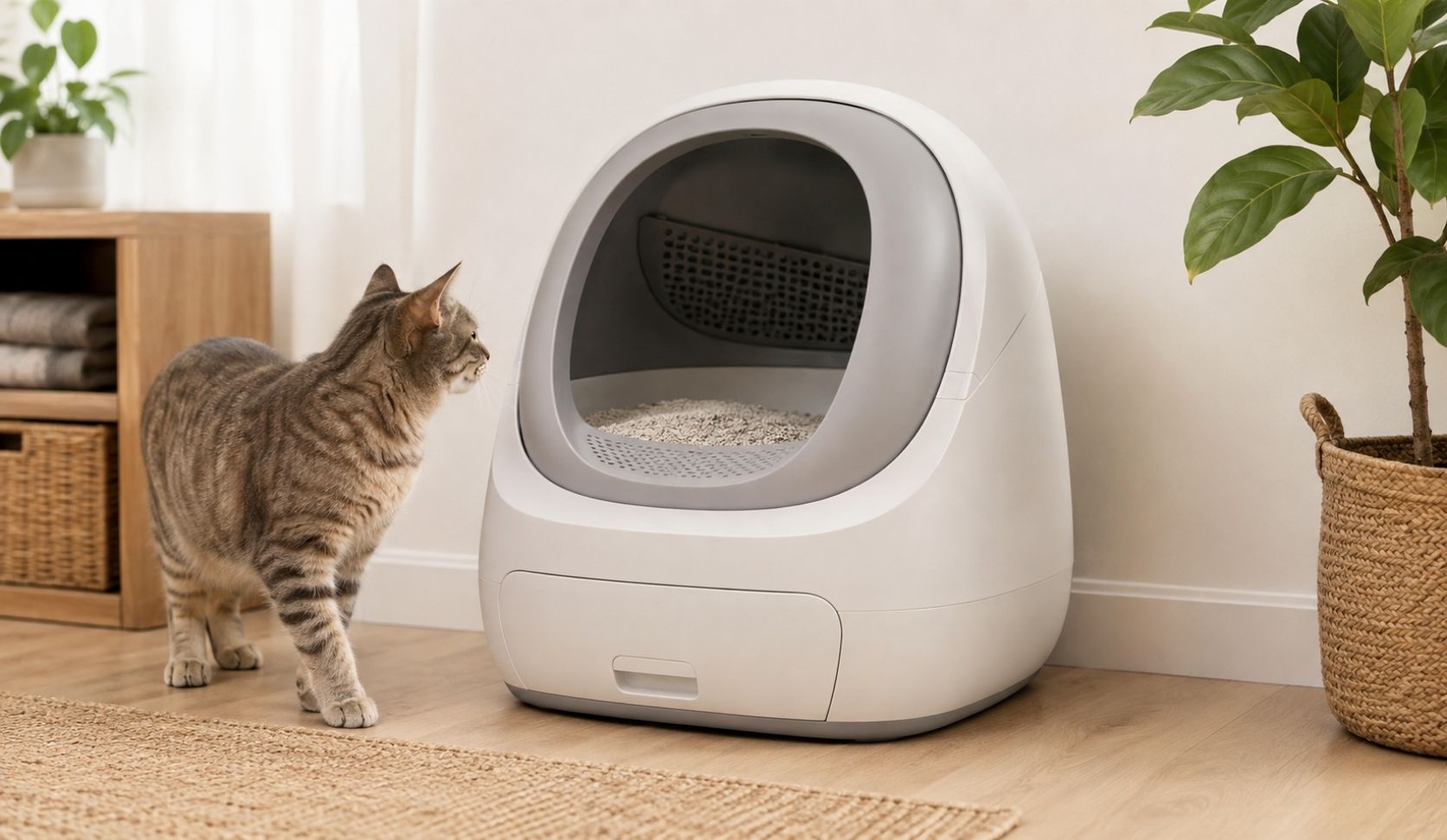
Usually it is a convenience purchase, not a necessity, and in some single-cat homes it is actively worse than the tray you already own. One cat makes the least waste, never queues, and has nobody to compete with over territory, so most of the machine's advantages shrink. Its upkeep does not shrink with them: the deep clean, the sensors and the acclimation risk cost the same whether one cat uses the unit or three.
I have run automatic litter boxes for five years with three cats: Mao, Leo and Deo. I write about what fails, not just what to buy, so here is the disclosure first: I have never run one for a single cat. What I have is five years of what these machines demand no matter how many cats use them.
What shrinks when there is only one cat
Three of the four reasons I would recommend one of these are multi-cat reasons, and one cat removes all three.
Waste volume is the first. A tray serving one cat crosses from fine to unpleasant far more slowly than a tray serving three. With one cat that gap is narrow enough that one honest scoop a day closes it.
Queuing is the second. A cat who finds the box occupied does not wait politely; an automatic unit resets the surface between visits. One cat never queues behind itself.
Territory is the third. Multi-cat litter trouble is frequently social: one cat guarding, one avoiding, a box that has become somebody's property. That is the subject of my guide to self-cleaning litter boxes for multiple cats. With one cat it does not exist.
The odor advantage survives, but smaller
The fourth reason is odor, and this one does survive. Sealing waste into a closed drawer soon after it lands beats letting it sit in an open tray at any cat count.
It survives smaller than you would expect. Litter-Robot's published guidance for a single-cat home is to empty the waste drawer every seven to ten days, against every day or two in a busy house. Read what that implies rather than what it promises: with one cat, waste sits sealed indoors far longer before it leaves. A well gasketed drawer handles that. One you have stopped opening because the app never nagged you does not.
So the single-cat odor benefit is real and conditional on your discipline, which is exactly what a manual routine runs on.
What does not shrink at all
Now the other column, and the part no product page puts in front of you. Almost everything one of these machines asks of its owner is a fixed cost. It does not scale down with your cat count.
The deep clean is the clearest case. Every so often the unit comes apart, the chamber gets washed, and the parts have to dry before it goes back together. With one cat that interval stretches out. The job itself does not get smaller: same pieces, same sink, same drying time. One cat pays the full price of a teardown that three cats would have split. I ran the whole work inventory in do automatic litter boxes save time: the machine trades many small jobs for a few large ones.
Sensors, stalls, and the rejection you cannot absorb
The rest of that column is unscheduled. Rims and sensors need wiping. Clumps wedge at the rake and stall a cycle. Filters and firmware run on the unit's clock. None of it gets rarer because you own fewer cats.
Then there is acclimation, where a single-cat home is more exposed than mine was. Deo needed the automation switched off for a full first week. He came around partly because Mao had already claimed the unit and used it in front of him. A single cat has no confident housemate to copy.
The asymmetry matters. In my house, a unit one cat refuses still does useful work for the other two. In a one-cat house, a refusal means the machine does nothing at all, and you are back to running two boxes.
Four cases where the answer is genuinely no
Two are about the cat. Two are about you.
A very small cat. Weight-triggered units need enough cat on the platform to register a visit reliably. Near the bottom of that range you will spend your saved time chasing missed cycles and false readings. I cover where the floor sits, and how to check yours, in automatic litter box kitten weight limit. This is a hard no, not a caution.
A nervous cat. If your cat startles at the vacuum, hides from visitors, or took weeks to settle after a house move, the odds of a clean transition drop, and there is no second cat to lead the way. This is the profile most likely to leave you with an idle machine and a tray back in the corner.
The two nobody warns you about
A settled routine that already works. This is the one I push hardest. If your cat has used the same box, in the same corner, with the same litter, without incident for years, you are proposing to change the substrate, the sound and the timing of the most habit-bound behavior your cat has. Most units also need clumping litter to sift, so a cat happy on crystals or pellets faces a litter change too. Working systems are worth more than convenient ones.
A household that does not mind scooping. If the daily pass is a thirty-second ritual you barely register, automation is not removing pain. It swaps a habit you have absorbed for a maintenance routine you have not. A disciplined manual routine beats a mediocre automatic box in a low-traffic house.
When a self-cleaning litter box is still worth it for one cat
The yes branch is real. It is just narrower than the marketing, and it is about your life rather than your cat's.
Long or irregular hours away. The strongest single-cat argument is not that there is less work, it is that the work stops being time-sensitive. A tray needs you home on a schedule. A sealed drawer holds a standard for twelve hours, or overnight, without you.
Scooping is physically hard. If bending to a floor-level tray twice a day hurts, that is a sufficient reason on its own and I would not argue with anyone about it. It is a comfort question, not a cat question, and it is the one case where I would stop weighing the trade-offs entirely.
Odor pressure, and the two-cat tipping point
A strong odor motive. If the box has to live somewhere you actually spend time, sealed beats open, and that does not depend on cat count. Pair it with a drawer schedule you will genuinely keep, because the single-cat interval is long enough to forget.
And if a second cat is even a possibility, the arithmetic flips. Waste volume, queuing and territory all switch back on at once, which is why two cats is a different article: I work that case through in is a self-cleaning litter box worth it for 2 cats. Buying ahead of a cat you are actually planning to get is a reasonable move. Buying for a cat you will never get is just the ad working.
Frequently asked questions
Do I really need a self-cleaning litter box for one cat?
No. For one healthy adult cat with a routine that works, it is a convenience purchase. Volume, queuing and territory shrink at one cat; the upkeep does not.
How often do you empty the waste drawer with one cat?
Litter-Robot publishes seven to ten days for a single-cat home, against every day or two in a busy house. Fewer trips, but waste sits sealed indoors longer.
Is a self-cleaning litter box bad for a nervous single cat?
Often, yes. In a multi-cat home a nervous cat can watch a bolder housemate go first. A single nervous cat has no example to follow.
Should I keep my old litter box if I buy an automatic one?
Yes, for the first few weeks at least. If your cat never transfers to the machine, the old tray is the one that was working.