
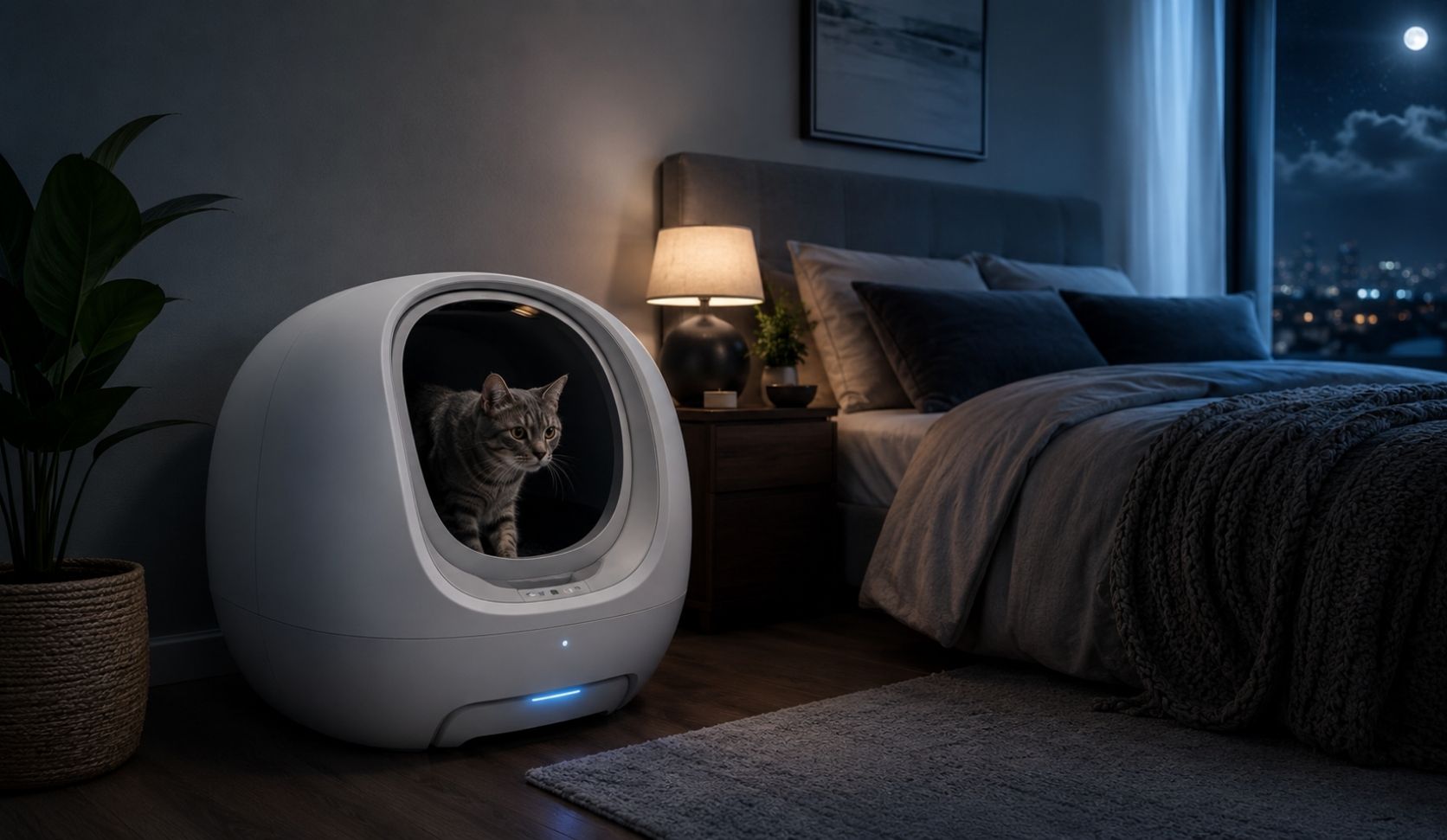
An automatic litter box is not loud in absolute terms, published figures put a cleaning cycle somewhere between roughly 32 and 60 decibels, and most guidance treats 40 dB or below as tolerable near a sleeping area. But the number is not what wakes people. A cycle is a sequence of sounds in a silent house, and the part that lifts a light sleeper out of sleep is usually the waste dropping into the drawer at the end, not the motor at its peak.
I have slept one wall away from a running unit for five years. Here is what that actually sounds like, and what to do if you already own one.
What it actually sounds like
The cycle is not a single tone. It has four distinct parts, and they arrive in order.
First there is a click and a low motor start, quiet, but it is the first sound after silence, which makes it the one that registers. Then the rotation: a steady mechanical hum, the longest part of the cycle and, oddly, the least disruptive, because it is continuous and the brain settles into it quickly. Then the sift, which is granular and slightly gritty, like sand shifting. Then the drop, clumped waste falling into the drawer below.
That last sound is short, sudden, and has no lead-in. In daytime it is nothing. At three in the morning, in a house with no other sound in it, it is the one that opens your eyes. Every decibel chart I have seen reports a peak figure for the cycle as a whole and none of them separates these four events, which is why the charts do not predict who gets woken.
The numbers, and who is publishing them
The published range runs from about 32 dB at the quiet end to over 60 dB at the loud end, with the commonly repeated rule of thumb being that 40 dB or below is bedroom-tolerable and anything above roughly 50 dB will be noticeable. Motor design is the stated reason for the spread: brushless motors are reported to run something like 10 to 15 dB quieter than gear-driven ones.
I want to be straight about where that data comes from. homerunPET, PetPivot, catsluvus, vigopaw and autolitterbox.co.uk are the pages ranking for this question, and they are manufacturers or affiliate roundups. I have not found independent, audited acoustic testing of these machines from a source with no stake in the answer. Some of these pages go further and publish sleep-disruption comparisons, one claims zero wake events over fourteen nights with a quiet model against eight to twelve weekly disruptions with a loud one. Treat that as marketing, not evidence. It has not been independently verified, and I would not make a purchase decision on it.
The broad shape of the claim, quieter motors exist, and they are quieter, is almost certainly true. The precision is not earned.
Why a "quiet" box still wakes you
Sleep researchers have understood for a long time that sudden-onset sound disturbs sleep more than steady sound at the same level. A 40 dB cycle starting out of complete silence is more disruptive than 50 dB of continuous background noise you have already adapted to.
This is why the decibel rating on the box you are considering is a weaker predictor than the room you put it in. A quiet unit on a bare hard floor, in a room with nothing else running, will wake a light sleeper. A slightly louder unit on a rug, in a room with a fan going, may never register. The floor matters because hard surfaces reflect and amplify the drop; a mat or rug under the unit absorbs a genuine amount of it.
If you are still choosing, this is worth knowing before you spend on the quietest model. If you already own one, it is better news, because the room is the part you can change.
Placement fixes that work when you already own it
- Get it off bare hard flooring. A mat or rug under the unit is the single cheapest improvement and it targets exactly the sound that wakes people.
- Increase distance before you change rooms. The far corner of the same room often does more than you would expect, and it does not disrupt your cats' established route to the box.
- Do not shut it inside a cupboard or cabinet. It seems obvious as a fix and it is a bad one, enclosures trap odor, restrict the ventilation these units need, and can make cats reluctant to enter. You will trade a sleep problem for a rejection problem, which is much harder to undo.
- Keep outlet reach and mechanism clearance first. Placement is constrained by power and by the space the mechanism needs to move. A quieter spot the box cannot physically occupy is not a spot.
- Move it before you move the cats. If your cats have a settled route to that box, changing the location is not free, introduce the new position the way you would introduce a new box, gradually. Getting a cat comfortable with the unit is the same problem in a different order.
The delay setting as a noise tool
There is one more lever, and most people never touch it. The cycle delay decides how long the unit waits after a cat leaves before it runs. Lengthening it does not make the box quieter, but it moves when the cycle happens, pushing it away from the moment the cat leaves, which in a multi-cat house is often the middle of the night rush.
It is a real tool and it has genuine trade-offs, including safety margin and clump quality, so it is worth understanding properly rather than just turning up. I have written up how the delay actually works, including the part where a second cat resets the timer.
One last thing worth saying: a box that has become newly loud is not a placement problem. A grinding, knocking or straining sound that was not there last month is a fault signal, and the troubleshooting sequence is where that goes. And if you are weighing all of this before buying at all, the five-year multi-cat account covers noise alongside everything else that matters.
Frequently asked questions
How many decibels is an automatic litter box?
Published figures range from about 32 dB to over 60 dB during a cycle, with 40 dB or below generally described as tolerable near a sleeping area. Nearly all of this data comes from manufacturers and affiliate roundups rather than independent testing.
Can I put an automatic litter box in the bedroom?
You can, but a light sleeper probably should not. The issue is the sudden drop of waste into the drawer in an otherwise silent room, which is not well predicted by the unit's decibel rating.
Which part of the cycle is loudest?
The motor is usually the peak figure, but the waste dropping into the drawer is the sound that most often wakes people, because it is short and has no lead-in.
Does putting a mat under the box help?
Yes. Hard floors reflect and amplify the drop, and a mat or rug absorbs a meaningful part of it. It is the cheapest fix available and it targets the right sound.
Should I put the box in a cupboard to muffle it?
No. Enclosing the unit traps odor, restricts ventilation and often makes cats reluctant to use it. You would be trading a noise problem for a rejection problem.