
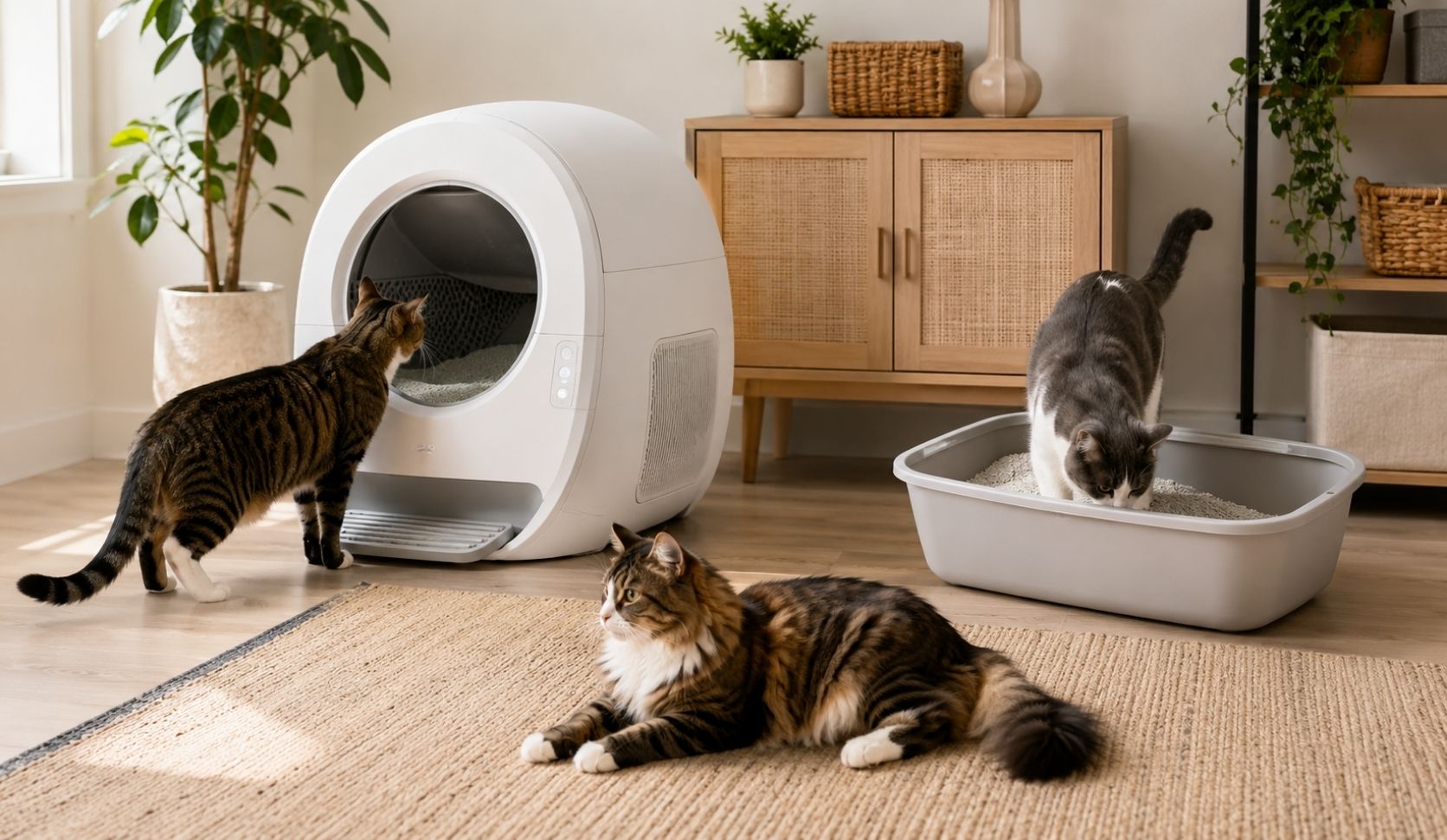
One automatic litter box per two to three cats, plus at least one more box somewhere else in the house, and that extra box does not have to be automatic. The N+1 rule bends for automation, it does not vanish. A machine that empties itself continuously satisfies the capacity half of the rule honestly. It cannot satisfy the location half, because one machine is one place.
I have run automatic boxes for five years in a three-cat house with Mao, Leo and Deo. Every guide I read while deciding stated N+1 as settled fact, and then every product page I read afterward quietly stepped around it. Nobody reconciled the two. This is my attempt, and it starts by noticing that the rule has been doing two separate jobs the whole time.
What the N+1 rule is actually doing
The rule is not my finding and it is not new. The 2014 AAFP/ISFM Guidelines for Diagnosing and Solving House-Soiling Behavior in Cats (Carney et al., published in the Journal of Feline Medicine and Surgery by the American Association of Feline Practitioners and the International Society of Feline Medicine) states it with a hedge most repeaters drop: in multi-cat households, "the historical rule of thumb is to have at least one more litter box than the total number of cats, although this is not an absolute requirement."
That qualifier is in the original. Even the veterinary source treats N+1 as a rule of thumb, not a law. What the same guidelines are much firmer about is what the boxes are for, and it turns out to be two different things.
| The job | What it means | What satisfies it |
|---|---|---|
| Capacity | A clean surface is available whenever a cat wants one | Volume: box size, litter condition, how often waste is removed |
| Location | A cat can reach a box, and leave it, without meeting another cat | Space: separate rooms, separate approaches, separate exits |
Manual boxes bundle those two jobs into one object, which is why the guidance can be stated as a single number. Automation pulls them apart. The single number stops working, and almost nobody says so.
The capacity half, which automation honestly satisfies
This is where the machine deserves real credit. A manual box degrades across the day: cleanest just after you scoop, worst just before. An automatic unit cycles after each use, so the surface a cat steps onto at 11pm is close to the surface it stepped onto at 7am. That is not marketing copy. It is the one genuine structural advantage automation has, and it is the reason a single unit can carry more cats than a single tray.
It is also where the vendor numbers come from. Manufacturer guidance for high-capacity units lands at roughly two to four cats per machine, and Litter-Robot's own blog caps its recommendation at four cats per unit. That is a volume calculation answering a volume question: how much waste the drawer holds before it overflows. It is a fair answer, and it is solvable by emptying the drawer more often.
In five years, capacity was never what failed here. Whether one unit can genuinely carry three cats has its own answer, and mine is that three is the ceiling rather than the comfortable middle.
The location half, which one machine cannot satisfy
One machine is one place. Whatever the drawer holds, the unit sits in one spot, with one entrance and one approach path. Capacity does not change geometry, and this is where the product pages go quiet.
The guidelines are specific about space in a way they never are about volume. They note that cats "perceive litter boxes located adjacent to each other as one large box," that openings should be "positioned at right angles or around the corner from each other" so the arrangement "allows cats to exit the box and avoid an approaching cat," and that at least one box belongs on each level of a multilevel home.
Every one of those is an instruction about where things sit. Not one is about waste.
So the spare box in N+1 is not spare capacity. It is an escape route. It exists for the cat who arrives and finds the box occupied, or finds another cat parked beside it, or who got startled there last week and has quietly decided that corner of the house is no longer safe.
The three moments a single unit has no answer for
- Occupied. Another cat is inside, or sitting at the entrance. In my house that was Deo. No hissing, nothing anyone would call a fight, just a cat positioned where another cat has to walk past him.
- Mid-cycle. The unit is briefly unavailable while it runs, and some cats will not stand around waiting for a machine to finish.
- Out of action. A jam, a power cut or a drawer you forgot turns one automatic box into zero boxes. A plain tray is never zero.
A second box in another room answers all three, and it answers them whether or not anyone is home. If a cat is already eliminating outside the box, that goes to a veterinarian before it goes to a shopping list. Urinary problems and territory problems look identical from the hallway, and hardware cannot rule one out.
How many automatic litter boxes your house actually needs
Treat this as guidance, not arithmetic. The right answer depends on your cats' history with each other far more than on their number.
| Cats | What I would actually run | Why |
|---|---|---|
| 1 | One box, automatic optional, plus a second tray if the home has more than one level | Location pressure is low with no one to avoid |
| 2 | One automatic unit, plus one plain box in a different room | Comfortable, with a real escape route |
| 3 | One automatic unit, plus one or two plain boxes elsewhere, ideally on another level | Working at the edge of what one machine covers |
| 4+ | Two units, or one unit plus several trays, deliberately spread across rooms | Capacity and geometry both strain at once |
For a single cat the honest question is not how many but whether you need automation at all, and I have argued that it is often overkill for one cat.
Here is the concession the category avoids: the second box does not have to be automatic. The escape route only has to exist. An uncovered tray in another room satisfies the location half completely, at no ongoing complexity, and it keeps working during a power cut. Buying a second machine is a different decision driven by different symptoms, and when one unit stops coping covers where that line sits.
If you are still working out whether an automated setup suits a multi-cat house at all, the full five-year account is the place to start.
Frequently asked questions
Does an automatic litter box count as more than one litter box?
Partly, and only on one axis. Because it is emptied continuously, one unit genuinely does the work of more than one manual box in terms of clean surface available. It still counts as one location, so it cannot fill the role of the spare box in the N+1 rule.
Do I still need an extra box if my automatic unit is always clean?
Yes. Cleanliness is the capacity half. The extra box exists so a cat who is blocked, startled or simply particular has somewhere else to go, and no level of cleanliness in one spot provides that.
Does the second litter box have to be automatic too?
No, and in most homes it should not be. A plain tray in a different room satisfies the location requirement, costs nothing to run, and stays available when the machine is jammed, cycling or unplugged.
How many cats can share one automatic litter box?
Manufacturer guidance clusters around two to four cats per high-capacity unit, with Litter-Robot capping its own recommendation at four. From five years with three cats, I would treat three as the practical ceiling, and only for healthy adults who already shared a box without conflict.
Where should the extra box go?
Somewhere the cats can reach and leave without crossing paths, on a different level if you have one. The AAFP/ISFM guidelines specifically warn that boxes placed next to each other read as one large box to a cat, so putting a tray beside the machine adds capacity you do not need and no escape route at all.