
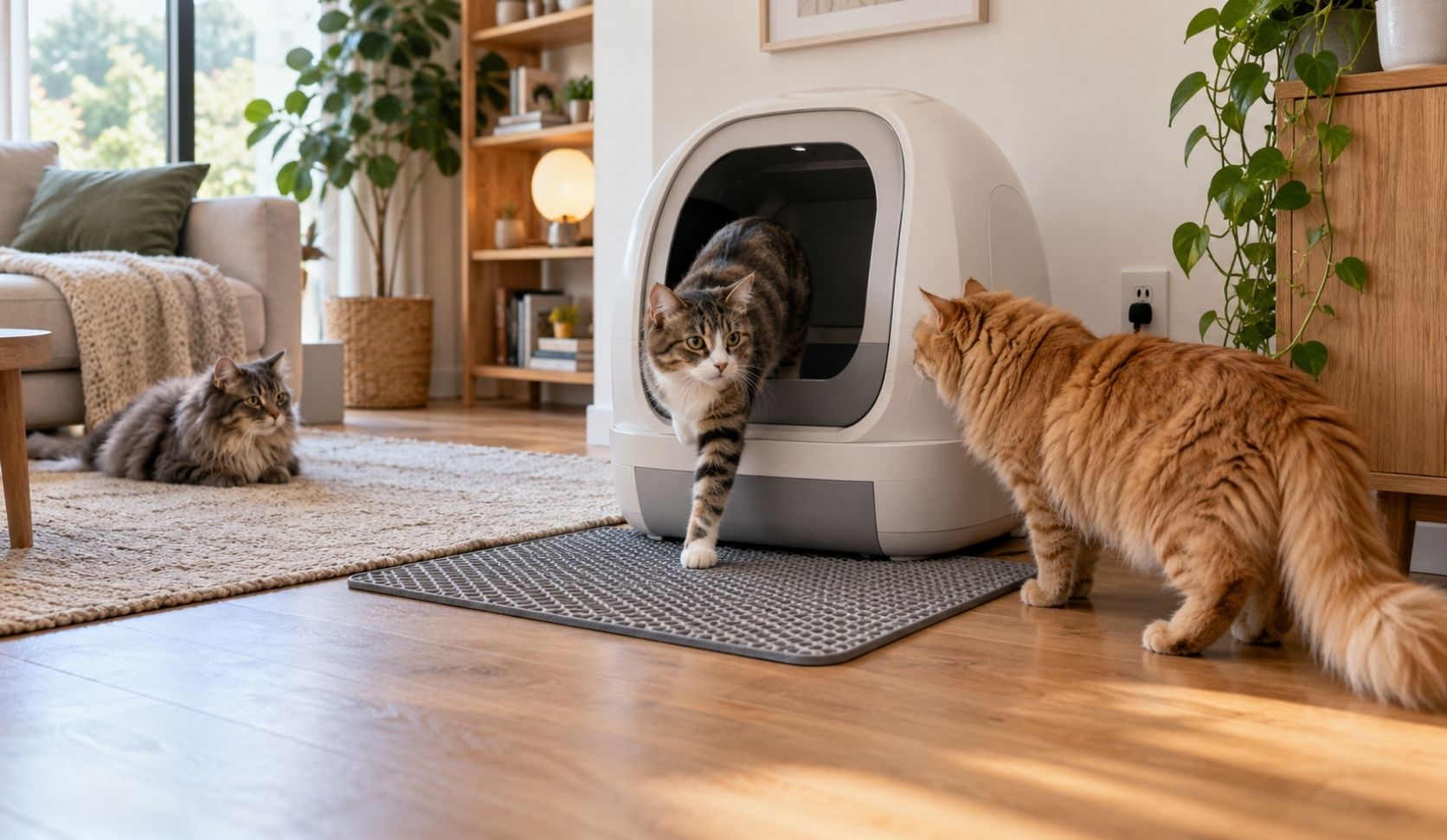
What to look for in an automatic litter box has less to do with any single machine than with the cat and the house it is going into. The features that actually decide whether a unit works are your cat's temperament, size and age, your home's placement and power realities, and how the box behaves the day something goes wrong. None of that sits on a spec sheet. I have run these machines for five years with three cats, Mao, Leo and Deo, and every purchase that went well started with a question about the cat, not the box.
This is not a spec sheet or a model comparison, and you will not find a scoring table below. It is the list of questions I wish someone had handed me before the first unit arrived, and each one points to where I have already worked through the full answer in detail, rather than repeating it here.
Questions about your cats
Start with the cat, because every other question on this list is downstream of the answer, and answering them out of order is the most common way people end up buying the wrong unit.
How many, and do they already share space calmly
How many cats will actually use this box, and do they already share a litter box without one of them guarding it? A unit's advertised capacity and a unit that is genuinely comfortable at that capacity are two different claims, and the gap between them is the whole subject of can one automatic litter box handle three cats. Answer the social question before the volume question. A capable machine cannot fix a cat who has already claimed the entrance as hers.
How old is she, and how does she move
Age changes the geometry of the purchase, not just the temperament of it. A box that suits a healthy adult can be a genuine step backward for a cat with stiff joints, and the reason is almost never the brand, it is the entry itself. I go through why height matters more than any other spec in automatic litter boxes and senior cats. If your cat is older or has had any mobility change at all, read that piece before you read a single review.
Temperament, and what belongs to a vet first
Is this a cat who investigates new things calmly, or one who startles at the vacuum and hides for an hour afterward? That answer sets your whole introduction plan before you have chosen a unit at all. In my house, the calmest of the three still needed the automation switched off for a full week before he trusted the noise. And if there has been any recent change in litter habits, a vet visit belongs before the shopping, not after it. A machine cannot diagnose the reason a cat stopped using a box.
Questions about your home
Once you know the cat, look honestly at the room, because a great unit in the wrong spot behaves like a mediocre one.
Where will it actually sit
Automatic units are bigger than the tray they replace, and most need clearance on at least one side for a drawer or a waste bag to come fully out. Measure the actual spot before you order anything, not the empty corner you have in mind. A unit wedged against a wall on its service side turns a two-minute task into a monthly negotiation with a piece of furniture you have to move every single time you empty it.
Is there a plug there, and does the route matter
These machines run on continuous power, so the spot you picked needs a real outlet nearby, not an extension cord threaded across a hallway your cats also cross. Power is also the first thing worth checking when a unit stops mid-cycle, before you assume anything electronic has failed on it.
How much noise will this room actually tolerate
A motor cycling near a bedroom at two in the morning is a different problem than the same motor running in a laundry room down the hall. Cycle noise is not a fixed number you can shop by, it changes with the surface the unit sits on and how close it sits to a wall. If a quiet house matters to you, test this in the actual room, at night, before you commit to a return policy running out.
Questions about reliability
This is the category most buying guides skip entirely, and it is the one that decides whether the machine still does its job on a bad day, not just a good one.
What happens when the internet drops
A well-built unit keeps cleaning when your Wi-Fi does not, because the sensor and the motor live inside the box, not inside an app somewhere. Ask this directly before you buy, and if you already own a unit, you can test it yourself rather than take a seller's word for it. I walk through exactly how in what happens to an automatic litter box without wifi.
What actually fails first
In my five years it was rarely the motor. The parts that wear are the small ones: sensors that need wiping clean, rims that catch stray litter, seals that stop closing all the way. Ask what the manufacturer lists as a wear part, what that part costs to replace, and what the warranty actually covers once a part wears rather than breaks outright, because that answer tells you more about real ownership cost than the price on the box ever will.
What the deep clean actually commits you to
Every unit needs to be taken apart, washed and dried on a schedule, and the size of that job does not shrink because you bought a nicer model. Before you buy, be honest about whether your household is the kind that will actually do that teardown on schedule. A machine you resent maintaining ends up worse than the plain tray it replaced, no matter how well it scored on a review site.
The one question to ask last
Ask this after everything above, not before it, because it only makes sense once you already know the answers to the rest.
Would a plain manual routine genuinely serve this specific cat better than any machine on the market right now? For some households the honest answer is yes, and it has nothing to do with the price of the unit. A settled single cat with a routine that already works without complaint is the clearest case I know, and I lay out exactly why, with the other honest-no cases, in is a self-cleaning litter box worth it for one cat. Read it before you buy, not after, while the return window still means something.
If your answer to that piece is still yes, buy with confidence, you have already done the real work this checklist exists for. If it gives you pause, sit with that pause instead of shopping past it. It is the most useful thing a checklist like this can hand you, and it is worth more than any feature list a product page will ever offer you.
Frequently asked questions
What is the most common mistake buyers make?
Buying for the machine's feature list instead of the cat's temperament and the room's realities. Units that get returned or abandoned almost never fail on features, they fail on a rushed introduction, a bad placement, or a household that never intended to keep up the maintenance.
Should I buy for the cat I have, or the cat I might get?
Buy for the cat and the household in front of you today. If a second cat is a real, near-term plan, it is fair to factor that in, but a hypothetical future cat should not justify a purchase your current cat does not need.
Does a higher price answer more of these questions automatically?
No. Price tracks features, not fit. A premium unit with the wrong entry height for a senior cat, or placed somewhere too loud for your home, fails in exactly the same way a budget unit does.
How long should I test a new unit before deciding it was the wrong choice?
Give any change at least one to two weeks, with the old box still available the whole time. Acclimation and genuine rejection look similar in the first few days, and only time tells them apart.