
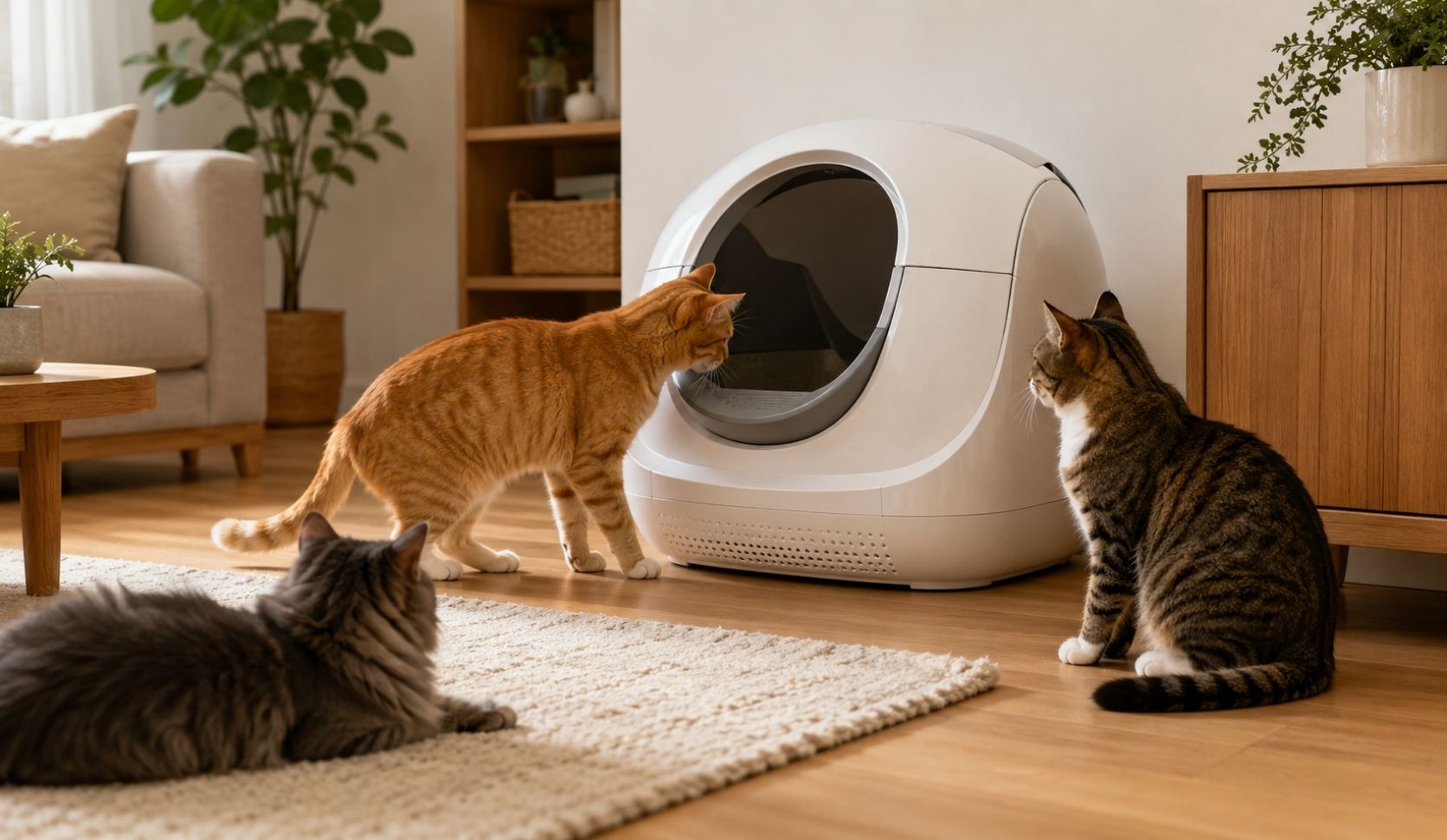
One automatic litter box can serve three cats, but three is the ceiling, not the comfortable middle. It works if all three cats are healthy adults who already share a box without conflict, if you empty the waste drawer every two or three days rather than when you remember, and if no one in the group guards the entrance. If any of those three things is not true, one unit will not be enough, and the thing that fails first is almost never the machine.
I have run a single automatic box in a three-cat home for five years. It started as a two-cat setup with Mao and Leo, and Deo arrived later. That third cat is where I learned the difference between a box that can cope and a box that is coping comfortably, and it is a bigger gap than any product page admits.
What the vendors say, and where their number comes from
Manufacturer and retailer guidance puts one high-capacity unit somewhere between two and five cats, and the supporting advice is usually about drawer capacity: a four-liter waste drawer covering two to three cats for three to four days, with emptying every three to five days once you are past three.
It is worth noticing that the guidance is not even internally consistent. Litter-Robot's own blog says in one place that "one Litter-Robot is perfectly suited for 2-5 cats depending on the model," and elsewhere sets the ceiling at a maximum of four cats per unit. Same company, same site, two different answers. Neakasa and homerunPET land in the same broad band without agreeing on where it ends.
That spread is not sloppiness so much as a sign that nobody is measuring the same thing.
Here is the thing to notice: that is a volume calculation. It answers "how much waste fits in the drawer before it overflows," which is a genuine constraint and a solvable one. You can empty a drawer more often. What the number does not describe is whether three cats will use one box peacefully, which is a completely different question and the one that actually decides the answer in a real house.
So the vendor figure is not dishonest. It is just answering a narrower question than the one you are asking.
What actually breaks first in a three-cat home
In my house it was never capacity. The drawer filled faster, obviously, and my emptying rhythm went from twice a week to every other day. That was an adjustment, not a problem.
What changed was traffic. Three cats in one house do not distribute their box visits evenly through the day, there are clusters, usually early morning and early evening, and a single box has a queue during those windows. An automatic box makes this sharper than a manual one, because after each use the unit waits before it cycles, and a second cat arriving during that wait restarts the timer. I have written up how that cycle delay actually behaves separately, because it surprises almost everyone.
The second thing was subtler and took me longer to see. With two cats, nobody paid much attention to who was in the box. With three, there was a period where Deo would sit near the entrance while another cat was inside. No hissing, no fight, nothing you would call a problem if you walked past it. But guarding a single entrance is exactly the behavior that pushes a cat to eliminate somewhere else, and that risk is well documented in feline behavior guidance. With three boxes it is a non-event. With one box it is the whole ballgame.
The N+1 rule, and how automation bends it
Veterinarians and feline behaviorists have recommended the same rule for decades: one litter box per cat, plus one spare. Three cats means four boxes. Every automatic-box marketing page I have read acknowledges this rule and then moves past it quickly, because it is inconvenient for a product sold as a replacement for your whole lineup.
My honest position after five years is that the rule bends but does not disappear. One good automatic unit genuinely does the work of more than one manual box, it is emptied continuously rather than once a day, so at any given moment it presents a cleaner surface than a manual box halfway through its cycle. That is a real advantage and it is why one unit can carry three cats at all.
But "bends" is not "vanishes." The spare box in the N+1 rule is not there for volume. It is there so that a cat who is blocked, startled or simply particular has somewhere else to go. A single unit, however good, cannot provide that, and no amount of drawer capacity substitutes for a second location. That reconciliation deserves its own piece and will get one; for now, take the rule seriously rather than as marketing friction.
The honest test: are you at the ceiling or past it?
Run this for a week before you decide you need a second unit, or before you conclude one is enough.
- Watch the entrance at your busiest hour. If you see a cat waiting, hovering or sitting nearby while another is inside, more than once, that is queuing and it will not improve on its own.
- Check the drawer on a fixed day, not on instinct. If it is full before you expected it every single time, your rhythm is behind the household, not the machine.
- Look for elimination outside the box, anywhere, even once. This is the signal that matters most and the one people explain away. It is also a signal that can be medical rather than behavioral, and that possibility goes to a vet, not to a shopping list.
- Count healthy adults. A kitten, a very small cat, or a senior with mobility trouble changes the maths entirely and is not a capacity question at all.
- Ask whether your cats already shared happily before automation. If they did not, one box will not fix it.
If two or more of those come back badly, you are past the ceiling. That is the point at which the second-unit decision is worth taking seriously, and it is not a failure of the machine you own.
For two-cat households the calculation is genuinely different and considerably more forgiving, I have worked through the two-cat version of this maths separately. And whichever side of the line you land on, the drawer rhythm is what keeps the whole thing tolerable; the maintenance schedule covers what that actually looks like week to week.
Frequently asked questions
Can one automatic litter box handle three cats?
Yes, if all three are healthy adults who already share a box without conflict and you empty the waste drawer every two to three days. Three is the upper limit of what one unit manages well, not its comfortable operating range.
Why do manufacturers say one box handles four or five cats?
Because that figure is based on waste-drawer volume rather than on cat behavior. Capacity is a real constraint and their numbers are reasonable for it, but territory, queuing and guarding are what actually break a single-box household.
Does the N+1 rule apply to automatic litter boxes?
It bends but it still applies. An automatic box does more work than one manual box because it is cleaned continuously, but the spare box in the N+1 rule exists to give a blocked or particular cat somewhere else to go, and one unit cannot provide a second location.
How often do I need to empty the drawer with three cats?
Published guidance suggests every three to five days for three or more cats. In my own three-cat house every other day is what keeps it genuinely pleasant, and I would treat the published figure as the outer limit rather than the target.
One of my three cats has started going outside the box. Is that a capacity problem?
It might be, but do not assume it. Eliminating outside the box can have medical causes, and that needs a veterinarian rather than a second unit. Rule that out first, then look at capacity and territory.