
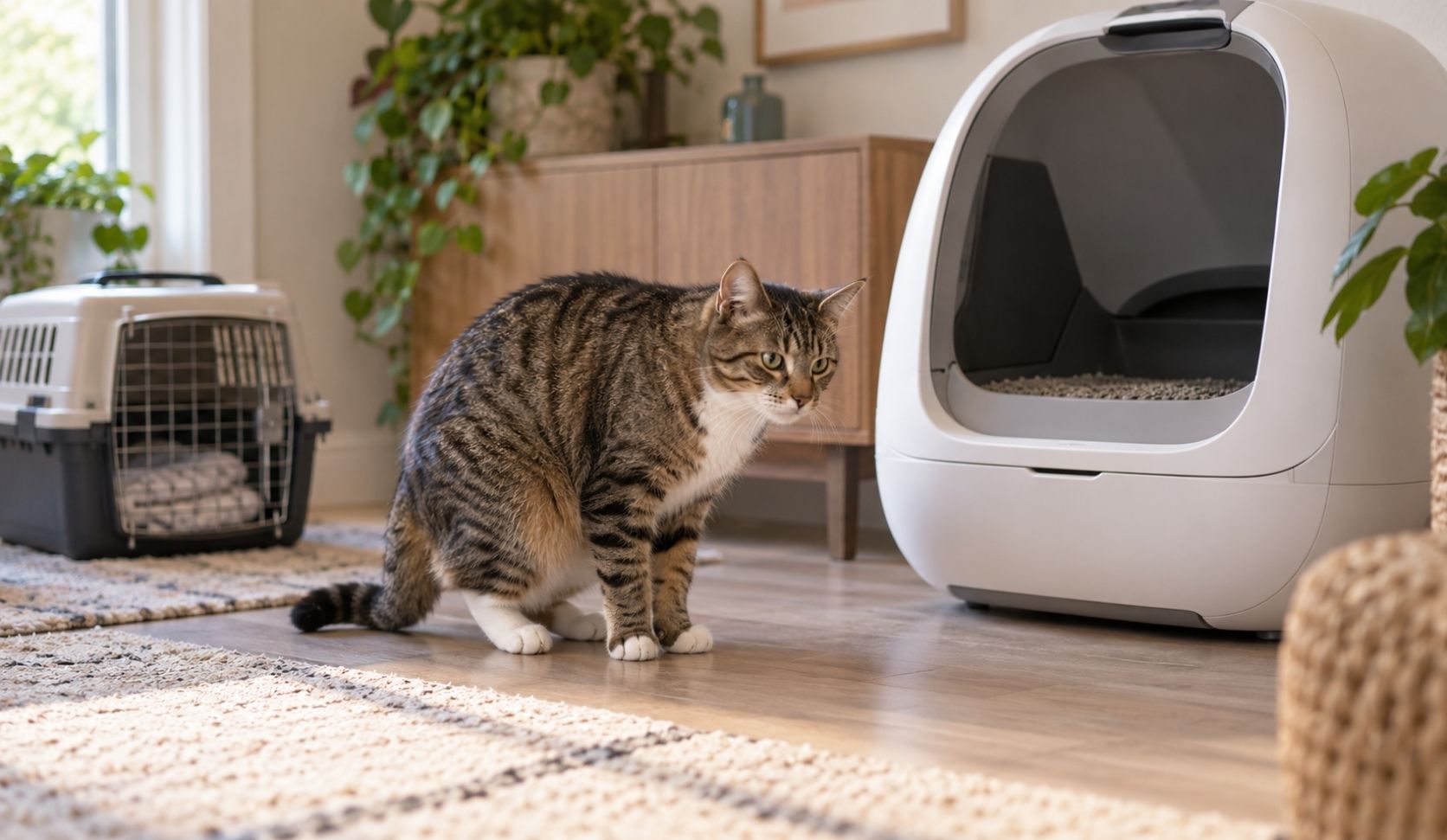
Read this first. If your cat is straining in the litter box and producing little or no urine, that is a veterinary emergency, including out of hours, no matter what you changed recently. A new litter box does not rule that out. See the full list of red flags and what to do about each at the medical red flags to rule out first, then come back here once your cat has actually been examined and cleared.
I am Sarowar. I run automatic litter boxes for three cats, Mao, Leo and Deo, and I write about what fails. I am not a veterinarian, and CatVerge is not a medical resource. Nothing below is a diagnosis, and nothing below is a reason to wait.
Why a Recent Switch Makes the Medical Step More Urgent, Not Less
You just changed the litter box. You have an explanation sitting right there in front of you, and it is a tempting one, because it does not involve a phone call or a car ride. That is exactly the problem with it.
A change you made and a symptom that started around the same time look like cause and effect. Timing is not proof. Coincidence is easy to mistake for causation, and the cost of getting that wrong is measured in hours, not days, because some of the medical reasons a cat stops using a box move fast. A recent change does not make the medical rule-out less necessary. It makes it more necessary, because it hands you a plausible story that a genuine problem can hide behind.
The box is the thing you can see, touch and return to the store. Whatever might actually be going on with your cat, you cannot see. You cannot rule it out by looking at a bag of litter or a plastic bin, and neither can I from here. That is the whole reason the order below is fixed rather than optional. That is not a reason to panic. It is a reason to let a professional confirm what your eyes cannot, before you spend any energy on the box itself.
Step One: The Medical Rule-Out Comes Before the New Litter Box Gets Blamed
This is not a suggestion, and it does not bend based on how new your litter box is, how much it cost, or how sure you feel that the box is the reason. Before you touch the setup or think about behavior, your cat needs to be seen by a veterinarian.
I already wrote out the full list of red flags and the reasoning behind each one on the medical rule-out page linked above, and I am not going to repeat that list here. Repeating it risks making it feel like a second, lighter version of the same instruction. It is not. Go read it. If any of it applies to your cat, that page tells you exactly what to do, and the answer is the same regardless of what changed in your home this week.
If you have read that page and your cat shows none of those signs, call your veterinarian anyway and describe what you have seen, including the timing of the new box. A phone call costs you nothing. Your veterinarian, not a litter box website, is the one who can decide whether your cat needs to be seen today or can be booked in properly. This step does not end when you feel reassured. It ends when a veterinarian has actually examined your cat.
Step Two: Setup, Only After Your Cat Has Been Cleared
This section is for one reader only: the person whose cat has been examined by a veterinarian and told this is not a medical problem. If that visit has not happened yet, this section is not for you yet. Go back up to Step One. Nothing here is more urgent than that appointment, and reading ahead is exactly how a person talks themselves into waiting another day.
Cleared? Good. Now the box itself is a fair question, and there are a few places I would look first. None of what follows is complicated, but it only matters once the appointment above is behind you, not before.
Did you change the litter along with the box? That is two variables moving at once, and it is its own well-documented driver of rejection, separate from anything about the box. I wrote up how to isolate that specific change in changing litter type inside an automatic box.
Did the old box disappear the same day the new one arrived? Pulling the familiar option before the new one is trusted removes the cat's fallback at the exact moment they need one. I cover the timing that actually works in keeping the old litter box during the transition.
Where did the new box land, and can every cat in the house actually reach it without crossing contested territory? Location and access account for more rejected boxes than the hardware itself ever does. A box placed somewhere a cat has to pass another cat, a loud appliance, or a closed door to reach is a box that gets avoided regardless of what brand it is.
Step Three: Behavior, Last
Like the section above it, this one is for the reader whose cat has already been cleared by a veterinarian. If you arrived here without reading Step One, go back. The order is the point of this whole article, and skipping to the end defeats it. That reminder matters here more than anywhere else in this piece, because behavior is the easiest step to jump to and the easiest one to get wrong by skipping ahead.
Cleared and the setup checks out? What is left is pacing and territory, and both take longer than most people expect. A cat does not have to distrust the box itself to avoid it. They can simply be avoiding the disruption around it, especially in a multi-cat home where a new object changes the traffic pattern everyone had already worked out. I own three cats sharing units, and I have watched one of them hold out for days after the other two had already settled back into a normal routine. That is not a sign anything is wrong with that cat. It is a sign that introducing new equipment into a shared territory takes each animal on its own timeline, not the household's average.
If you are rebuilding trust in a multi-cat setup, or deciding whether one automatic box can actually serve everyone in your home, I wrote the longer account of what that looks like in practice, mistakes included, in my full account of running a self-cleaning litter box for multiple cats.
Frequently asked questions
My cat is only peeing outside the box occasionally, not every time. Does the medical step still apply?
Yes. An intermittent pattern is still a pattern a veterinarian should hear about, described exactly as you have seen it. Frequency does not tell you which cause you are dealing with, and it is not something to sort out by watching for a few more days first. Waiting to see if it happens again just delays a conversation your veterinarian is better placed to have with you now.
We changed the box a week ago and everything seemed fine until yesterday. Could it really still be the box?
That question belongs to your veterinarian, not to a guess made at home. A new symptom appearing after a delay is not evidence either way about the box on its own. Call and describe the full timeline, including the switch, and let the exam answer it.
What if my veterinarian examines my cat and finds nothing?
Then Step Two and Step Three above are exactly where to start, in that order. A clean exam does not mean nothing changed for your cat. It means the setup and the transition are now the honest next places to look.
Is it safe to just switch back to the old box while I figure this out?
Ask your veterinarian first rather than deciding on your own. Swapping equipment based on a guess is a setup change, not a medical response, and it does not substitute for the exam described in Step One.
Our cat is peeing outside the box but using it for solid waste normally. Does that change anything?
No. Any change in urination habits gets the same first step as every other pattern described here: a veterinary visit, not a guess about which part of the routine is responsible.
Sarowar writes CatVerge from a three-cat home. He is not a veterinarian and CatVerge is not a medical resource. If your cat shows any of the emergency signs described above, close this page and call a veterinarian.