
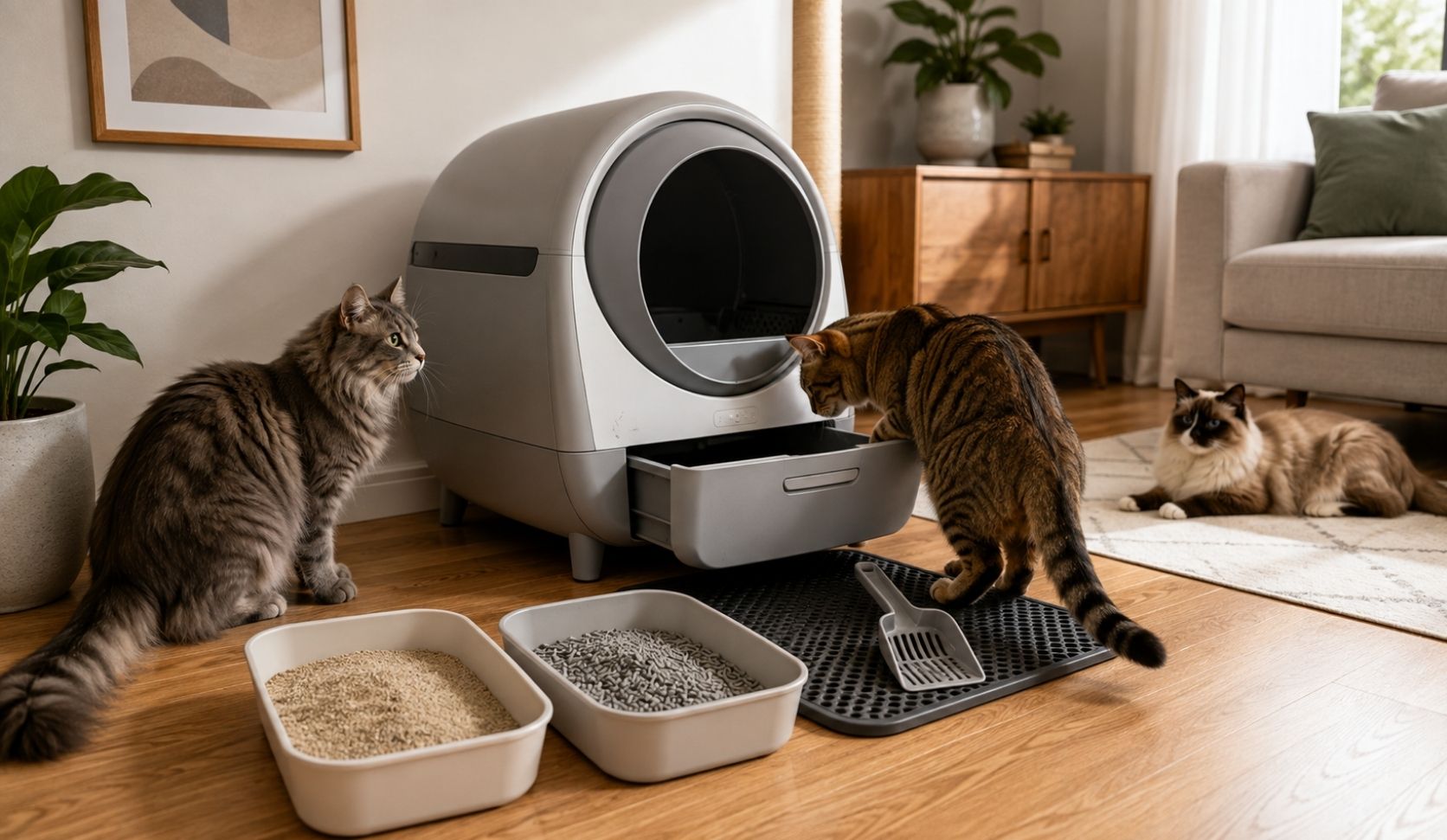
Change the substrate, not the machine's diet. Do not run a blend of two litters through an automatic litter box. Keep one litter in the sifting box at a time, offer the new litter in a plain open pan beside it, and swap the machine over in a single move once the cats have committed. A blend of two litters with different clump strength is exactly what a sifter handles worst.
That puts me at odds with most of what you will read today, so let me show my work. I have run automatic boxes for five years with three cats (Mao, Leo and Deo), and I have changed litter twice. The first time, I followed the standard gradual-blend advice and spent two weeks pulling wet crumbs out of a machine that had been fine the month before.
Changing litter in an automatic litter box: why the usual advice conflicts
Two bodies of advice exist here, written to solve different problems.
The cat-behavior side says change substrate gradually, because cats form substrate preferences and abrupt change is a known trigger for eliminating outside the box. The AAFP and ISFM house-soiling guidelines (Carney et al., 2014) recommend a fine, sand-like, unscented, clumping material at least 1.25 inches (3 cm) deep. Where a cat's preference is unclear, they call for providing multiple boxes with different litters and variable litter depths. That is a preference test, not a blend.
The automatic-box side says hard clumping clay, medium granule, low dust, for reasons I work through in my guide to the best litter for an automatic litter box.
Both halves are right. The trouble is that the usual way of doing the first half, mixing old and new litter in the one box you own, is a direct attack on the second.
What a two-substrate blend does to a sifter
A sifting box applies one fixed mechanical action to whatever is in it. It does not analyze the bed first.
So you get hybrid clumps. Urine landing on the boundary between two litters forms a lump that is strong on one side and crumbly on the other. It survives being lifted, then breaks apart in transit. Part reaches the drawer, part falls back into the clean bed as wet crumbs. Nothing jams, nothing errors, and the box reports a normal cycle while you get an odor problem you cannot locate.
It also gets worse daily, because the ratio never sits still. The machine removes litter, you top up from the new bag, and the mix shifts every cycle. There is no stable blend to settle into, just a slightly different substrate each time the box turns.
The switch that respects both halves
The fix is to stop asking the machine to hold two litters at once.
Put a second box, a cheap open pan, next to the automatic one and fill it with the new litter only. Leave the automatic box alone, still running the old litter. Both requirements are satisfied at once: the cats get a genuine choice between substrates, which is what the veterinary guidance actually asks for, and the sifter keeps running the single litter it was built around.
Then watch which box gets used. When the new litter is clearly winning with every cat, and for me that meant several days of all three using it without hesitation, change the machine in one move. Empty it, wipe it out, refill with the new litter alone. The cats accepted that substrate days ago, so nothing about it is abrupt to them. It is abrupt only to the machine, which does not care what is in it as long as it is one thing.
If the automatic box is your only box
Buy a pan. It costs less than a bag of litter and you will use it again.
If that is genuinely not an option, take the clean break rather than the blend. Empty the machine, refill with the new litter, and accept a higher rejection risk instead of a guaranteed mechanical mess. A clean break asks one clear question and gives you a clear answer. A blend asks a behavioral question and creates a mechanical failure at the same time, and you cannot tell which one you are looking at.
One honest wrinkle: the veterinary preference (fine, sand-like) and the machine preference (medium granule, hard clumping) are not identical. Most decent clumping clays sit in between, but if your cat is fussy, that gap is real and no article closes it for you.
What to watch in the first week
Run two separate inspections and do not let them blur together.
Mechanically, look at the clean bed rather than the drawer. Wet crumbs in the clean litter mean clumps are breaking during the cycle. Undersized clumps in the drawer say the same thing from the other end. If the drawer feels light while the box smells, material is staying behind, and odor follows whatever the sifter fails to lift.
Run your hand through the bed on day three. It should feel uniform and dry. Grit, or damp patches near the bottom, means the substrate is not working in that machine, whatever the bag claims.
If the unit stalls, throws an error, or the smell will not clear even after a full litter change, that is a different problem, and my guide to a self-cleaning litter box that is not working covers it.
The behavior side, and where I stop guessing
Watch for hesitation at the entry, digging that is shorter than usual, or a cat who steps in, turns around and leaves. Deo gives one short scratch when he dislikes something, and it is the earliest signal I get from any of them. The right response to all of it is to slow down: go back to the two-box setup and give it more time.
One thing here is not a litter question. If a cat starts eliminating outside the box and keeps doing it, that goes to your veterinarian. The AAFP and ISFM guidelines treat house-soiling as warranting a physical exam and diagnostic testing to rule out medical causes first. I have owned these machines for five years. I am not a clinician, and this is where I stop.
How to back out, and why reverting is not failure
The signal to stop is simple: you are still finding crumbs in the clean bed after a full change to the new litter, or a cat who used the box happily last month now hesitates at it.
Backing out is cheap. Empty the machine, wipe it down, refill with the litter that worked.
I have reverted once. The new litter was lower dust and I wanted it to work, but it clumped soft, and soft clumps do not survive a sifting cycle. That is a compatibility result, not a defeat. If you are weighing a non-clay option, I went through crystal, pine and tofu litters in an automatic box separately.
People struggle to back out because they blended and cannot tell whether the cat or the machine is the problem. Keep one litter in the machine and the answer stays obvious. If the real question is acceptance of the machine itself, getting a cat used to a self-cleaning litter box is its own piece.
Frequently asked questions
Can I mix two brands of cat litter in an automatic litter box?
I would not. Blending is reasonable advice for a manual box. In a sifting box, two litters with different clump strength produce clumps that break mid-cycle and drop back into the clean bed. Offer the new litter in a separate open pan instead.
How long should switching cat litter take?
I cannot give you a day count. The AAFP and ISFM guidelines describe preference testing, not a percentage schedule, and the vendor pages publishing day-by-day ratios cite nothing. The switch is done when the cats choose the new litter without hesitation.
Do I need to empty the automatic box completely when I change litter?
Yes. A partial change leaves you running exactly the blend you were trying to avoid. Empty it, wipe it out, refill with the new litter only.
My cat started going outside the box after I changed litter. What now?
Revert to the old litter, and book a vet visit if it continues. Eliminating outside the box has medical as well as behavioral causes, and the veterinary guidelines put ruling out medical causes first. I cannot diagnose it, and neither can a comment thread.