
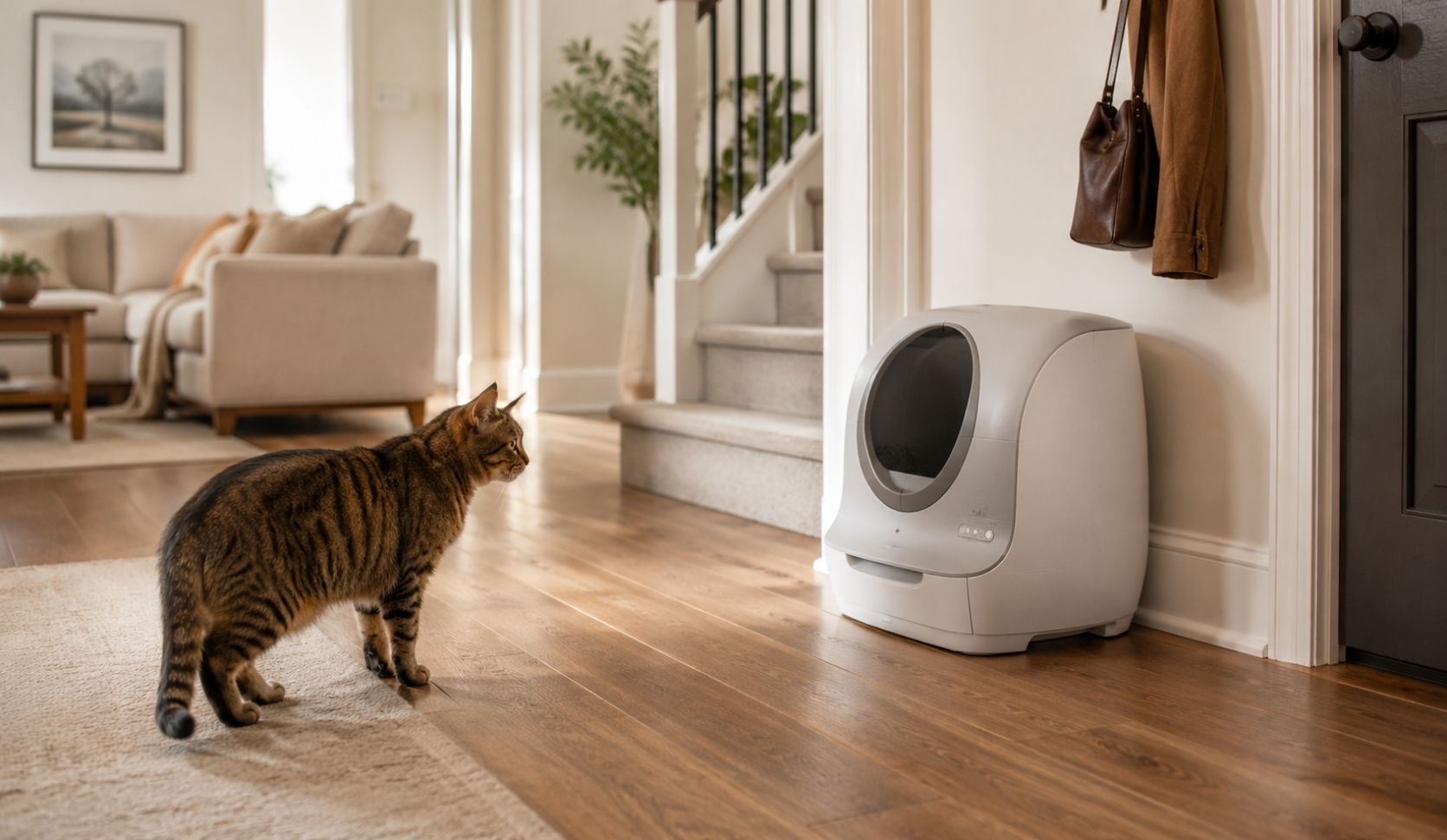
I've owned automatic litter boxes for five years now, and Mao, Leo, and Deo have taught me something the spec sheets never mention: a perfectly functioning machine in the wrong spot becomes a box three cats will refuse. Your cat isn't telling you the device is broken. Your cat is telling you the location is wrong.
Here's the practical first test before you conclude the unit failed. Move it once to a different room. Give it a full week. If the rejection stops, placement was the problem, and you've just solved it for the cost of an extension cord. If the rejection continues, we have a different diagnosis on our hands.
This piece covers the behavioral side of placement: escape routes, ambush lines, household traffic, proximity to food and water, and whether your cat can reach the box without being cornered or blocked by another cat. This is separate from the engineering side of placement (power access, clearance for cleaning, operational noise) that a guide to apartment placement covers. Both matter. They just matter for different reasons. More broadly, if you're deciding whether an automatic box fits your household at all, the five-year multi-cat resource walks through the full adoption curve across multiple cats.
The Five Placement Mistakes That Most Often Cause Rejection
Dead-End Locations
Cats need to enter a litter box and leave it without being trapped. A box tucked into a corner, a closet, or the far end of a basement room violates this completely. The AAFP and ISFM 2014 Guidelines for Diagnosing and Solving House-Soiling Behavior note that cats must be able to "exit the box and avoid an approaching cat." A dead-end location doesn't just feel cramped to your cat; it removes the exit strategy entirely.
Leo learned this the hard way when I first placed the automatic box in a corner of the laundry room. He'd approach it, then retreat. The box itself was fine. The architecture was not. Moving it two feet to the left so he had an open path to leave changed everything. Within two days, he started using it again.
High-Traffic Doorways
Automatic litter boxes in living spaces, hallways, or anywhere people or other household members pass through constantly create anxiety. Most cats prefer private places to eliminate. They don't want to be interrupted mid-cycle or watched by household traffic. If you've placed the box in a main thoroughfare hoping it would be more "accessible," your cat's reading it as the least private toilet option in the house.
I made this mistake before I learned. My second placement attempt was just inside the main hallway. Deo would approach, hear footsteps approaching from the kitchen, and back away. He wasn't afraid of the machine. He was uncomfortable eliminating where he could see people walking past. Moving it to the spare bedroom meant fewer eyes, less acoustic disruption, and zero rejection.
Near Food or Water Stations
Cats have natural, deeply hardwired preferences: they do not eliminate where they eat. The AAFP and ISFM guidelines emphasize keeping litter boxes separate from food and water bowls. I've seen owners place the automatic box in the same room as the food station "for convenience," and it backfires every time. Your cat doesn't care about your convenience. Your cat's instinct says "the box belongs far from where I take in food."
Mao held out on me until I moved the box to a different room entirely from the feeding station. Six feet away in the same room was not enough. Different room made it work.
Boxes That Block Each Other
If you have multiple cats and placed the new automatic box right next to an existing manual box, your cat may be perceiving them as one large box rather than two separate resources. The AAFP and ISFM guidelines note that "cats perceive litter boxes located adjacent to each other as one large box." More important: if the boxes are arranged so one cat has to pass the other to reach either box, you've created a blocking point. Confident cats will monopolize access, and nervous cats will hold it and use the floor instead.
When I introduced the automatic box, I positioned it at a 90-degree angle to the manual box in a different corner of the room, at least four feet away. This wasn't just about space; it was about creating two genuinely separate options rather than one obstacle course. For a deeper look at the multi-cat dynamics, the piece on what happens when one cat refuses covers the holdout scenario despite others accepting the device.
Positions That Create Ambush Scenarios
Some cats are what researchers call "despot" cats, meaning they position themselves to intercept other cats using the box and prevent access. If your box placement creates a natural ambush point (say, directly in line with another cat's favorite resting spot), the confident cat gains the power to block, and the shy cat will find somewhere else to go.
Deo and I had this. He has a favorite spot on the shelf unit next to where I'd first placed the box. He could see every approach. Leo learned quickly that going to the box meant a confrontation. Moving the box to an angle where Deo couldn't see the entry without moving changed the social math entirely. Deo couldn't guard a box he couldn't see from his spot.
How to Test a New Location Without Restarting Acclimation
The good news: testing a placement change does not mean starting the full introduction-week over. You don't need to turn the automation off again or run the old manual box alongside it, which is different from the powered-off introduction approach.
Here's the practical protocol. Keep the box in its new location with automation running normally. Give it seven full days with no other changes to your setup, your cat's routine, or the litter type. Don't move the box again during this week; any additional changes muddy the data. Watch for two signals: does your cat approach it? Does your cat use it? If the answer to both is yes by day three or four, placement was likely the issue. If the cat approaches but doesn't use it, or avoids it entirely, placement is probably not your core problem.
Mark the date and location in a note so if you ever need to move it again, you remember what worked and why. I keep a photo of where the box sits now because it took me three relocations to find the sweet spot.
When Placement Isn't the Problem
If you've moved the box to a quiet, private, multi-exit location away from food and water and blocked traffic, and your cat is still refusing to use it, placement is not your diagnosis. Your cat may be responding to noise or movement triggers from the automation itself. That's covered separately. Or your cat's refusal might be accompanied by other changes: straining at the box, frequent trips with little output, or a sudden shift after months of normal use. Those signs require a veterinary evaluation before any behavior troubleshooting.
If avoidance comes with behavioral changes (hiding, reduced appetite, lethargy), or if you see straining or infrequent urination with the box refusal, do not test placement further. Route to your veterinarian directly. House-soiling issues can signal medical problems that are urgent.
FAQ
Q: How long should I wait before concluding placement isn't the problem?
A: Give it a full seven days in the new spot with no other changes. Cats are creatures of routine; it can take 5-7 days for the change to register, but most cats signal acceptance or refusal within the first three to four days.
Q: If I move the box, do I need to turn off the automation and start over?
A: No. You're not re-introducing the device; you're testing whether location changes behavior. Keep everything else the same and move only the box.
Q: Should the new location be far from where it was originally?
A: Not necessarily. A two-to-three room distance is usually enough. If the old location was a dead-end corner, moving to an open wall in the same room can be sufficient. The key is addressing the specific constraint (exit routes, traffic, food proximity) that likely caused the original rejection.
Q: What if moving the box helps temporarily, but my cat stops using it again after a few weeks?
A: Temporary improvement followed by renewed avoidance usually signals a medical change rather than a placement issue. Have your cat evaluated by your veterinarian, especially if you notice any change in frequency, strain, or output volume.
Q: Can placement preferences differ between my cats?
A: Yes, completely. Mao's ideal spot is different from Leo's. This is why adding a second automatic box placed in a different part of the house often solves multi-cat refusal faster than moving one box. If one cat consistently refuses placement that works for the others, consider whether that cat's stress level or social position in the household is the real issue, not the machine.