
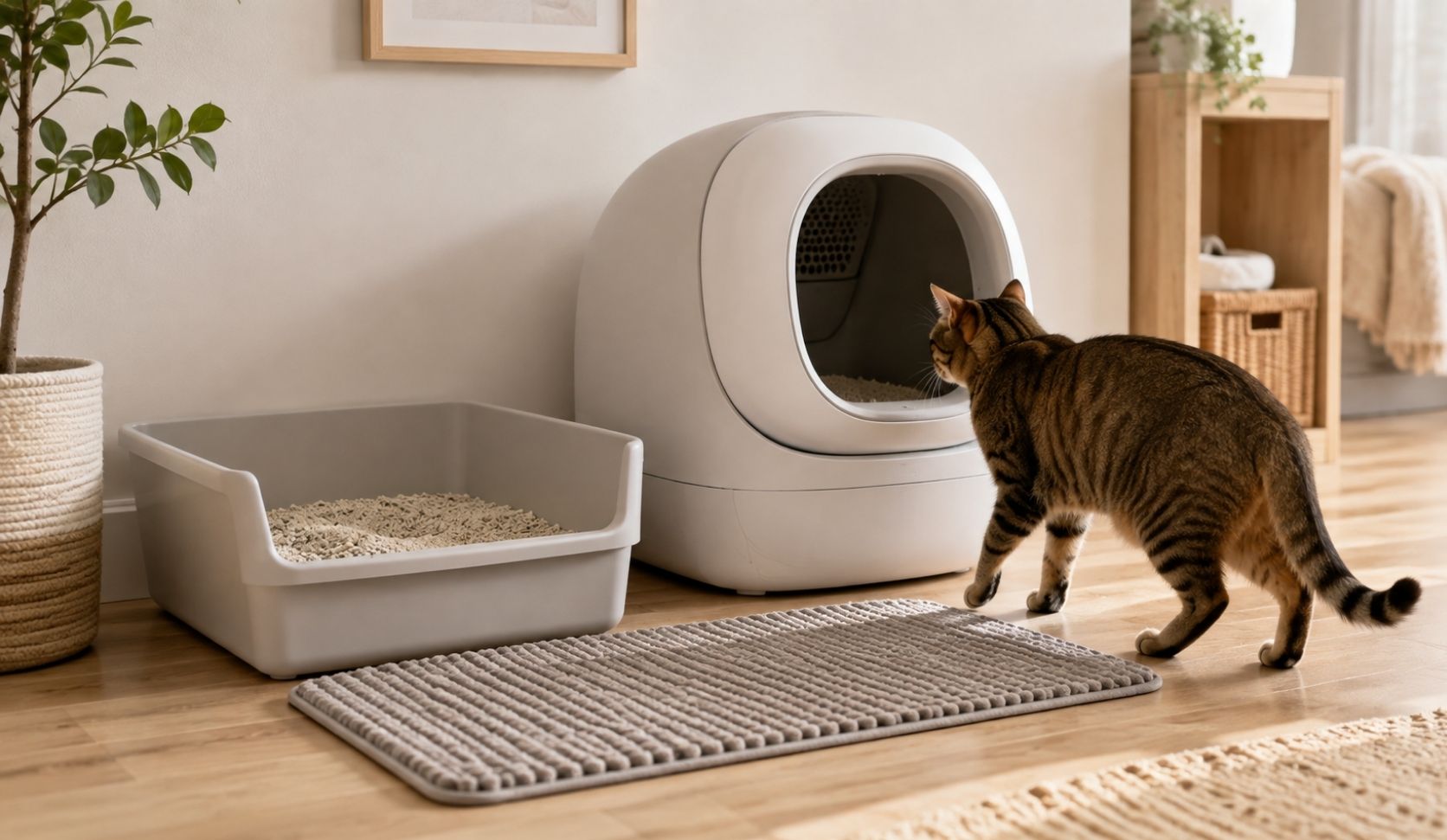
Run the new automatic litter box beside your cat's existing manual box, and leave the automation switched off for the entire first week. Let it sit there as a plain, silent box your cat can walk into on its own terms, with no noise and no movement. Only once your cat is using it calmly and unprompted, unpowered, do you turn the cycling on. I have run this exact method with three cats in my own three-cat home.
Introducing an Automatic Litter Box Powered Off: The Short Answer
That's it. That single step decides whether a cat accepts an automatic box or writes it off completely. I am not a veterinarian and this is not a formal protocol borrowed from a manufacturer's manual. It is what actually worked with Mao, Leo, and Deo, three different cats with three different temperaments, over five years of running these units. Mao is cautious and needed the full week. Leo used the new box within a day. Deo split the difference. What was consistent across all three was this: the box had to be a boring, ordinary object before it became a machine.
This is also the piece I point to from our full transition guide, because it is the one step in that plan that people rush, and rushing it is the single most common reason someone tells me "my cat hates it" when the cat never actually got a fair chance to trust the box.
Why Turning On Cycling Too Early Causes False Rejections
Here is the mechanism, because understanding it changes how you follow the rule. A litter box is one of the only places a cat is both stationary and vulnerable at the same time. Before a cat will use one, it needs to trust that the spot is stable and predictable. An automatic unit asks a cat to build that trust twice: once for the object itself, and once for the fact that the object moves and makes noise on its own.
If you turn on cycling in week one, before the first kind of trust exists, a startle event happens at the worst possible moment. The cat has not yet decided the box is safe, and now the box has also proven it can move without warning. That single bad experience does not just delay acceptance, it often resets it to zero, and the cat starts avoiding the box entirely rather than cautiously investigating it. What looks like "this cat hates the box" is usually just a cat that got scared before it had any reason to trust the box in the first place.
What Week One Actually Looks Like
Day to day, week one should look almost uneventful, and that is the point. On day one, I place the new unit next to the old manual box, filled with the same litter my cats already use, powered completely off. I do nothing else that day. Over the next few days, I let each cat sniff, step in, and investigate on its own schedule, sometimes with a treat near the entrance, never by picking a cat up and placing it inside.
For the rest of the week, the new box just sits there as a second, ordinary litter box. I scoop it by hand, same as the old one, so it stays clean and inviting without any motor ever running. The old manual box stays exactly where it was the whole time; removing it early is the other common mistake, and our piece on how long to keep the old box around during the switch covers that timing in more detail. Some cats use the new box on day two. Others wait until day five or six. Both are normal.
When to Turn the Automation On
The signal to watch for is not a date on a calendar, it is behavior. Once a cat is walking into the new box, using it, and walking away without hesitation, circling, or sniffing suspiciously at the edges, on more than one occasion, that is your cue. Not the first use. A cat's first visit is often just curiosity. What you are waiting for is a cat that treats the box as unremarkable, because unremarkable is what you want it to feel like when the motor eventually runs too.
When that happens, I run a single cleaning cycle only while the box is empty, so the cat can hear and watch it from a distance without anything happening near its own body. Then I keep the cycling on going forward. Timelines vary by cat, which is exactly why I do not tie this to a fixed number of days. If you want the fuller range of what "normal" looks like across different cats, our piece on how long cat acclimation to an automatic litter box actually takes walks through that in more detail.
Already Turned It On Too Early? Here's How to Recover
If you already switched the cycling on in week one and your cat bolted, stopped using the box, or started avoiding the area, that is not a failed cat and it is not a failed box. It is a timing mistake, and it is fixable. Turn the automation back off completely. Give the box a few quiet days as a plain box again before you even think about the motor.
Do not treat this as starting over from a worse position than day one. You are not behind, you are just repeating the part of the method that got skipped. Keep the old manual box available the entire time you are rebuilding trust, and resist the urge to test the cycling again "just to check." Wait for the same behavioral signal described above: calm, repeated, unhesitating use while the box is off. Cats forgive a startle more easily than owners expect, as long as the box goes back to being boring for a while first. If you have a three-cat or larger household, worth noting that each cat resets on its own schedule; our guide to running a self-cleaning litter box in a multi-cat home covers how one cat's setback does not have to slow the others down.
FAQ
How long should an automatic litter box stay powered off before I turn it on?
There is no fixed number of days. Some cats are ready in two or three days, others take closer to two weeks. Watch for calm, repeated, unhesitating use of the box while it is off, and let that behavior decide the timing, not a date on a calendar.
Is running the box unpowered for a week a veterinary recommendation?
No. This is my own tested practice from five years of running automatic litter boxes with three cats, not a formal medical protocol. I am not a veterinarian and always defer to one on anything that looks health related.
What if my cat still won't use the box even after a full week powered off?
Keep the old box available and give it more time before concluding it is a real refusal. Some cats genuinely need two to three weeks. If your cat is straining, urinating little or nothing, or showing other signs of distress, stop treating it as a training issue and call your vet.
Can I skip the powered-off week if my cat used a self-cleaning box before at a friend's or shelter's home?
I would still run a short powered-off period, even just a day or two, since the specific unit, its noise, and its placement in your home are new even if the concept isn't. It costs you almost nothing and removes one more variable.
Do I need to keep the old manual box during the powered-off week?
Yes. Keep it in place the entire time. A cat that has not yet fully trusted the new box needs a known, safe alternative, or it may eliminate somewhere else in the house entirely.