
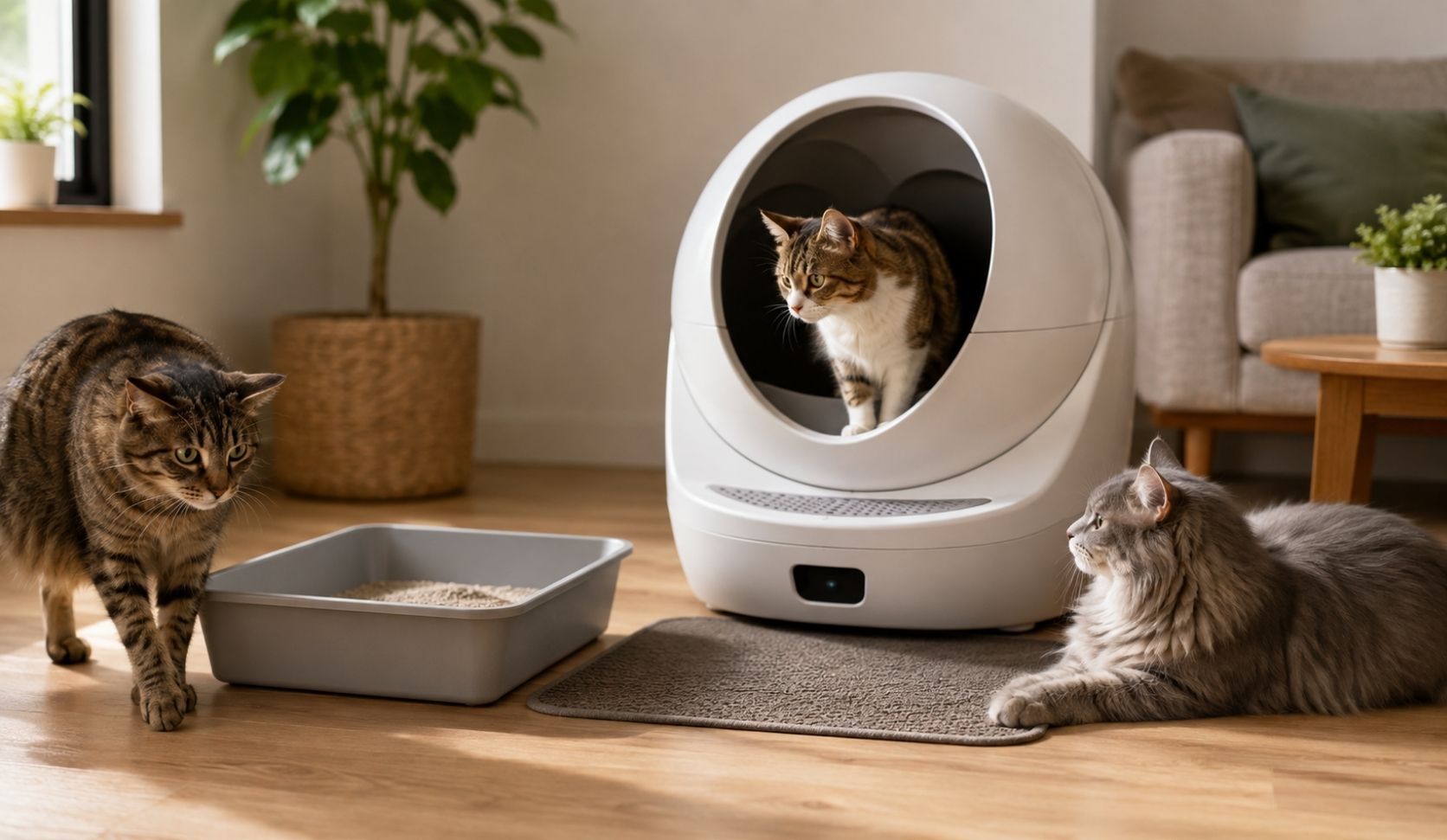
If one cat in your home refuses the automatic litter box while the others took to it fine, the box itself is usually not the whole story. In a multi-cat home the holdout is often reacting to the other cats, not just the machine: territorial pressure, guarding, or fear of being cornered near a device that moves and makes noise. Start by keeping a plain manual box available so the holdout is never forced to choose between the automatic box and your floor, then work out whether the real problem is the device or the social dynamic. Here is how to tell them apart, and what actually fixes it.
Why one holdout is a different problem than "my cat won't use it"
Most advice you will find online treats litter box refusal as one problem with one cat. That is not your situation. Your other cats adapted, which tells you the device works, the litter is fine, and the placement is at least tolerable. So the standard single-cat troubleshooting list, retrain slowly, check the litter type, clean it more often, only gets you so far. It skips the variable that is actually different in your home: the other cats.
A single cat rejecting a new box is almost always about the box. One cat rejecting a box that its housemates already use is usually about access, safety, and social pressure around that box. Same symptom, different cause. If you treat it like a device problem when it is a social problem, you will spend weeks adjusting settings that were never the issue.
I write from years in a three-cat home, so I have watched exactly this play out. One cat can decide a resource belongs to someone else and quietly opt out, and it looks nothing like a cat that is simply scared of a machine.
Is it the device, or is it the other cats?
This is the fork in the road, and you can usually tell which side you are on by watching, not guessing. Give it a few days of observation before you change anything.
| What you see | Points to the device | Points to the other cats |
|---|---|---|
| Cat startles and bolts when the box cycles | Yes | |
| Cat will use the box only when the house is empty and quiet | Yes | |
| Cat approaches, then a housemate appears and it walks off | Yes | |
| Cat never approaches even when alone | Yes | |
| Cat uses a manual box in a different room without issue | Yes | |
| Cat sniffs the machine but won't step onto the moving surface | Yes |
If the holdout uses a manual box happily somewhere the other cats do not patrol, the machine is not the core problem. If it avoids every box in that location, or freezes the moment the mechanism runs, the device (its motion, its noise, the enclosed shape) is a bigger factor. Many homes have a mix of both, and that is normal.
Territorial and resource-guarding signs to watch for
Cats do not always fight openly. A lot of multi-cat tension is quiet, and the litter box is one of the most commonly guarded resources in the house. These are widely recognized cat-behavior patterns, not clinical diagnoses, and they are worth learning to spot:
- One cat sits in a doorway or hallway that the box's location depends on, controlling the route without ever touching the other cat.
- A housemate "happens" to appear whenever the holdout heads toward the box, then the holdout redirects.
- The holdout waits until the other cats are asleep or fed before it will go.
- Staring, blocking, or slow tail-swishing near the box instead of outright aggression.
- The box sits in a spot with only one way in and out, so a nervous cat can be cornered there.
A single automatic box concentrates everyone's elimination into one location, which is exactly the setup a guarding cat can dominate. That is the trap: the machine that made your life easier also gave one cat a single chokepoint to control.
The one-box-per-cat-plus-one rule still applies
The long-standing guideline from feline behavior specialists is one litter box per cat, plus one extra. Three cats means four boxes, in more than one location. An automatic box does not repeal this rule. It counts as one box, and it lives in one spot, so a home that consolidated three manual boxes down to a single automatic unit has quietly gone from meeting the guideline to falling well short of it.
Location matters as much as number. Boxes spread across different rooms cannot all be guarded by one cat at once, because a cat cannot be in two places at the same time. Put boxes where a cat has more than one exit, not at the dead end of a hallway or the back of a closet. If your automatic box is in a tight, single-exit spot, that alone can be enough to make a cautious cat opt out.
Practical fixes, in the order I would try them
Work through these roughly in order. The early ones are free and reversible, so there is no reason to jump to buying more hardware first.
1. Keep a manual box for the holdout, in a different room. This is the single most important step, and it is not a step backward. It gives the anxious cat a safe, predictable option that never moves or makes noise, in a spot the other cats do not control. It also protects your floors and furniture while you work the problem. Keep it until, and only if, the cat chooses the automatic box on its own.
2. Move the automatic box, or give it a second exit path. If placement is the issue, relocating the unit to a lower-traffic, more open spot can change everything. Even opening up the approach so the cat is not walled in can help.
3. Reduce the ambush opportunities. Feed the cats separately, add vertical space and hiding spots, and use calming tools like pheromone diffusers to lower the overall tension. A less stressed household guards resources less.
4. Consider a second automatic unit, or a second box of any kind. If your other cats genuinely like the machine and the holdout just needs its own turf, adding a box in a separate location can resolve the whole thing. It does not have to be a second automatic unit. A plain box the holdout can own is often enough.
Whether a second automatic unit is worth it depends heavily on how many cats you have and your space. If you are weighing that specifically, our guide on whether an automatic box is worth it for two cats (publishing soon) walks through the trade-offs before you spend.
How long to give it before you decide
Give a genuine transition a few weeks, not a few days, as long as the holdout is reliably using its manual box in the meantime and is not eliminating in random spots or showing signs of distress. Cats adjust on their own timeline, and pushing harder usually backfires. If you are still early in the process for the whole household, our step-by-step guide to a calm automatic litter box transition (publishing soon) covers how to introduce the device without spooking anyone in the first place.
What you should not do is force interaction. Carrying a frightened cat to the box, or blocking off its manual box to make it "commit," tends to create a stronger negative association, not adoption. Pressure is how a temporary holdout becomes a permanent avoider.
The honest part: an automatic litter box does not suit every multi-cat home
Here is what the pages selling you a box will not say. One automatic litter box does not suit every multi-cat home, and running one automatic unit plus one manual box permanently is not a failure. It is a completely normal, stable setup that plenty of multi-cat households land on and never change.
If one of your cats is simply more comfortable with a quiet, still, predictable box, the kindest and most reliable answer may be to let it keep one. You still get most of the convenience for the cats that use the machine, and the holdout gets a setup it will actually use, which matters far more than tidiness. A box a cat refuses to use is not saving you any work.
The goal was never "every cat uses the robot." The goal is every cat reliably uses a box. If a hybrid gets you there, you have solved the problem. Keeping both boxes clean is the only ongoing cost, and our automatic litter box maintenance schedule (publishing soon) covers how to stay on top of both without it taking over your week.
When this is a vet problem, not a behavior problem
Behavior fixes assume your cat is physically well. Do not assume that if the signs point elsewhere. See a vet, promptly, if the holdout is straining in the box with little or nothing coming out, going more often than usual, crying while trying, licking its genitals excessively, or eliminating outside any box after previously being reliable.
A cat that repeatedly strains and cannot pass urine is a medical emergency. Urinary blockage can become life-threatening within a day, and it is more common in male cats because of their narrower urethra. That is an emergency-vet situation measured in hours, not a wait-and-see. A cat that stops using any box at all can also be signaling a medical issue, so rule out health before you keep working the behavior angle. I am an experienced cat owner, not a veterinarian, and anything on the medical side belongs with your vet.
If any of that describes what you are seeing, stop here and read the medical red flags to rule out first, which sets out the signs and the urgency with named veterinary sources. Nothing below this point is worth reading until a vet has seen your cat.
FAQ
Does adding a second automatic litter box really help?
It can, if the real problem is competition for a single unit rather than fear of the machine itself. A second box in a separate location gives the holdout its own turf that another cat cannot guard. It does not have to be a second automatic unit, though; a plain manual box the holdout can own often works just as well and costs less.
Is my holdout cat stressed, or just stubborn?
Cats are not really stubborn about elimination the way people mean it. A cat that avoids one box while using another comfortably is telling you something is wrong with the first option, usually safety, access, or the device's noise and motion. Treat it as information, not defiance.
Will forcing the two cats to interact fix it?
No, and it usually makes things worse. Forcing a frightened cat near the box or the housemate it avoids tends to deepen the negative association. Give the holdout its own safe box, reduce ambush points, and let the tension come down on its own timeline.
Can one automatic litter box handle a multi-cat home at all?
Often yes, for two to a few cats, depending on waste capacity, cleaning cycles, and how often you empty it. But "can handle" is about capacity, not about whether every individual cat will accept it. One cat opting out does not mean the box is defective; it means that cat needs a different option, and that is fine.
Is it normal for only one of my cats to refuse it?
Yes. Cats have different tolerances for noise, motion, and social pressure. It is common for most of a household to adapt while one holds out, and it does not mean you did anything wrong. It means you now have a two-track setup to manage, which is manageable.