
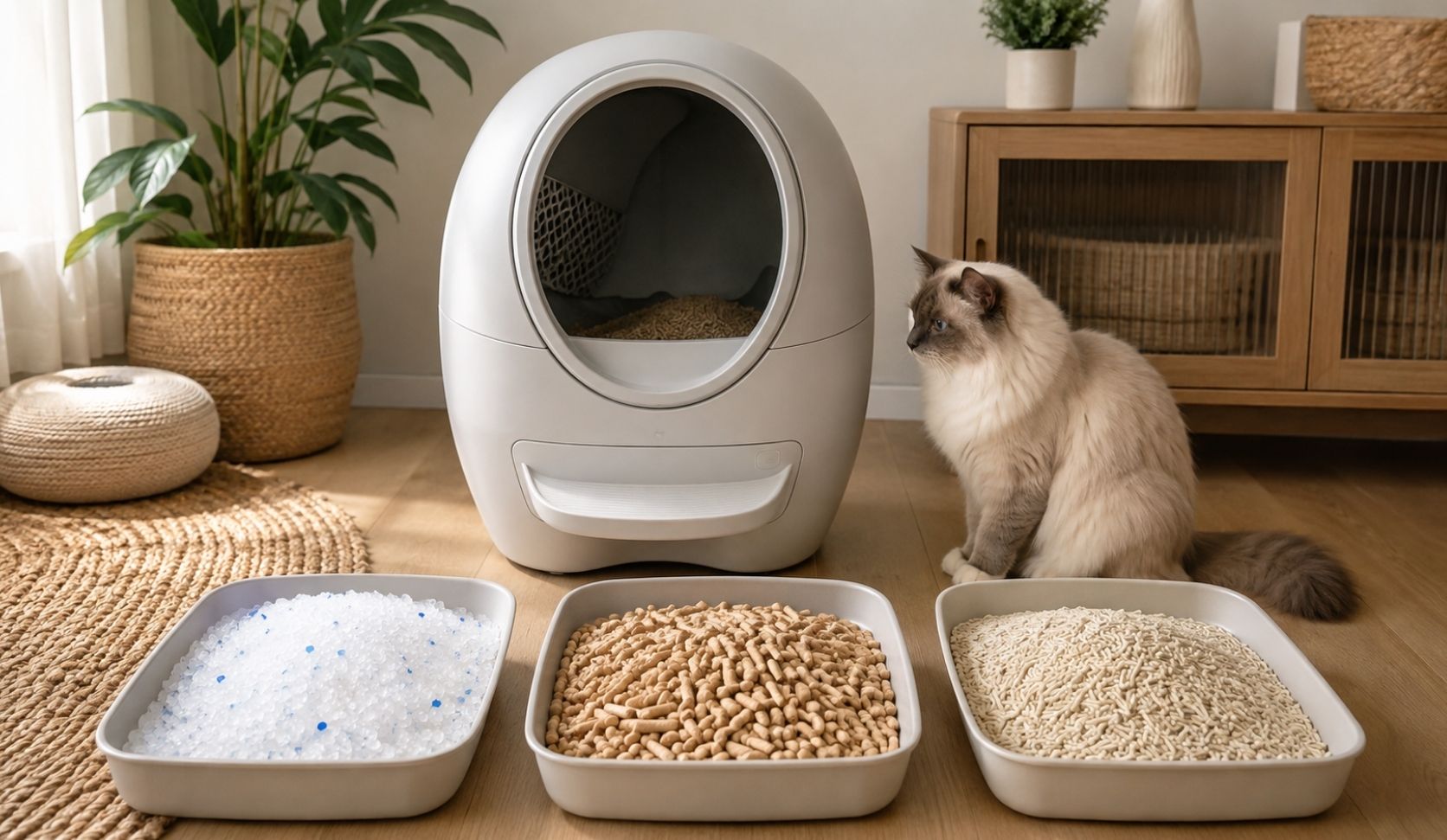
Most non-clay litters do not work well in an automatic litter box, but they fail in different ways, and the difference decides whether yours is unusable or merely annoying. Crystal absorbs instead of clumping, so the sieve has nothing solid to lift. Pine and wood pellets are too large for the mechanism and are the most likely to actually jam it. Tofu, corn, wheat and lightweight blends do clump, but softly, the clumps often break apart during the cycle and end up back in the bed.
Every page ranking for this question says "use clumping clay" and stops. If you have a reason not to, dust, weight, environmental preference, or a cat that dislikes clay, that advice leaves you with nowhere to go. So here is the substrate-by-substrate version.
Crystal and silica
Crystal litter works by absorption. The granules soak up urine and hold it, releasing moisture slowly, and the bed is stirred rather than scooped in normal manual use.
That is a direct mismatch with a sifting machine. The mechanism's entire assumption is that liquid waste becomes a solid object it can lift out. Crystal never produces that object. What the sieve sees is a bed of loose granules, all of which pass through the screen, so it separates nothing and returns saturated crystals to the bed cycle after cycle.
The result is a box that appears to work perfectly, full cycles, no errors, nothing caught, and smells anyway. Solid waste still gets removed, which makes it more confusing, because the machine is visibly doing something.
There is one narrow case: some units are specifically designed and sold around crystal or a proprietary substrate. If yours is one of them, follow its manufacturer's guidance, not this section. That is a fact about that machine and does not generalize.
Pine, wood and paper pellets
This is the one I would actively warn about, because it is the failure with a hardware cost attached.
Pellets are large, hard and uniform, and they behave nothing like granular litter in a mechanism designed for granules. They clump poorly in the first place, many pine litters are designed to break down into sawdust rather than form a liftable clump, and the pellets themselves are frequently too big to pass a screen sized for medium granules. That is the jam condition: material that cannot pass through the sieve and cannot be lifted out either, wedging where the mechanism moves.
Manufacturer guidance across the field is unusually direct about this, and it lines up with what I have seen. Of all the substitutions people try, pellets are the one most likely to leave you with a stalled cycle rather than just a disappointing one. A repeatedly stalling mechanism is not a cleaning problem, that is the troubleshooting sequence, and if you have been running pellets, start by taking them out.
Tofu, corn, wheat and lightweight blends
These are the near misses, and they are the ones worth actually testing if you have a reason to move away from clay.
They do clump. That is the important difference from crystal, there is a solid object for the sieve to catch. The problem is that the clumps are usually softer than clay clumps, and softness matters much more in an automatic box than in a manual one. A clump you lift gently with a scoop and a clump that is tumbled through a rotating chamber are being asked to survive completely different amounts of handling.
When a soft clump breaks up mid-cycle, the fragments fall back through the screen into the clean litter. You get partial removal, gradual saturation of the bed, and odor that builds despite the machine running normally, the same end state as crystal, arriving more slowly.
The second issue is tracking. Lightweight litters are light by design, which is the selling point, and light granules travel much further on paws. In a machine that tumbles the bed twice a day rather than sitting still, more of it ends up airborne and on the floor.
Where these are workable: a single cat, a low-use box, a substrate on the firmer end of the category, and an owner willing to deep clean more often to catch what the mechanism is leaving behind. That is a real set of conditions, not a polite no. But it is a trade, and you should know you are making it, why odor creeps back over months becomes a faster curve when the sieve is only catching part of what it should.
If you must move away from clay
- Change one thing. Do not switch substrate and adjust the cycle delay and move the box in the same week. When something goes wrong you will not know which change caused it.
- Give it two weeks, and watch the mechanism, not the bed. The question is whether it is lifting whole clumps or leaving crumbs behind. Fragments in the clean litter after a cycle is your answer.
- Check the drawer contents, not just the drawer level. A drawer filling normally with broken material is a different signal from a drawer filling with intact clumps.
- Stop immediately on any stall. A mechanism that catches, strains or halts mid-cycle with a new substrate is not something to persist with. Remove it.
- Expect to deep clean sooner. Whatever the sieve fails to lift is still in there, and it accumulates faster than the interval you were used to.
If any of that goes badly, the honest fallback is clay, and understanding why these machines are built around it makes the failures above predictable rather than surprising. The transition itself, in either direction, has its own pitfalls around cat acceptance and clump quality during the changeover, and deserves its own treatment rather than a bullet here.
Frequently asked questions
Can you use crystal litter in an automatic litter box?
Generally no, unless your unit was specifically designed for it. Crystal absorbs rather than clumping, so the sifting mechanism has no solid clump to lift out and returns saturated granules to the bed.
Will pine pellets damage an automatic litter box?
They are the substrate most likely to jam one. Pellets are often too large to pass a screen sized for medium granules and tend to break into sawdust rather than clump, which is the combination that stalls a mechanism.
Does tofu litter work in a self-cleaning box?
Sometimes, in a low-use single-cat box, with a firmer product and more frequent deep cleaning. Tofu clumps but usually softly, and soft clumps often break apart when tumbled through the cycle.
Why does my box run normally but still smell with non-clay litter?
Because cycling and separating are different things. If the litter does not form a clump the sieve can lift, the machine completes a perfect cycle and removes nothing, so urine stays in the bed.
How long should I test a new litter before deciding?
About two weeks, watching whether the mechanism lifts whole clumps or leaves fragments in the clean litter. Stop immediately if the mechanism stalls or strains rather than waiting out the trial.