
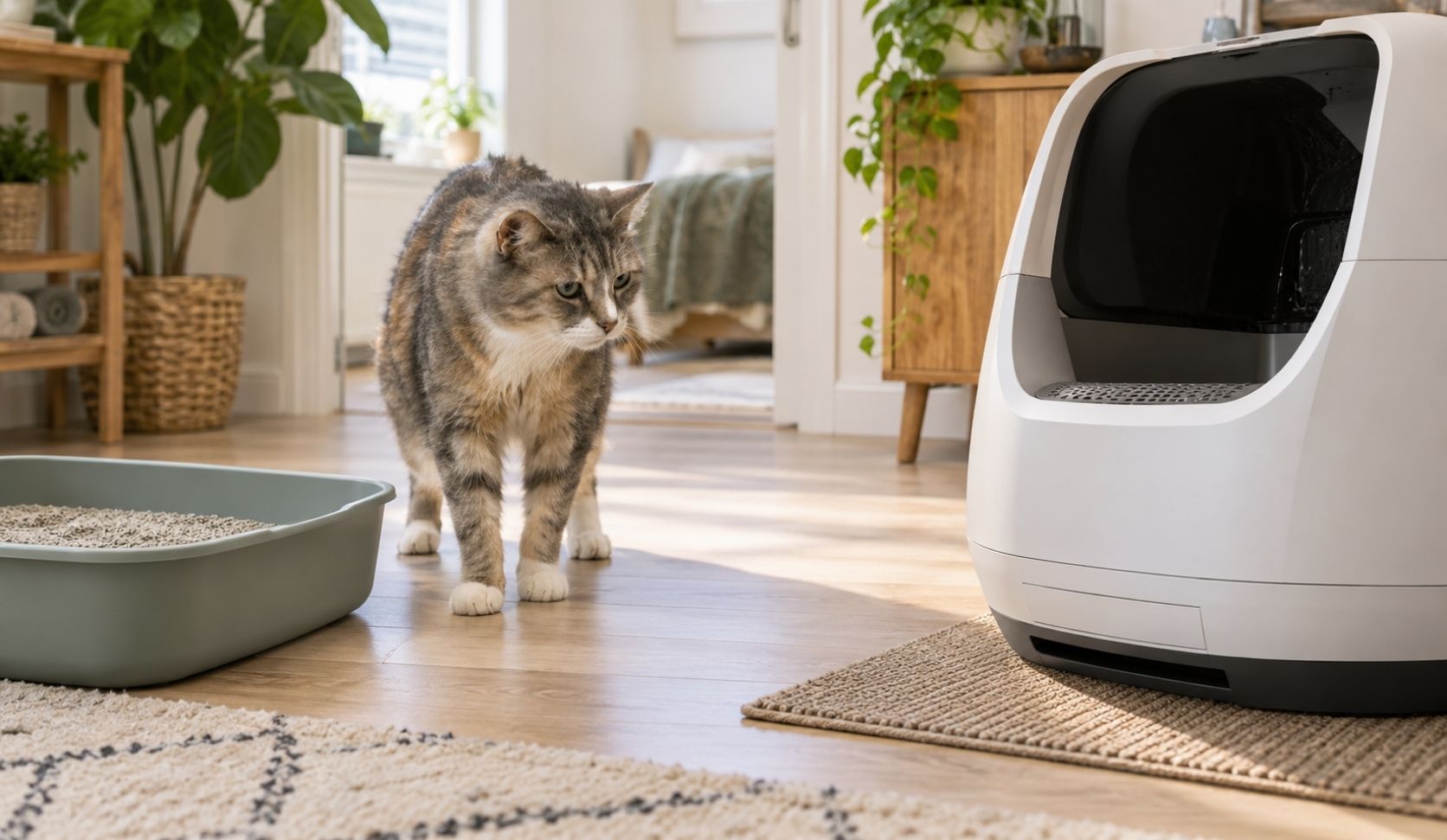
An automatic litter box is not automatically better for an older cat. The thing that decides it is entry height, and standard units are high, published figures put the typical step-in threshold at around 7 to 9 inches, while guidance for cats with stiff joints clusters at under 4 inches. That is not a small gap. For a cat with mobility trouble, the wrong automated box is genuinely worse than a plain low-sided pan, because a box that is hard to enter is a box that eventually gets avoided.
I am not a veterinarian and this is not medical advice. What follows is about geometry, and about what to watch for so you can take it to someone qualified.
Why a step hurts and a ramp does not
This is the part almost nobody explains, and it makes every other decision obvious once you have it.
A vertical step forces the cat to flex the hip past 90 degrees while bearing full body weight on the standing leg. That is a demanding movement for a joint that is already sore, and it is demanding in a specific way, the load and the flexion happen at the same instant, on one limb.
An inclined ramp changes both variables. The hip angle stays open, and the load spreads across all four limbs through the approach rather than concentrating on one. The cat is walking, not climbing. That is why a ramp is not merely "a gentler step", it is a different movement, and for an inflamed joint the difference is substantial.
Once you can see it that way, the rest follows. Height is the number people quote, but what actually matters is whether the cat has to lift and load simultaneously.
The numbers, and how much to trust them
| What | Published figure |
|---|---|
| Standard automatic unit step-in | ~7–9 inches |
| Point at which a stiff cat may stop using the box | over ~5 inches |
| Commonly recommended ceiling for seniors | under ~4 inches (some sources say up to ~12 cm / 4.8 in) |
| For severe mobility trouble, short legs, or heavy cats | under ~5 cm (2 in) |
| Senior-oriented automatic models | ~3–5 inches, or a ramp attachment |
Two honest caveats. First, these figures come mostly from vendor blogs, Meowant, CATLINK, furrbby and various roundups, with Vetstreet and Cats.com sitting a little further from the sale. Second, the sources do not agree with each other, which is why the ranges above are ranges. Treat them as a shape rather than a specification: well under five inches is the target, and lower is better the stiffer the cat.
What none of these numbers can tell you is your own cat's threshold. A 4-inch entry that one cat manages easily is too much for another on a cold morning.
What to watch for at the box
You do not need a measurement to see this. You need to watch her enter, a few times, at different times of day.
- Hesitation before entering, pausing at the threshold, gathering herself, or approaching and turning away.
- Scrabbling on the way in or out, back feet slipping, a scramble rather than a step.
- Half-in postures, front feet in, back feet out, or eliminating with part of her body outside the box.
- Going right beside the box rather than in it. This is the one people read as spite or protest. It very often is not.
- A change in how often she goes, in either direction.
Every one of those goes to a veterinarian, not to a shopping cart. Mobility change in an older cat is a medical observation, and so is any change in elimination, and both can have causes that have nothing to do with the height of a box. I can tell you what the geometry demands. I cannot tell you why your cat is finding it hard, and neither can a product page.
If the vet's answer is that she is stiff, then the box height becomes the actionable part, and that is where the next section applies.
What to do when the box you own is too high
You do not necessarily need to replace it.
A ramp is the first thing to try. Some manufacturers sell one for their unit; a stable, non-slip incline of any kind achieves the same geometry. Stability matters more than material, a ramp that shifts under her weight will be refused faster than the step was.
Keep a low-sided manual pan alongside, permanently. This is the advice I would give most strongly and the one that gets skipped because it feels like admitting the machine failed. It has not failed. It is doing the work for the cats who can use it comfortably while a pan covers the cat who cannot. In a multi-cat house that is barely a change, since the box-count question already points toward more than one location.
Look at the approach, not just the entry. A slippery floor in front of the unit makes the step harder than the step alone. A mat helps, and it helps with litter tracking at the same time.
Do not move the box to solve this. An older cat with a settled route does not benefit from relocation, and refusal has many causes that look identical from outside, when one cat in a multi-cat home stops using the box covers how tangled that can get.
And if you are still choosing a unit with an older cat at home, entry height belongs at the top of the list, above capacity and well above app features. The five-year account of living with these machines covers what actually matters day to day.
The same safety question exists at the other end of a cat's life, for very different reasons, kittens and very small cats are limited by sensor thresholds rather than by joints.
Frequently asked questions
Are automatic litter boxes good for senior cats?
Not automatically. Standard units have a step-in threshold of roughly 7–9 inches, while guidance for cats with stiff joints suggests staying under about 4 inches. A high-entry automatic box can be worse for an arthritic cat than a simple low-sided pan.
What entry height should a senior cat's litter box be?
Published guidance clusters under 4 inches, with some sources allowing up to about 12 cm (4.8 in) for most seniors and recommending under about 5 cm (2 in) for cats with severe mobility trouble. Sources vary, so treat these as a target rather than a specification.
Why is a ramp better than a low step?
A vertical step makes the cat flex the hip past 90 degrees while carrying full weight on one leg. A ramp keeps the hip angle open and spreads the load across all four limbs, which is a materially easier movement for a sore joint.
My older cat has started going next to the box. Is that the height?
It might be, but do not assume it. Going beside the box can have medical causes and needs a veterinarian rather than a new purchase. Rule that out first, then look at the geometry.
Should I replace my automatic box if my cat is getting older?
Not necessarily. A stable non-slip ramp, plus a low-sided manual pan kept alongside permanently, solves most of it without giving up the automatic box for the cats who use it comfortably.