
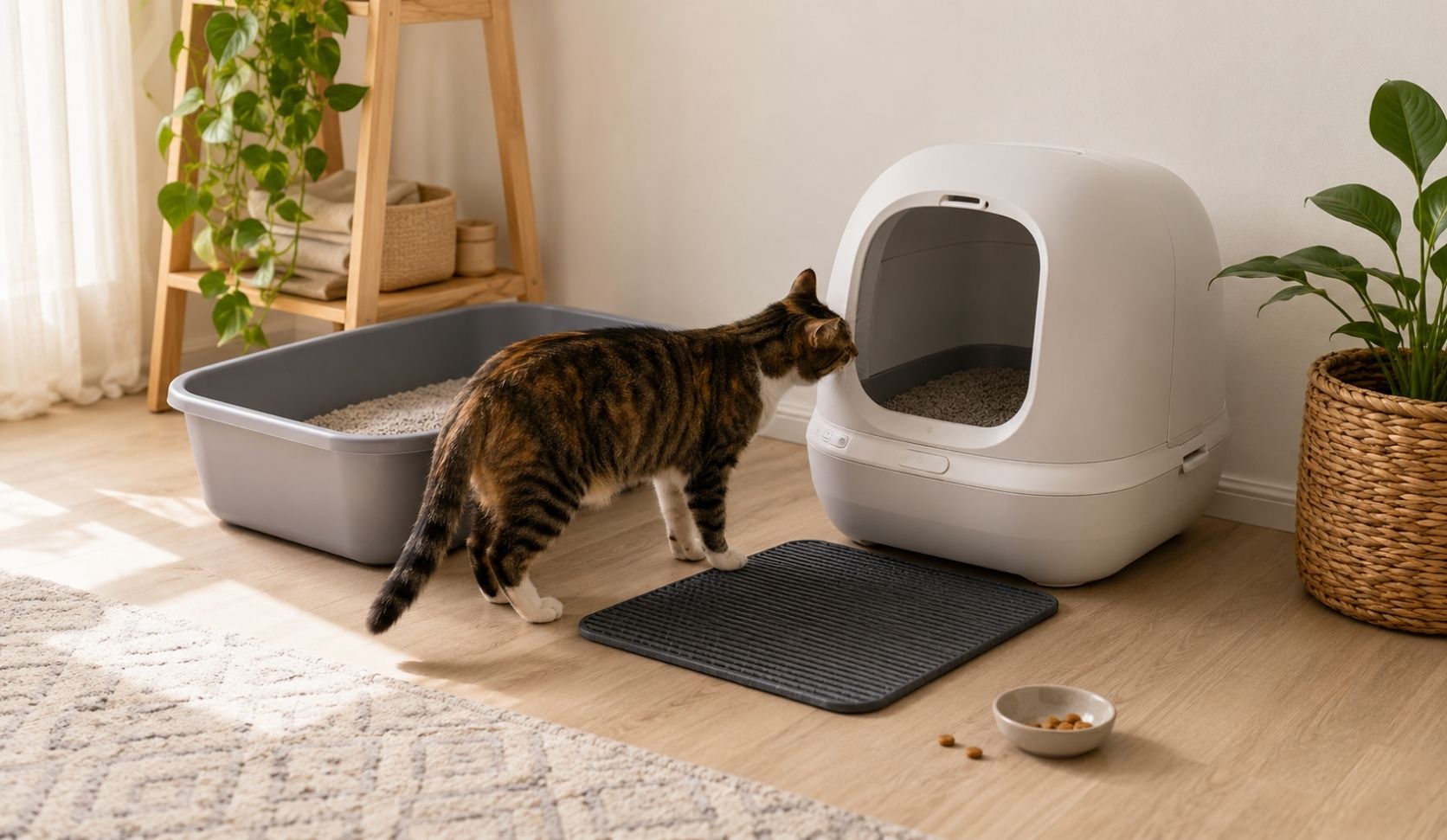
Short answer: Set the new box up turned off, right next to the old one, and fill it with the exact litter your cat already uses. Never pick your cat up and put it inside. Let your cat use it powered down for about a week, reward every visit, then run a cleaning cycle only when the box is empty so your cat learns the noise means nothing bad. Keep the old box the entire time. Most cats settle in within a few days to two weeks. A small number never do, and that is not something you did wrong. If your cat stops urinating or strains with little to no output, stop treating it as a training issue and call a vet the same day.
I have lived with automatic litter boxes in a multi-cat home for a long time, and I write about what fails, not just what the boxes promise on the packaging. So this guide covers the standard transition that genuinely works for most cats, then the part almost no one selling these devices will tell you: what it actually looks like when a cat is never going to accept one, and what your real options are at that point.
Why cats reject a self-cleaning litter box in the first place
A litter box is one of the few places a cat feels safe while completely vulnerable. Anything that makes that spot feel unpredictable can break the association. With automatic boxes, there are usually four culprits:
- Noise. The motor and the raking or rotating cycle are quiet to us and loud to a cat sitting inches away.
- Movement. A surface that shifts, tilts, or rotates on its own reads as "unstable" to an animal that wants firm footing.
- The enclosed feeling. Many automatic boxes are hooded or globe shaped, so a cat loses the open sightlines it relies on to watch for threats.
- A change in litter or texture. Some units only work well with a specific litter, and switching litter type at the same time as switching boxes is two changes at once.
The fix for all four is the same underlying idea: change one thing at a time, slowly, and let the cat decide the box is safe rather than trying to convince it.
The step-by-step transition plan (with a realistic timeline)
Do not rush this. The single most common reason a transition fails is an owner who removes the old box too early or runs the cleaning cycle before the cat trusts the unit. Here is the sequence that works.
| Stage | Roughly when | What you do |
|---|---|---|
| Setup | Day 1 | Place the new box, powered off, right next to the old box. Fill it with your cat's current litter. Do nothing else. |
| Free investigation | Days 1 to 3 | Let your cat sniff, step in, and explore on its own. Drop a treat or a little catnip near the entrance. Never lift your cat in. |
| Powered-off use | Days 3 to 7 | Reward calmly every time your cat uses the new box. Scoop it by hand for now so it stays clean and inviting. |
| First cycles | Around day 7 onward | Once your cat is using the box comfortably, run the cleaning cycle only when the box is empty, so your cat hears and sees it from a distance and learns it is harmless. |
| Retire the old box | After 2 or more days of steady use | When your cat has chosen the new box consistently, move the old box a bit farther away, then remove it. If use drops, put it right back. |
A few rules that hold the whole plan together:
Keep the old box available the entire time. This is not optional. A cat that does not fully trust the new box needs a known-safe alternative, or it will simply go on the floor. Removing the old box early is how owners create the exact problem they were trying to avoid.
Use the litter your cat already knows. If the unit needs a special litter, transition the litter first in the old box over a week or two, then move to the new box. Do not stack two changes.
Reward, never force. Positive association is the whole game. Forcing a cat into a moving box can create a lasting aversion that is much harder to undo than the original hesitation.
Give it about a week of calm before automation. Cats need time for stress to settle after a change. Running the motor on day one, while your cat is still deciding, is the fastest way to lose it.
Some manufacturers advertise that the large majority of cats acclimate, often citing a figure above ninety percent. Treat that as a manufacturer marketing claim, not an independent statistic. In real homes it is usually true that most cats adjust, but "most" is not "all," and the plan above matters precisely because your cat might be in the minority.
Multi-cat homes: shared box, individual verdicts
One detail the vendor guides skip: in a multi-cat home, acceptance is not a single yes or no. Each cat votes separately. It is completely normal for two cats to adopt the new box in a week while a third keeps using the old one for a month, or never switches at all.
That changes your math. The general rule for litter boxes is one per cat plus one, and an automatic unit counts as one box no matter how self-cleaning it is. If you have three cats sharing a single automatic box, a resource-guarding or nervous cat can get shut out even when the box itself is working fine. Watch which cat is actually using it, not just whether it is being used. If you are weighing a single automatic box against your cat count, our companion piece on whether a self-cleaning box is worth it for two cats (publishing soon) walks through the household math in detail.
Normal caution or a real problem? How to read your cat
Owners tend to panic at the harmless signs and under-react to the dangerous one. Here is how to tell them apart.
| What you see | What it usually means | What to do |
|---|---|---|
| Sniffing, circling, pawing the edge, hesitating for days | Normal caution. Your cat is investigating. | Keep going. Reward, stay patient. |
| Startling at the first cycle, then returning | Normal. The noise is new, not threatening. | Only cycle when the box is empty for now. |
| Using the old box but ignoring the new one after a week | Slow adopter, not a refusal yet. | Extend the timeline. Do not remove the old box. |
| Peeing or pooping just outside or near the box | A protest or aversion signal. | Slow down, keep the old box, rule out litter or placement issues. |
| Straining with little or no urine, frequent trips producing nothing, crying, or licking the genitals repeatedly | Possible urinary blockage. This is a medical emergency, not a behavior issue. | Call a vet the same day. In a male cat, treat it as urgent. |
That last row is the line you do not cross with patience or training. A cat that cannot urinate is a genuine emergency: a urethral obstruction, most common in male cats because their urethra is narrower, can become life threatening within roughly a day or two, according to the American College of Veterinary Surgeons and university veterinary hospitals. If your cat is straining and producing little or no urine, that is a vet visit today, not a box you keep tweaking. When in doubt, a cat that is holding it or going outside the box for more than a day is worth a call to your vet, because house soiling can have a medical cause underneath the behavioral one.
I am not a veterinarian and this site is not a medical resource. On anything that looks like it could be health related, defer to your vet quickly. It is cheaper to be wrong about an emergency than to be right about a training plan.
When acclimation just does not work: the honest part
Here is what the manufacturer pages leave out. Sometimes you run the plan perfectly, take three weeks, keep the old box, reward every visit, and the cat still will not use the automatic box. It happens. Certain cats never make peace with a surface that moves and hums under them, and no amount of patience rewires that.
The signs that you are heading toward a genuine no, rather than a slow yes:
- After two to three weeks of a patient transition, your cat is still using the old box exclusively and avoids the new one entirely.
- Your cat shows real stress around the unit: fleeing the room when it cycles, refusing to enter even when it is off, or eliminating elsewhere despite a clean, accessible new box.
- You have already ruled out the fixable causes: wrong litter, box placed somewhere loud or high traffic, cleaning cycle running while the cat is nearby, old box removed too soon.
If you have honestly worked through those and your cat is still refusing after several weeks, you are probably not going to win this one by waiting longer. Continuing to push at that point mostly just stresses the cat and risks pushing it to eliminate in worse places around the house.
Your options if a cat never accepts it
A refusal is not a dead end. You have several reasonable moves, and none of them is a failure:
- Keep a manual box for that cat. In a multi-cat home, the simplest answer is often the best: let the cats who accept the automatic box use it, and keep a plain box for the holdout. One stubborn cat does not mean the device was a mistake for the others. Our guide on what to do when one cat in a multi-cat home refuses the box (publishing soon) goes deeper on managing a split household.
- Try a different style of unit. Not all automatic boxes feel the same to a cat. An open, low, raking design is a very different experience from an enclosed rotating globe. A cat that hates one form factor sometimes accepts another. This is worth trying only if you can return the first unit or genuinely want a second device, not as an open-ended spending loop.
- Return it while you still can. Check the return window the day you buy, before you even open it fully. Many retailers accept returns within a set period, and some sellers list gently used units. If your cat has clearly refused after a fair transition, returning or reselling the unit is a completely rational outcome, not a waste. Knowing the window up front is what protects you.
- Rule out the box before blaming the cat. If the unit is jamming, smelling, or misbehaving, the cat may be reacting to a broken machine, not the concept. Our troubleshooting guide for a self-cleaning box that smells or stops working (publishing soon) covers the mechanical causes worth checking first.
The honest framing I wish someone had given me early: an automatic litter box is a convenience device, not a training obligation. If it does not suit a particular cat, the cat is not wrong and neither are you. Keep what works for the animal, and do not let the price of the gadget talk you into a fight your cat will not agree to.
FAQ
Is my cat refusing the box a health or stress sign I should worry about?
Usually it is behavioral: caution about noise, movement, or a new litter. But refusal can also be medical. If your cat is straining, urinating little or nothing, making frequent unproductive trips, crying, or repeatedly licking its genitals, treat it as a possible urinary blockage and call your vet the same day, especially with a male cat. When elimination changes suddenly, rule out a medical cause first.
How long should I give my cat before deciding it won't work?
Most cats adjust within a few days to two weeks. Give a patient, correctly run transition a full two to three weeks before concluding it is a real refusal, and only after you have kept the old box available and ruled out litter and placement problems.
Can I return a self-cleaning litter box my cat won't accept?
Often yes, if you act inside the return window. Check the retailer's return policy the day you buy it, keep the packaging, and do not force a weeks-long fight past the window. If your cat has clearly refused after a fair transition, returning or reselling is a reasonable outcome.
Does trying a second brand or style make sense?
Sometimes. A cat that rejects an enclosed rotating design may accept an open raking one, since they feel very different to the cat. Only try this if you can return the first unit or genuinely want a second box, not as a habit of buying until something sticks.
Should I ever remove the old litter box to force the switch?
No. Removing the old box early is the most common cause of a cat eliminating on the floor. Keep it until your cat has chosen the new box on its own for at least a couple of days, and put it back immediately if use drops.