
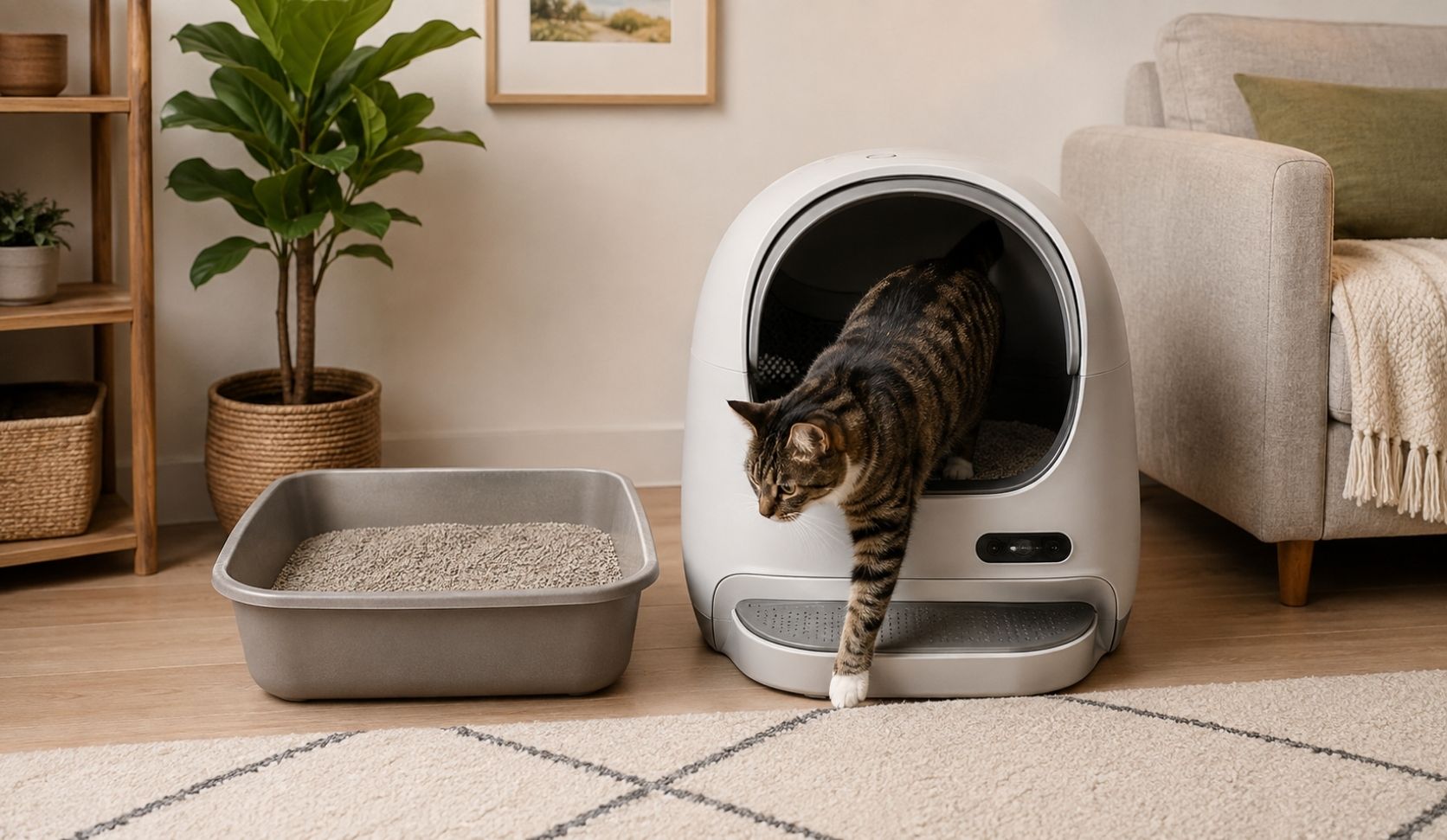
When I started running automatic litter boxes in my three-cat home, I thought I was being efficient. New box, new litter, all at once. Seemed logical. Then Mao started avoiding the box, and I couldn't figure out why. Was it the machine? The substrate? The location? I had changed three things and had no idea which one spooked him.
Here is the short answer: change the box first, keep the old litter inside it, and only switch substrate after your cat is reliably using the new machine. When you change both at once, you lose diagnostic information. If your cat balks, you cannot tell which change caused it, and recovery becomes expensive in time and stress. One variable at a time is not caution, it is the only way to get an interpretable answer.
The machine demands hard clumping clay. Your cat demands gradual change. These are both correct. But doing both changes simultaneously collapses them into a single unknown, and that unknown is harder to solve than either change in isolation. For context on running automatic boxes in a multi-cat environment, see the five-year multi-cat account.
Why Doing Both at Once Doubles the Risk
This is not about being extra cautious. This is about diagnosis.
Imagine your cat starts eliminating outside the box. Your first instinct is to troubleshoot: Is it the new box she doesn't like? Or is it the new litter? If you changed both, you now have two equally plausible explanations and no way to test between them. You might spend a week switching back to old litter in the new box, only to discover the real problem was the machine all along. Or you might abandon the automatic box entirely when the actual issue was the substrate. Each wrong guess costs you days.
When you change one variable at a time, every outcome teaches you something. If your cat uses the new box reliably with the old litter, you have succeeded at the hard part: the cat accepts the machine. That success is a platform. From there, switching litter is a contained experiment. You know the box works, so any new resistance points to the substrate.
This is what veterinary and behavioral researchers mean by "controlling variables." You are not being conservative; you are being methodical. The cats in my home taught me this the hard way. Leo accepted the automatic box in a week but fought the new litter for two weeks after. Deo was the reverse: tolerant of new litter but wary of the machine itself. Without changing them separately, I would have blamed the wrong component and possibly removed the box before Leo had a fair chance.
The Correct Order: Box First, Litter Second (and Why)
Start with the new automatic box. Fill it with the litter your cat is already using.
The box is the bigger change. It is mechanical, unfamiliar, possibly audible or mobile in ways your cat has not experienced. It is also the harder change to reverse. If your cat hates it, you can put the old litter back in an old-style box temporarily, but you cannot reasonably keep running an automatic machine full of incompatible substrate for weeks while your cat "gets used to it." The machine will not function.
By contrast, litter is litter. The box itself remains the same. Once your cat is reliably using the new automatic box (I would wait until elimination is consistent for at least a few days), then you can gradually introduce the substrate the machine requires. Use the guide at how to switch litter without breaking the sifter for the specific method. The substrate switch will be smoother because you have already removed the bigger variable.
The reason this matters: your cat's baseline comfort with the machine is now stable. Any new resistance you see is a signal that points cleanly to the litter. You can respond to it without doubt.
If you are unsure what litter your current box needs, or what the automatic machine requires, see what these machines need from a litter for the requirements and compatibility rules. Know this in advance so you do not create a crisis where the old litter is genuinely incompatible with the new machine.
The Exception: When Current Litter Cannot Carry Over
There is one circumstance where this sequencing breaks down: if your cat is currently using a substrate that will not work in an automatic machine at all.
Pine-based, pellet, or non-clumping litters will jam or escape an automatic box. If your cat is on one of these, you face a genuine constraint. You cannot fill an automatic machine with substrate that will damage it. In this case, you will have to introduce both the box and a compatible litter simultaneously, and accept that you are trading sequencing for necessity.
This is where the diagnostic cost comes due. You will have to move more slowly and watch more carefully. If your cat objects, you are back to uncertainty: box or litter? My suggestion here is to prioritize observation. Watch which box your cat gravitates to (the old one or the new one). Watch the positioning and posture. These behavioral cues can sometimes tell you whether the issue is the machine itself or just discomfort with a new substrate. But yes, you have lost the clean separation, and recovery will take longer.
If You Already Changed Both: How to Back Out
You are not in a failure state, but you do need to restart with one variable.
Go back to the old box and the old litter. Ensure your cat is reliably using it for several days. This resets your baseline and removes the diagnostic noise. Once she is confident again in the old setup, you can then introduce the new automatic box alone, using the old litter. Only after that transition is solid do you switch substrate.
This takes longer than the original plan. But the original plan, if it backfired, has already cost you time. You are not losing additional time; you are recovering interpretable information so the next attempt works. The setup at the week-one powered-off rule describes a controlled box-introduction method that works even after a failed dual-change.
The core principle remains: one variable at a time. You are not starting over from zero; you are starting over from the right place.
FAQ
Q: Does the box really need to go first?
A: Yes. The machine is the bigger and less reversible change. Once your cat accepts it with familiar litter, you have solved the harder problem. Litter can change later without disrupting that baseline.
Q: What if my cat is already using an automatic box and I want to change litter? Do I still need to go slowly?
A: Yes. The principle is the same. If your cat has one variable stable (the machine), you can change the other (litter) more cleanly and read the response clearly. See how to switch litter without breaking the sifter for the method.
Q: Can I use the old litter in the new automatic box, even if it is not the machine's preferred type?
A: If it will fit through the sifter without jamming, and your cat uses it, then yes, temporarily. You are buying time to observe the box acceptance before complicating things with a new substrate. Many automatic boxes tolerate a wider range of litter than the manufacturer's preferred type, but check what these machines need from a litter to know the limits beforehand.
Q: How long should I wait before switching litter after the new box is accepted?
A: There is no hard rule. I generally wait a minimum of a few days of reliable use, often longer. The point is not speed; it is stability. Once you are sure the box acceptance is solid and consistent, litter becomes the next controlled experiment.
Q: What if my cat starts eliminating outside the box after I introduce the new litter? Should I switch back right away?
A: Do not change two things in panic. Switch back to the old litter, confirm your cat returns to box use, and then retry the substrate change more gradually. Eliminating outside the box is a signal to slow down, not to keep pushing forward.