
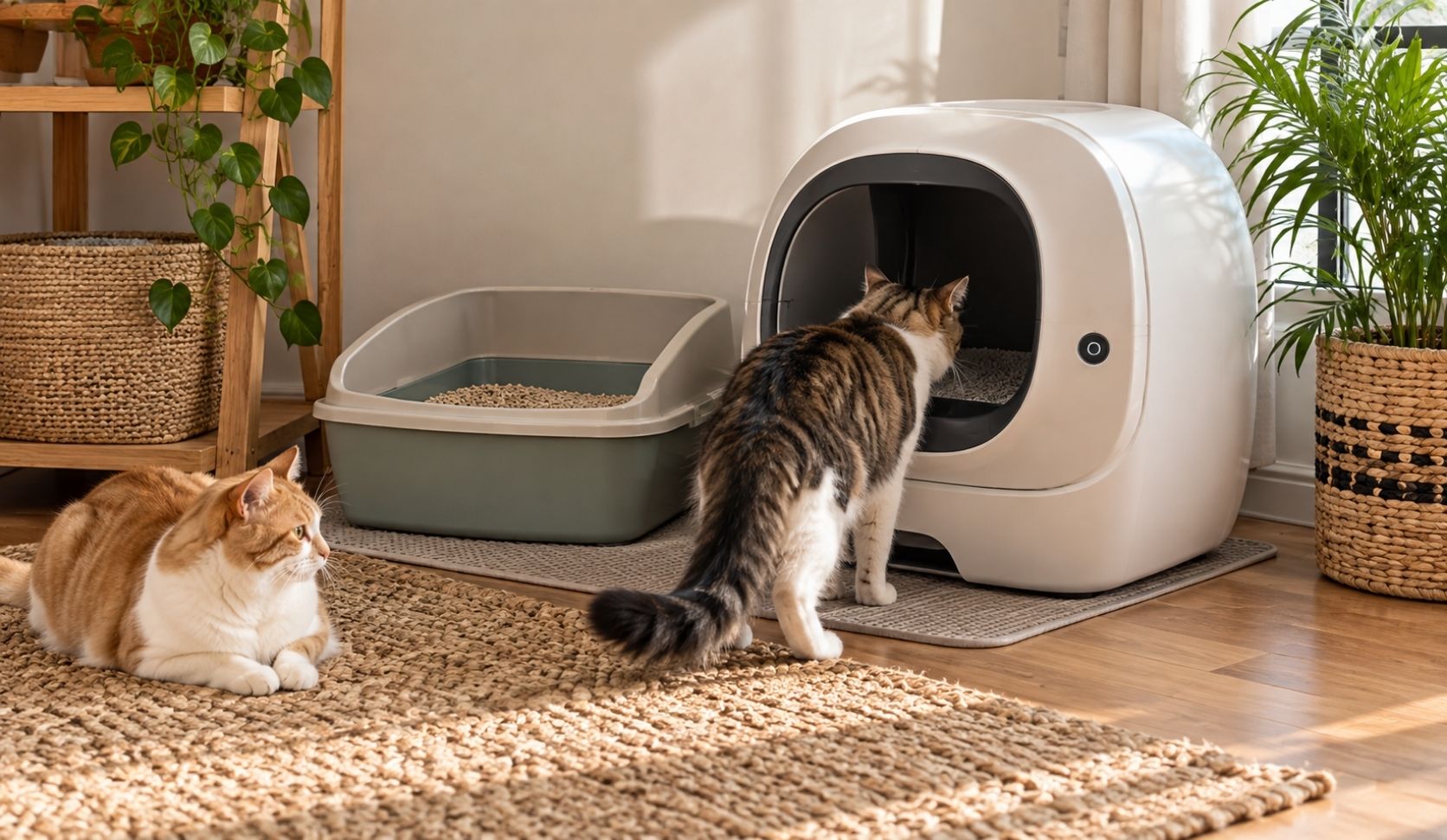
The honest answer on how to encourage a cat to use a new litter box is that encouragement works at the margin and never against a real objection. You cannot reward a cat past a reason. What actually moves her is subtraction rather than addition: her own litter in the new box, the box in the spot she already trusts, and whatever she dislikes taken away. Treats and praise help a little, they help most when they are used away from the box rather than on it, and one widely repeated tactic, putting food or treats on the box itself, can suppress use rather than encourage it.
This page is only about the encouragement question. The full introduction sequence lives in how to get a cat used to a self-cleaning litter box, and I am not repeating it here.
What every advice page agrees on
Credit where it is due, the mainstream guidance is broadly sound and worth stating before I argue with parts of it. Purina, Catster's vet-reviewed guide and Rover all converge on the same core: reward use with praise or a treat, keep the routine calm, use familiar litter, be patient for days to a couple of weeks, and never punish an accident. That last point is the strongest in the whole category. Punishment reliably increases anxiety around the box and makes avoidance worse.
Where I part company is on two of the tactics they recommend, and on how much credit the treats deserve at all.
The timing problem nobody mentions
Reinforcement works when the reward arrives close enough to the behavior for the animal to connect the two. That window is short, and litter box use is a private, unhurried activity that your cat prefers to do without you standing there.
Which produces a genuine conflict. To deliver a treat inside the useful window, you have to be present at the box, watching. Being watched at the box is one of the things cats dislike about a box. So the tactic that is supposed to build a positive association is delivered in a way that adds a mild negative one, and the treat you hand over thirty seconds later, once she has walked off, is a treat she connects to walking off.
That is why I put reinforcement at the bottom of the list rather than the top. It is not useless. It is just not the lever people think it is.
Why treats at the box can backfire
Cats separate eating from eliminating. It is the reason every reputable source tells you to keep food and water bowls away from the litter box, and it is why cats often reject a box placed near a feeding station.
Now look at the standard advice again: put treats on the steps of the new box, scatter treats around it, sprinkle catnip at the entrance. That advice asks the cat to treat one location as both a feeding site and a toilet. Some cats will eat the treat and use the box anyway. Some will eat the treat and then treat the area as a food place, which is the opposite of what you wanted, and a few will do neither.
If you want to use food, use it as a proximity reward rather than a location cue: treat her after she leaves the area, in the place you normally treat her, on the days she uses the new box. You are rewarding the cat, not decorating the box.
What actually encourages a cat to use a new litter box, in order
Her own litter, moved across. A scoop of used litter from the old box into the new one is the single most effective thing on this list. It converts an unfamiliar object into a place that already smells like her. Every vendor guide recommends it and they are right.
One change at a time. A new box and a new litter at once doubles the number of reasons for her to say no and removes your ability to tell which one she objected to. Why changing litter during the switch doubles the rejection risk is the long version, and it is the mistake I see most often.
The same location. Put the new box where the old one already is, not where you would prefer it. Location is its own rejection cause, and it is entirely separate from the box. Placement mistakes that cause rejection covers the five that come up most.
No moving parts yet. With an automatic unit, encouragement mostly means removing the thing that is scaring her, which is the cycle. Leave it powered off until she is using it without hesitation. The week-one rule is the whole method and it does more than any treat.
Privacy and a lack of audience. Leave the room. Do not narrate. A cat who is being supervised at the box is being given a reason to find somewhere else.
Access timing. She is most likely to go after a meal, after a nap and after play. You do not need to place her in the box for this, and you should not. Just make sure the route to it is open and the house is quiet at those moments.
Then, if you like, the treat. After she leaves, in the usual spot, delivered calmly. It does no harm and it makes you feel better, which is worth something during a stressful week.
What to stop doing
Do not put her in the box. Several guides recommend lifting the cat into the new box after meals. I would not. Being carried and placed is not neutral for most cats, and if the box is where the unwanted handling happens, the box becomes the thing she avoids. Let her walk in.
Do not punish, scold or clean up in front of her. This is the one universal in the literature. Punishment after an accident produces anxiety, and anxious cats eliminate outside the box more, not less.
Do not use scent sprays as a substitute for fixing the cause. Attractant products and calming diffusers are at best a small assist on top of a correct setup. They do not overcome a bad location, a frightening cycle or a litter she dislikes.
Do not restrict her to a small room with the new box to force the issue. Confinement is a tool for a specific medical or retraining situation directed by a vet, not a shortcut for a healthy cat who is hesitating about a machine.
If encouragement is not working
There is a point where more patience stops being the answer, and there is a point before that where this stops being a training question at all.
Rule out the medical cause first, always. A cat who avoids the box may be avoiding pain rather than the box. Straining with little or no urine, frequent trips to the box, crying while in it, or blood in the urine mean you call a vet immediately, and in a male cat a urinary obstruction is a same-day emergency. The medical red flags to rule out first sets out what to watch for and how urgent each sign is. No amount of encouragement outranks that call.
If she is medically clear, well introduced and still refusing after a fair run, the answer is not a better treat. It is a change to the setup, or an honest stop. I wrote when to give up on an automatic litter box because nobody selling these machines will write it, and stopping is a legitimate outcome rather than a failure of effort.
Frequently asked questions
Do treats actually work for litter box training?
They work as a general association builder and they are close to useless as a corrective. If a cat has a reason to avoid the box, a treat does not outweigh it. Use treats away from the box, after she has used it, and fix the reason separately.
Should I put catnip near the new litter box?
I would not. Catnip near the entrance encourages rolling, playing and lingering at a spot you want her to use as a toilet, and it puts a food-adjacent cue at the box. If you want to use catnip to build confidence with a new object, use it while the unit is powered off and before it is in service.
How long should I keep trying before something is wrong?
Give a well run introduction one to two weeks with the old box still available. If there is no progress at all in that time, stop adding encouragement and start checking causes: medical first, then litter, then location, then the machine itself.
Is it okay to praise her while she is using the box?
Keep it quiet or skip it. Most cats prefer to be left alone at the box, and a voice from the doorway is interruption rather than reward. Praise afterward, when she comes to find you.