
The Short Answer
Stop trying when your cat's response to the box has stopped changing, not when a certain number of weeks has passed. A cat that is slow but still edging closer, sniffing longer each session, or using the box for part of the day and the old one for the rest, is still moving, even if the pace is frustrating. A cat whose behavior today looks identical to its behavior two weeks ago, no closer, no more curious, no less avoidant, has not slowed down. It has stalled. Movement versus no movement is the entire rule, and the rest of this piece explains how to check it properly.
Why "Keep Being Patient" Stops Being Useful
Standard advice, and it is not wrong, groups cats into rough temperament bands. Confident cats often adjust within the first week, cautious ones can take one to three weeks, and anxious or senior cats can take three to six weeks or longer, and none of those slower timelines are a sign anything has gone wrong. That advice is genuinely useful early on, and abandoning a transition on day four because progress looks slow would be a mistake.
But "keep being patient" was written to cover the many cats who are still moving somewhere inside those bands, not the cats who stopped moving entirely. Advice built for a slow-but-working transition gets stretched to cover a transition that quietly stopped working, because nobody wrote the sentence for the difference. Every vendor guide I have read ends the same way: try again, give it more time, stay patient. None of them tell you what to do once patience stops changing anything, because that sentence does not sell a unit. That is the gap this piece exists to close.
The Stopping Criteria
This is the actual rule, and it has nothing to do with a calendar. Acclimation timelines already vary enormously by temperament, days for one cat, weeks for the next, so counting weeks tells you almost nothing about whether a specific transition has failed. What tells you something is whether your cat's response is still changing.
Check these against your own cat's behavior, not a schedule:
- No directional change. The cat is not investigating more, entering more, or lingering longer than it did at the start. Every reset (automation off again, box cleaned, nothing else touched) produces the identical result.
- Avoidance is spreading, not shrinking. Instead of narrowing to just the box, the avoidance has widened to the room it sits in, or to litter use in general. That second pattern is also a reason to check the medical section below first, not last.
- The stress response repeats at full intensity. A startled first encounter is normal, but a cat that still flinches, bolts, or refuses to approach on the tenth attempt exactly as it did on the first is not adjusting.
- Every fixable variable is already controlled for. You changed one thing at a time, ruled out the causes below, and the response still has not moved.
- The cat has a working alternative. A second, manual box that gets used normally means your cat's needs are being met elsewhere, so retiring the automatic unit becomes a decision about the machine, not about your cat's wellbeing.
I learned the first of those the hard way. An enclosed unit I bought for its reviews, not for Mao's temperament, sat unused so long that I kept telling myself the timeline was still open. It was not. Nothing about his response ever changed, session to session, week to week. Comparing week one against week six side by side showed the identical flat refusal both times. I had just kept asking "how much longer" instead of the right question, "has anything actually changed."
If two or more of the criteria above are true for your cat, and you have ruled out the fixable causes in the next section, you are no longer looking at a slow transition. You are looking at your answer.
What You Should Have Ruled Out First
None of the criteria above are trustworthy until you have controlled for the fixable reasons a cat stops, not just the temperamental ones. Four checks matter most, and skipping any one can make a fixable problem look like a permanent refusal.
Medical. Any change in litter box behavior, especially straining, frequent trips, or crying, needs a veterinarian before anything else, not another week of the transition plan. This is not optional, and it is not behavioral until a vet says it is not medical. Pause every other step on this list until that call has been made.
Placement. A box in the wrong spot, too exposed, too loud a location, too far from where the cat already feels safe, produces refusal that looks exactly like temperament and has nothing to do with it. Moving the unit is the cheapest fix available and the most commonly skipped one.
Litter. Changing the litter type at the same time you introduce the box means you are testing two variables at once, and you will not know which one your cat is actually rejecting. If litter changed alongside the unit, revert the litter first and watch what happens before deciding the box itself is the problem.
Method. A cat introduced to a box running its full automated cycle from day one gets a fundamentally harder test than a cat given a quiet first week with the automation switched off. If that method was never followed properly, the transition has not really been given a fair run yet, no matter how many weeks have gone by.
Only once all four are genuinely controlled for, not just considered, does a flat, unchanging response mean what the checklist above says it means.
Stopping Is an Outcome, Not a Failure
Once the fixable causes are ruled out and the checklist still points the same direction, stopping is not a failure of effort. It is information. Some cats and some machines are simply not a match, the same way some cats never tolerate a carrier or a harness no matter how correctly you introduce it. That is a fact about the individual cat, not a verdict on how hard you tried.
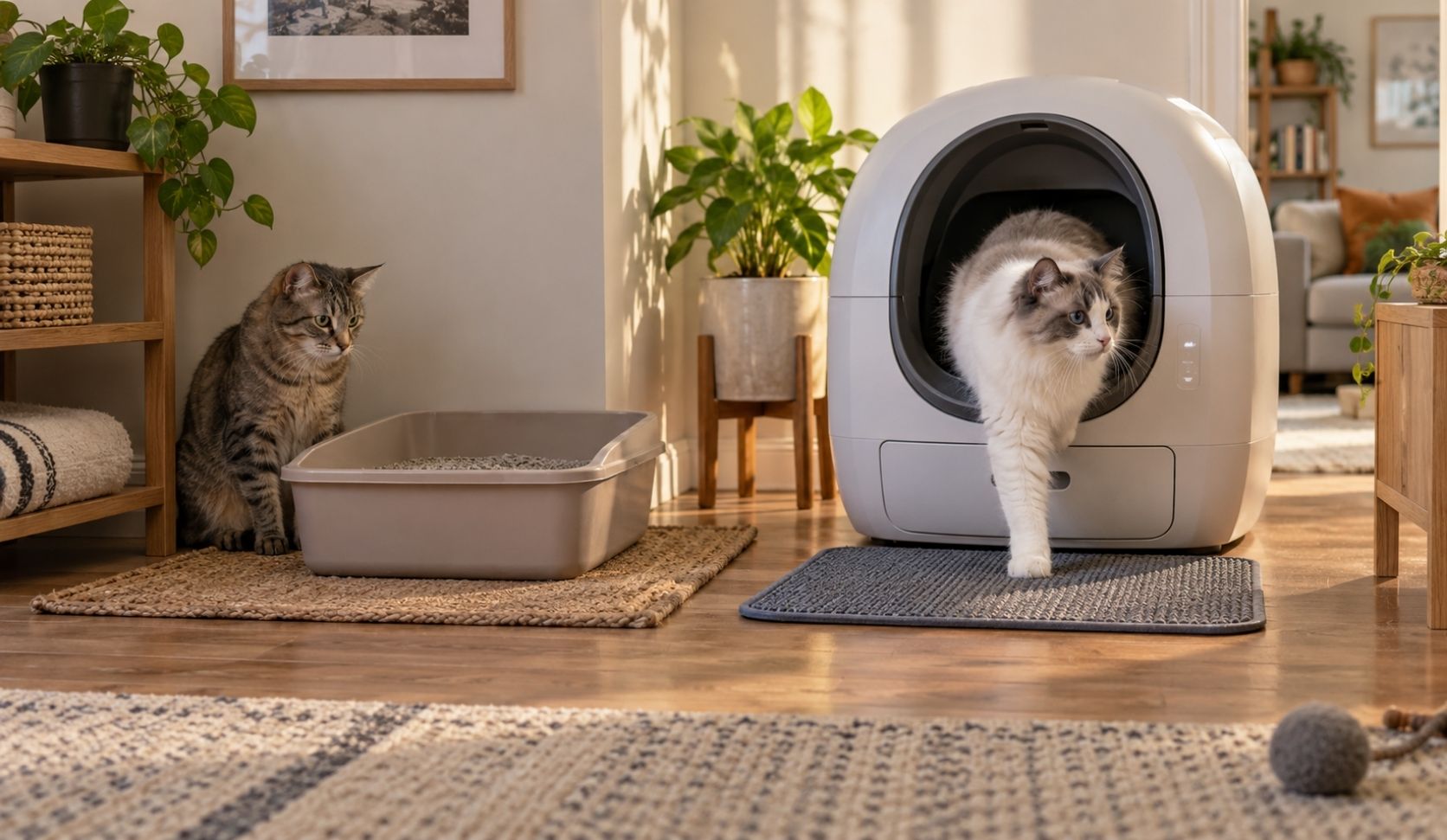
What stopping looks like in practice is usually one of two honest paths, not a single verdict. Some owners return or resell the unit, if it is still within a return window or resalable, closing the chapter cleanly. Others keep the unit running for the cats who do use it and simply add a manual box, permanently, for the one who does not. In a three-cat home like mine, that second path is closer to the actual design than a compromise: not every cat has to use the same equipment for the household to be well served. I will cover both paths properly, returning or reselling a rejected unit, and what a permanent hybrid setup looks like day to day, in pieces of their own soon.
For now, the only thing worth carrying forward is this: a cat that never adjusts is not a verdict on you, on the cat, or on the money already spent. It is one data point about one pairing of one cat and one machine, and the checklist above is how you tell that data point from an excuse to quit too early.
Frequently Asked Questions
How is a "stalled" cat different from a "slow" cat?
A slow cat is still changing: sniffing longer, entering further, using the box for part of the day. A stalled cat looks the same today as it did weeks ago, no closer, no more curious, no less avoidant, no matter how many resets you try.
Is it normal for a cat to never accept an automatic litter box?
It is not the most common outcome, but it is a real one, and it happens for reasons that have nothing to do with how well you handled the introduction. Some individual cats and some individual units are simply not a match.
Should I try a different automatic litter box before giving up completely?
That is a fair question once the checklist above genuinely points to stalled, not slow, but it is a separate decision from this checklist, not something to fold into it. Ruling out placement, litter, and method first matters more than swapping hardware.
What if only one cat in a multi-cat home refuses the automatic box while the others use it fine?
That is a narrower question than a full stop, and it usually resolves differently, since the other cats' success already rules out most device-level explanations.
Does giving up mean the money already spent was wasted?
No. It bought real information about this specific cat, and a working manual routine for the cat who does not use the automatic unit is not a loss. It is the household working as it actually needs to.