
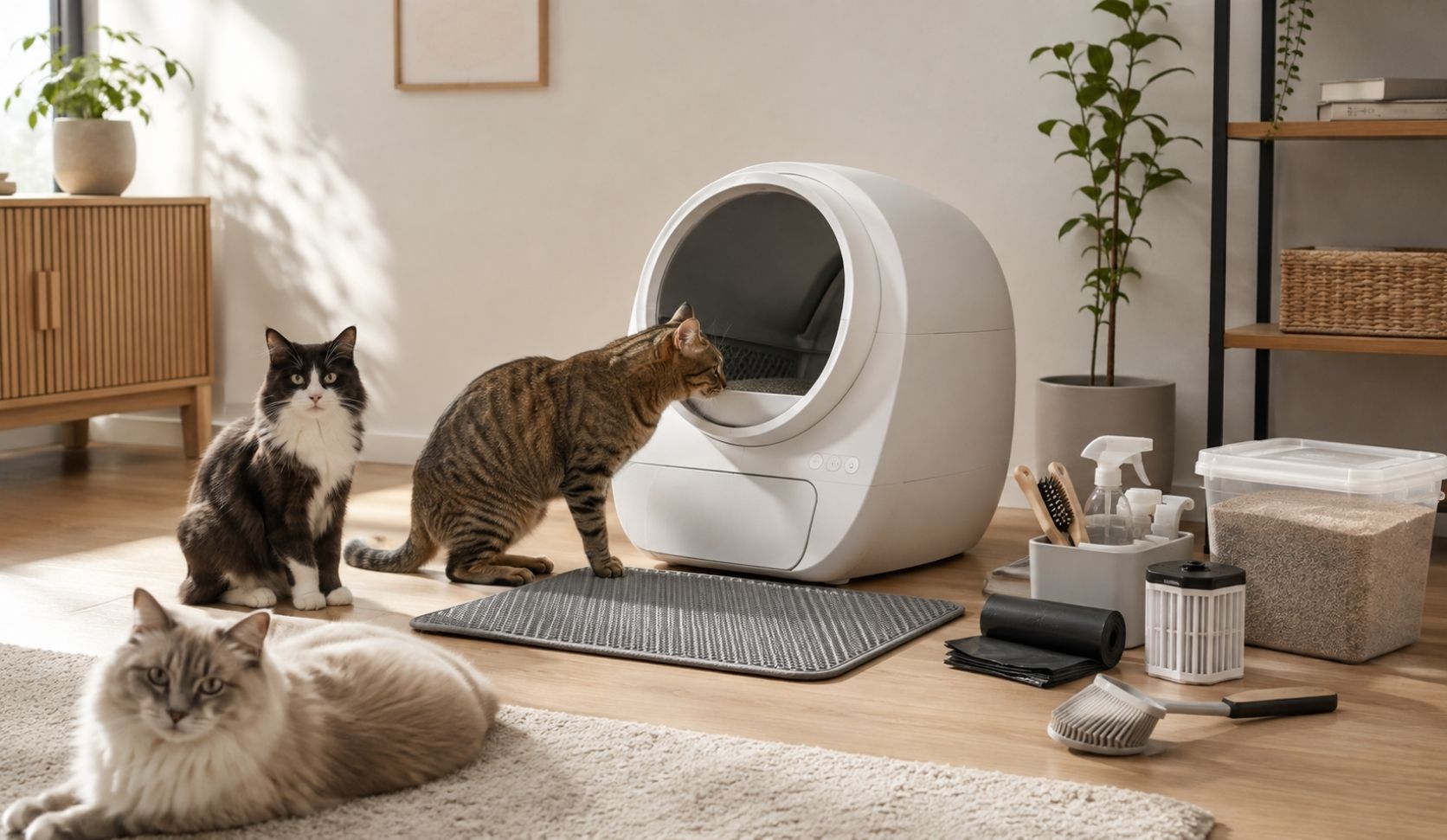
A self-cleaning litter box still needs a maintenance schedule. Here is the short version. Every day, glance at the waste drawer and clear anything the rake missed. Empty the waste drawer every 1 to 4 days depending on how many cats use it. Do a full litter change every 2 to 4 weeks. Deep-clean the whole unit with unscented soap every 1 to 3 months, wiping the sensors and swapping any carbon filter while you are in there. The more cats you have, the more each of those numbers moves toward the frequent end. "Self-cleaning" automates the scooping. It does not eliminate the upkeep.
I run automatic litter boxes in a multi-cat home, and the single biggest misunderstanding I see is that people expect to buy the machine and forget it. That is not how these units work, and skipping the upkeep is exactly what leads to the smell, the error lights, and the surprise repair costs people blame on the product later. Here is the real schedule, and, more usefully, why each task matters and how it scales with the number of cats in your house.
The daily 30-second check nobody should skip
Every day, look at the unit. That is the whole task. You are checking two things: is the waste drawer close to full, and did the last cycle actually finish cleanly. A rake or sifting mechanism can leave a clump behind, especially in a busy multi-cat house where cycles fire back to back. Thirty seconds of eyes-on tells you whether the machine kept up.
This check matters more than it sounds. When a waste drawer packs full, the sensor can misread it, the unit can pause mid-cycle, and odor climbs fast. Catching that on day one instead of day four is the difference between a wipe and a full teardown clean.
Emptying the waste drawer: this is where cat count changes everything
Most manufacturer and industry guidance lands on emptying the waste drawer somewhere between every 2 and 7 days. That range is so wide because it is trying to describe every household at once. In practice, the number is driven almost entirely by how many cats deposit into the same drawer.
Here is a starting-point schedule scaled by household size. Treat it as a baseline to adjust to your own cats, not a rigid rule, since litter type, cat size, and diet all shift the numbers:
| Household | Empty waste drawer | Full litter change | Deep clean unit |
|---|---|---|---|
| 1 cat | Every 3 to 4 days | Every 3 to 4 weeks | Every 2 to 3 months |
| 2 cats | Every 2 to 3 days | Every 2 to 3 weeks | Every 6 to 8 weeks |
| 3+ cats | Every 1 to 2 days | Every 1 to 2 weeks | Every 4 to 6 weeks |
Notice that going from one cat to three is not a small bump. It roughly triples the waste load, and it also pushes the deep clean and litter change to the frequent end, not just the drawer emptying. That last point is the one people miss, and I cover it in its own section below. If you are still deciding whether one unit can handle a two-cat load at all, that is a separate calculation worth doing before you buy (see the linked piece on whether an automatic box is worth it for two cats (publishing soon)).
Full litter changes: how often, and the signs you waited too long
Emptying the drawer removes clumps. It does not refresh the litter that stays in the globe or bowl. Over time, fine dust, moisture, and missed urine coat the remaining litter and stop it clumping properly, which is what actually causes the lingering smell people assume is a broken unit.
General guidance is a complete litter change every 2 to 4 weeks. Multi-cat homes and heavy users should sit at the 2-week end. You will know you waited too long when you see any of these:
- Clumps that crumble or stick to the bottom instead of lifting clean
- Odor that returns within hours of a cycle finishing
- Litter that looks damp or gray even right after the machine runs
- A cat starting to hesitate at the entrance or eliminating just outside the box
That last sign is the important one, and it is a health signal, not just a housekeeping one. More on that below.
Deep-cleaning the unit: what it involves and what happens if you put it off
A deep clean is a full teardown: empty all the litter, remove the globe, bowl, or drum, and wash the surfaces the litter touches with warm water and unscented soap. Wipe down the rake or sifting mechanism, clean the drawer, and let everything dry fully before you reassemble and refill. Skip scented cleaners and never use bleach unless the manufacturer specifically allows it, because residue can irritate a cat or, worse, put them off the box entirely.
The general schedule is every 1 to 3 months. If you put it off well past that, waste film builds up in the seams and on the mechanism, and that is where three problems start: persistent odor that no amount of drawer-emptying fixes, sensors that misfire because they are coated in dust, and mechanical strain as the rake drags through gummed-up litter. A unit that gets deep-cleaned on schedule is a unit that does not throw the errors people mistake for a defect. If your box is already acting up, work through the litter box smell and not-working troubleshooting checklist (publishing soon) before you assume it is broken. Nine times out of ten in my experience, the fix is a maintenance step that got skipped.
Sensor and mechanism checks: the step most owners forget exists
This is the maintenance task almost no generic schedule spells out, and it is the one that prevents the expensive surprises. Automatic litter boxes rely on weight or infrared sensors to know when a cat entered, when to cycle, and when the drawer is full. Those sensors sit right in the path of dust and litter, and when they get coated, the unit starts behaving strangely: cycling when no cat is present, refusing to cycle, or reporting a full drawer that is nearly empty.
About once a month, and always during a deep clean, gently wipe the sensor area and the contact points per your model's manual, check that the rake or drum moves freely by hand with the power off, and make sure nothing is wedged in the mechanism. A carbon or charcoal filter, if your unit uses one, is also a monthly-to-quarterly swap; a saturated filter does nothing and lets odor through. None of this takes long, and it is far cheaper than a service call for a "fault" that was really a dusty sensor.
The honest part: "self-cleaning" does not mean maintenance-free
No one selling these units frames it this way, so I will. Self-cleaning describes one job: the machine scoops for you between visits, which is genuinely worth it, especially if you are away from home a lot. It does not empty its own drawer, it does not change its own litter, it does not wash itself, and it does not clean its own sensors. Every one of those still lands on you.
There are two things buyers underestimate specifically. First, multi-cat homes do not just fill the drawer faster; they wear the unit faster. More cycles per day means more mechanical use and more moisture in the globe, so the deep clean and the litter change move up in frequency too, not only the drawer emptying. Second, the maintenance is not optional in the way manual-scooping shortcuts sometimes are. When the machine's sensors and mechanism depend on clean surfaces, a skipped deep clean does not just smell; it can stop the automation working at all. The convenience is real, but it is convenience with a maintenance contract attached.
Why staying on schedule is a health issue, not just a chore
A clean box is not only about your nose. Cats are fastidious, and a box that gets too dirty becomes aversive. When that happens, many cats hold their urine longer than they should or stop using the box, and veterinary sources link a consistently dirty box to litter box avoidance and to lower urinary tract problems. Holding urine and box aversion are associated with conditions like feline lower urinary tract disease, and urinary blockage in male cats is a genuine emergency. If your cat suddenly avoids the box, strains, or cries in it, that is a vet visit, not a cleaning problem. I am not a veterinarian and this site is not a medical resource; treat any change in your cat's bathroom habits as a reason to call one.
One more honest note, because it is a health point people should hear plainly. If you are pregnant, the CDC advises avoiding handling cat litter and waste because of the risk of toxoplasmosis, a parasite spread through cat feces. Have someone else do the drawer and deep-clean tasks if you can. If you must do it yourself, wear disposable gloves, wash your hands thoroughly afterward, and empty waste promptly, since the parasite is not infectious for the first day or so after it is shed. An automatic box reduces contact but does not remove this precaution.
Your self-cleaning litter box maintenance schedule at a glance
Keep this near the box. It folds the whole schedule into one printable glance:
| Frequency | Task | Why it matters |
|---|---|---|
| Daily | Glance at drawer level; confirm last cycle finished clean | Prevents overflow, jams, and fast odor buildup |
| Every 1 to 4 days | Empty the waste drawer (frequent end for more cats) | Full drawers misread sensors and stall cycles |
| Every 2 to 4 weeks | Full litter change (2 weeks for multi-cat) | Old litter stops clumping and holds odor |
| Monthly | Wipe sensors, check mechanism moves freely, swap filter | Prevents misfires and false faults |
| Every 1 to 3 months | Deep-clean whole unit with unscented soap | Prevents film buildup, odor, and mechanical strain |
Adjust the frequent end up for every additional cat. If you are onboarding a nervous cat to the unit for the first time, a spotless box helps acceptance, and the transition guide for a cat afraid of the automatic box (publishing soon) walks through that separately.
FAQ
What happens if I skip a deep clean for six months?
Waste film builds up in the seams and on the mechanism, litter stops clumping cleanly, and dust coats the sensors. The practical result is persistent odor that drawer-emptying will not fix, cycles that misfire or stall, and added mechanical strain. Many "broken unit" complaints trace back to a long-overdue deep clean rather than an actual defect.
Do more cats mean more frequent deep cleans, or just more drawer emptying?
Both. More cats obviously fill the drawer faster, but they also run more cycles and put more moisture into the globe, so the litter change and the deep clean move to the frequent end too. A three-cat home is not a one-cat schedule with a fuller drawer; it is a faster schedule across every task.
Can I use scented cleaner or bleach to deep-clean it?
Stick to warm water and unscented soap. Scented cleaners leave residue that can put a cat off the box, and bleach should only be used if your unit's manufacturer specifically allows it. Rinse well and dry fully before refilling.
Does an automatic litter box mean I never touch cat waste again?
No. It scoops between visits, but you still empty the drawer, change the litter, and deep-clean by hand. It reduces contact, which matters for anyone who needs to limit handling waste, but it does not remove the maintenance or the standard hygiene precautions.
How do I know I am emptying the drawer often enough?
If odor returns between empties, or the drawer looks near full when you check it, shorten the interval. Start from the schedule above for your cat count and adjust toward the frequent end until the box stays fresh and your cats keep using it without hesitation.