
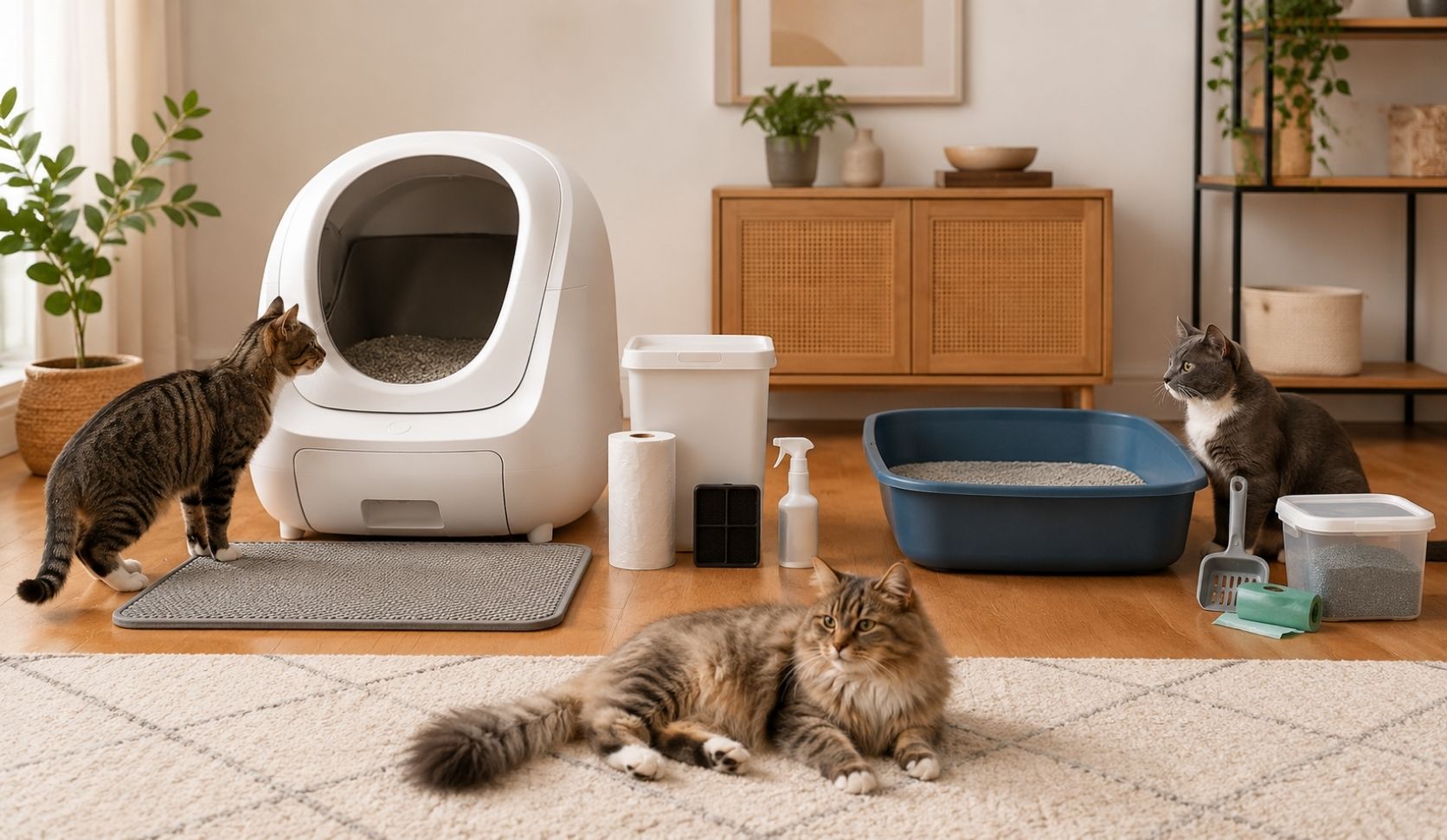
On self cleaning litter box cost vs manual, the honest answer is that the machine costs meaningfully more to buy and lands in roughly the same monthly range to feed. What decides the difference over years is not the sticker price. It is three things: whether the unit takes ordinary clumping clay or a proprietary consumable, how much clean litter it throws away on every cycle, and how long the manufacturer keeps selling parts for it. I am not going to hand you a total, because a total built from someone else's cats and someone else's litter is not a number you can spend.
Why I will not publish a single number
Every page that ranks for this query gives you a confident total. They disagree with each other, none of them shows the arithmetic, and none of them says whose cats produced the figure. A two-cat household running clumping clay in an open-drum unit and a one-cat household running a tray-based system are not the same purchase, and averaging them produces a number that describes nobody.
So this is a worksheet instead. Fill in your own numbers from your own receipts and you will get an answer that is actually about your house. It takes about ten minutes and it beats any total I could invent.
The five cost lines, side by side
| Cost line | Manual setup | Automatic unit | Notes |
|---|---|---|---|
| Purchase | One-off, low, replaced every few years | One-off, the largest single line in the comparison | The only line where the gap is dramatic |
| Litter | What your cats use, plus what you scoop out | What your cats use, plus what the machine sifts out | See the section below. This is the line people get wrong |
| Proprietary consumables | None. A liner if you want one | Waste drawer liners, carbon filters, or a full disposable tray, depending on the design | The swing variable |
| Parts and wear | A cracked pan, a lost scoop | Rakes, seals, sensors, drawers | Failure modes are covered in the parts article below |
| Your time | Daily, every day, forever | Weekly emptying plus a scheduled teardown | Time is a real cost, just not a billable one |
Run those five lines for the same period on both sides. Whatever period you pick, use the same one for both, and be honest about the last line.
The variable that swings it most: proprietary consumables
This is the thing the comparison articles skip, and it matters more than the purchase price.
Automatic litter boxes split into two families. One family is designed around ordinary clumping clay that you buy anywhere, in whatever brand is on offer that week, and sifts it into a waste drawer. The other family is designed around a consumable the manufacturer sells. PetSafe's ScoopFree line is the clearest example of the second type: it uses a disposable crystal litter tray that you remove and throw out as a unit, and PetSafe states on its own product pages that one tray can serve a single cat for up to a month. That is a clean, predictable, genuinely low-effort system, and it is also a subscription in everything but name, with a replacement cadence that multiplies by the number of cats using it.
Neither design is wrong. But they produce completely different cost curves, and a comparison that averages them is useless. Before you compare anything, answer one question: over the life of this unit, can I buy the consumable from anyone other than the company that sold me the machine? If the answer is no, your running cost is set by that company's pricing decisions, not by yours.
Units in the first family have their own constraint: they are built as sieves, and they are built around hard clumping clay specifically. That is not a preference, it is a mechanical requirement, and it is why the litter you can actually use in an automatic box is a narrower list than the litter aisle suggests.
The litter line nobody separates
Here is the arithmetic that surprised me most in years of running these machines with three cats.
Your litter spend is not one number. It is two. There is the litter your cats use, which is roughly the same whether you scoop by hand or a motor does it. And there is the litter that leaves the box without being used, which is different between the two setups and which nobody separates out.
A hand scoop is selective. You lift the clump, you tip the loose granules back, and the rest of the bed stays. A rake or a sifting drum is not selective in the same way. Every cycle carries some clean litter out with the clump, and a fine or lightweight litter loses more of it than a coarse one. That waste is invisible because it looks like normal litter consumption, and it shows up as "the automatic box goes through litter faster than I expected" rather than as a line item.
Two things reduce it. Medium granule hard clumping clay, because coarse granules fall back through the sieve rather than riding out with the clump. And filling to the manufacturer's fill line rather than above it, because an overfilled bed produces shallower clumps that break apart during the cycle. If your automatic box seems expensive to feed, that is where to look first, before you conclude the machine is wasteful by nature.
The costs that arrive after year one
The first twelve months of an automatic box are the cheapest twelve months you will have with it. After that, small parts start to matter, and they are the reason ownership cost is not a flat line. Rakes and seals get abrasive wear. Sensors get dirty and eventually get replaced. Waste drawers crack at the hinge. None of that is a defect, it is a machine doing its job, and I have written up what actually wears out and in what order separately so this page does not turn into a failure catalog.
The two questions to ask before you spend, both of which the manufacturer can answer in writing:
- Which components are sold as replacement parts, and for how long after a model is discontinued?
- What does the standard warranty cover, and for how long? Whisker, for example, publishes a one year standard warranty on Litter-Robot with a longer plan sold separately. Terms vary by manufacturer and by region, and they change, so check the current terms rather than trusting a page like this one.
Electricity belongs on the list for completeness. These units hold a small standby draw and run a motor for seconds at a time. It is a real line and it is the smallest one here. I have never seen it change anyone's decision.
The safety line that is not about money
Before any purchase decision, there is a constraint that no cost worksheet covers. Automatic boxes carry a crush and entrapment risk for cats the sensors are not designed to detect: kittens, very small adults, and cats that go back in mid cycle. Manufacturers publish a minimum weight for automatic operation for exactly this reason. Whisker states that the Litter-Robot 4, 5 and EVO SmartScale will not recognize a kitten under 3 lb (1.3 kg), and that units should be run in semi-automatic mode below that. The older Litter-Robot 3 carries a higher floor. Check your own model's published figure, and if your cat is under it, the honest answer is that the purchase waits. I go through the thresholds and the semi-automatic workaround in kittens, small cats and the weight limit.
When manual genuinely wins on money
A settled single cat in a household that is home most days is the clearest case where a manual box wins on cost and loses nothing else. The scooping is two minutes, the equipment is cheap, and there is nothing to fail. I make that case at length in is a self-cleaning box overkill for one cat, and I mean it.
The case flips when the labor is the problem rather than the money: multiple cats, an unpredictable schedule, a mobility limitation, or a household where the scooping quietly stops happening on the days it matters. That is a real return on the purchase, and it is time rather than money, which is why the cost comparison alone never settles it. For the multi-cat version of the whole picture, the five year, three cat account is the long version.
Frequently asked questions
Does an automatic litter box save money on litter?
Not reliably. It changes how litter is consumed rather than how much your cats produce. Some households spend slightly less because the box is maintained more consistently. Others spend more because clean granules ride out with each clump. Track it for two months on your own receipts before assuming either direction.
Is the purchase price the main difference?
It is the largest single line, but it is a one-off. Over several years the recurring lines, litter and proprietary consumables, are what actually separate the two setups. A cheaper unit with a locked consumable can cost more than a pricier unit that takes any clumping clay.
How do I compare two automatic units on running cost?
Ask one question of each: can I buy the consumables from someone other than the manufacturer? Then ask which parts are sold as spares and what the warranty covers. Those three answers predict running cost better than any feature list.
What if my cat rejects it after I have paid?
That is a real cost line and it belongs in the worksheet before you buy, not after. Check the return window and the return conditions published by the manufacturer or the retailer you are buying from, in writing, while you can still act on them.