
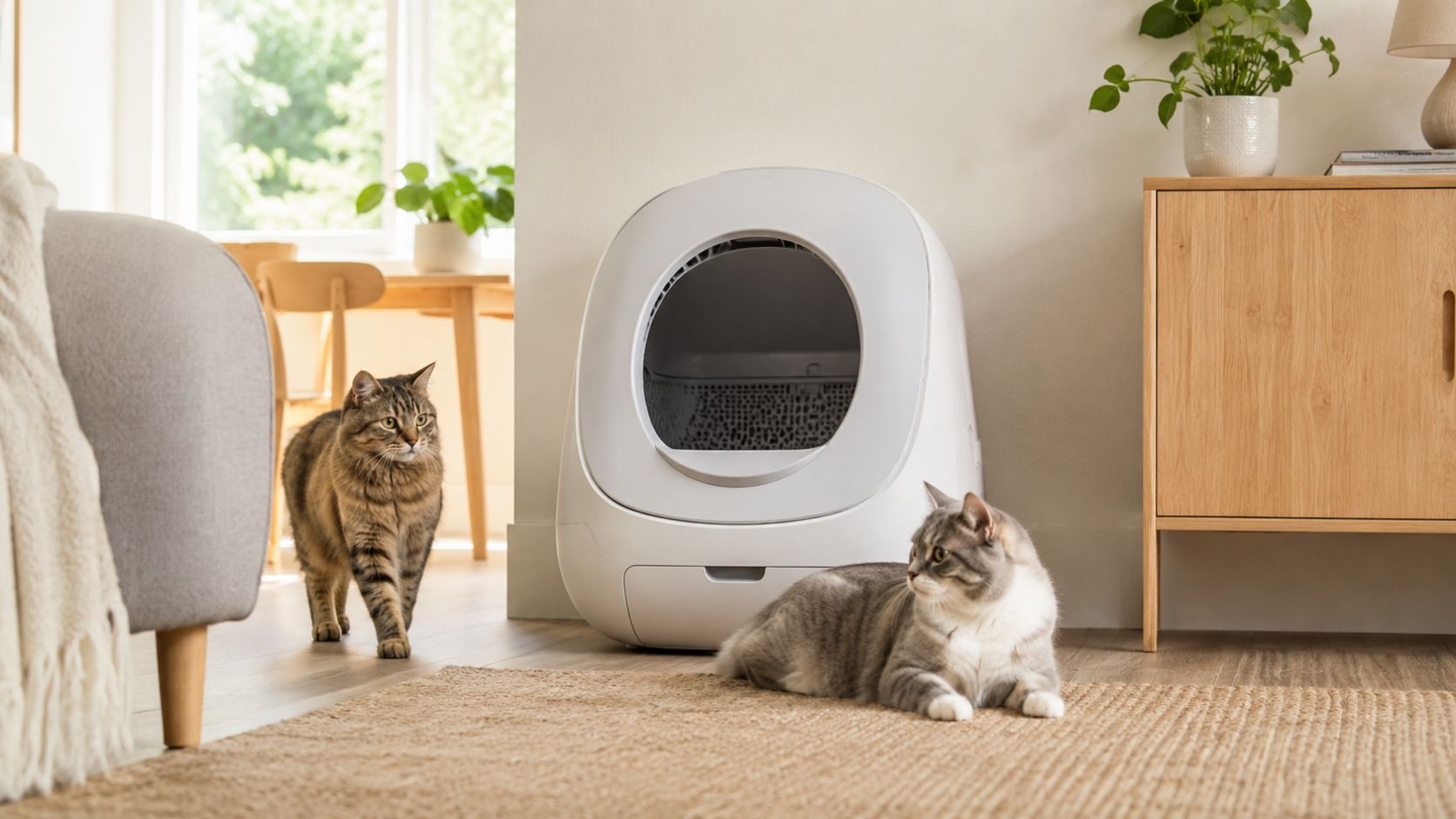
For two cats, a self-cleaning litter box is worth it when both are healthy adult cats big enough to trigger the safety sensors, they already share a box without fighting over it, and you are tired of scooping twice a day (or you are away for long hours, or scooping is physically hard for you). It is not worth it, or at least not yet, if either cat is a kitten or a very small, senior, or arthritic cat, if one of your two cats guards or ambushes the box, or if your current manual setup already works fine and money is tight. Below is the math that decides which camp you are in, because the answer for two cats is genuinely different from the answer for three or four.
I run automatic boxes in a multi-cat home, and I write about what fails, not just what to buy. So this is not a sales page. Two cats sits right on the line where these machines start to pay off, which is exactly why the generic "great for multiple cats" reviews are not much help. Let us do the actual arithmetic for your household.
The two-cat box math: "one box per cat plus one" still applies
The oldest rule in cat care comes from feline behaviorists: one litter box per cat, plus one spare. Two cats means three boxes. That rule exists because cats are territorial about where they eliminate, and a spare gives a bullied or picky cat somewhere to go.
Automatic-box marketing quietly rewrites that rule. Manufacturers rate a single high-capacity unit for up to four or five cats, and the pitch is that one machine can replace your whole lineup. For two cats, the capacity is real: one good auto box can physically handle the waste volume of two average cats without a problem.
Here is the honest part the vendor pages skip. Capacity is not the same as redundancy. The "plus one" spare box was never about volume; it was about giving a second cat an escape route and a backup when one box is occupied, guarded, or in mid-cycle (a self-cleaning box is locked out for a couple of minutes while it runs). So the realistic minimum for two cats is not one auto box alone. It is one auto box plus at least one backup box, which can be a plain manual tray. Anyone selling you a single unit as a complete two-cat solution is selling you the machine, not the behavior science.
How the math changes between 2 cats and 3-plus
Most articles lump every multi-cat home together. The numbers move a lot as you add cats, and two is the friendliest case.
- Cycle frequency. Fewer cats means fewer visits per day, which means fewer cleaning cycles, less motor wear, and a machine that spends more of its life idle. Two cats is gentle on the mechanism compared with three or four.
- Waste-drawer timing. This is the biggest quality-of-life difference. A high-capacity auto box holds roughly twice a week of waste for two average cats, versus needing attention every couple of days as you climb to three or four cats. Two cats is where "empty it about twice a week" is realistic instead of a chore.
- Territorial-conflict risk. With only two cats, the odds that one guards the box and blocks the other are lower than in a three-plus home, but they are not zero. And there is a catch specific to auto boxes: replacing several trays with one machine creates a single chokepoint. If one of your two cats is a guarder, funneling both to one box can make the problem worse, not better. If that is your situation, sort the behavior out first. I go deeper on that in the piece on what to do when one cat in a multi-cat home refuses the box (publishing soon).
So two cats gets you most of the convenience with the least mechanical strain and the lowest conflict risk of any multi-cat setup. That is why two is the size where these machines most often clear the bar.
Safety first: which of your two cats should not use one yet
This is the section the "worth it?" reviews rush past, and for a multi-cat home it matters more, because your two cats may not be the same size or age. Route anything medical or behavioral to your vet; I am an owner, not a veterinarian.
Automatic boxes decide when to run using sensors, and small animals can fall below the threshold. On popular models, a cat under roughly three pounds may not reliably trigger the weight sensor, which is why manufacturers say kittens should not use these in fully automatic mode. Reputable units layer in extra protection (infrared presence sensors that detect body heat, and motor-current sensors that stop and reverse the mechanism if it meets resistance), but layers are not a guarantee, and cheaper unbranded imports often have weaker sensors.
For two cats, the practical rule is to look at each cat separately:
- A kitten or a very small cat (under the model's minimum weight) should stay on a manual box, or use the machine in a semi-automatic or manual-cycle mode, until it grows into the safe range.
- A senior, arthritic, or tripod cat may be slow to enter and exit, which is exactly the cat you do not want near a timed mechanism. Keep a low, open manual box available.
- A cat with strong anxiety about enclosed or moving objects may simply refuse, and forcing it risks litter-box avoidance, which is a real health issue when a cat holds it in.
If one of your two cats is fine and the other is not, that is a common outcome, and it is another reason to keep a backup manual box rather than going all-in on a single machine. Easing a nervous cat onto one takes patience; I cover the step-by-step in getting a hesitant cat to accept an automatic box (publishing soon).
What two-cat owners actually pay for
I do not quote specific prices, because they date instantly and vary by model and region. Think in tiers instead.
Up front, the machine itself spans a wide range. Budget units cut corners on sensors and build quality (the exact places you do not want cut in a multi-cat home). Mid-range and premium units buy you better sensor redundancy, larger capacity, and quieter motors, which is what actually matters when two cats share one box.
Ongoing, the two-cat costs are the part people forget: clumping litter (the machines are picky about litter type), waste-drawer liners, and carbon or deodorizer filters on a rough monthly schedule, plus a small amount of electricity. Two cats sits at the lighter end of multi-cat consumable use, but it is still a recurring line item, not a one-time purchase. Budget for the refills, not just the box.
The maintenance reality at two-cat volume
Self-cleaning does not mean maintenance-free. It means no daily scooping, which is the win. What remains at two-cat volume:
- Empty the waste drawer about twice a week for two average cats. Bigger cats or a high-fiber diet push that up.
- Deep clean the whole unit periodically. Guidance for a single cat is roughly every three months; with two cats, closer than that is sensible. A deep clean means emptying all litter, washing the interior, and wiping the sensors so the box keeps reading your cats correctly.
- Swap filters and top up litter to the fill line on a regular cadence, and check that the mechanism moves without resistance.
None of it is hard, but it is real, and skipping it is how these machines start jamming or misreading a cat. I lay out a full cadence in a realistic maintenance schedule (publishing soon).
When two cats means you can skip it
Competitors push the sale. Here is the honest counter-case, the situations where two cats does not clear the bar:
- Your two cats already share one manual box happily and you do not mind a daily scoop. The machine solves a problem you do not have.
- You live in a small apartment where a bulky unit plus the recommended backup box will not fit comfortably.
- Either cat is a kitten, very small, senior, arthritic, or anxious about moving objects, as covered above. Wait, adapt, or keep them on a manual box.
- One of your two cats guards or ambushes the box. Fix the behavior with your vet or a behaviorist before adding a single chokepoint.
- You watch your cat's output closely for a diagnosed condition. A standard auto box hides waste in a sealed drawer, which can make it harder to spot changes in urine or stool your vet asked you to monitor.
If two or more of those describe you, save your money for now. That is not the answer a review site running affiliate links will give you, but it is the honest one.
Decision snapshot for two cats
| Your situation | Does it clear the bar? |
|---|---|
| Two healthy adult cats, both above the weight threshold, already sharing a box | Yes, this is the ideal case |
| Away long hours, or scooping is physically hard for you | Yes, strong reason to buy |
| One cat fine, one a kitten or small or senior | Partial: use it plus a backup manual box |
| One cat guards or ambushes the box | Not yet: resolve behavior first |
| Small apartment, current manual setup works fine | Skip it |
| Vet asked you to monitor output daily | Skip it, or ask your vet first |
FAQ
Do two cats need the largest litter box model?
Not necessarily the largest, but capacity matters more with two cats than with one. Look for a unit rated for at least three to four cats so the drawer and cycle timing have headroom. That rating buys you longer stretches between emptying, not just bragging rights.
Can I go longer between waste-drawer empties than a three-cat home?
Yes. Two average cats typically fill a high-capacity drawer to about twice a week, while three or more cats push it toward every couple of days. Larger cats or a diet change will shorten that, so let the smell and fill level guide you rather than a fixed calendar.
Is one automatic box enough for two cats, or do I still need a spare?
One good unit can handle the waste volume of two cats, but the behaviorist rule of a spare box still stands. Keep at least one backup box (even a plain manual tray) so a cat has somewhere to go while the machine cycles, or if one cat starts guarding it.
Is a self-cleaning litter box safe if one of my two cats is a kitten?
Kittens below the model's minimum weight may not trigger the sensors reliably, so manufacturers advise against fully automatic mode for them. Keep the kitten on a manual box or a semi-automatic setting until it grows into the safe weight range, and ask your vet if you are unsure.
Will two cats accept sharing one automatic box?
Many pairs do, especially if they already share a manual box. Some need a slow transition, and a few refuse entirely. Introduce it gradually, keep the old box available at first, and do not force a nervous cat, since litter-box avoidance is a genuine health risk.
CatVerge shares lived, multi-cat ownership experience, not veterinary advice. For anything involving your cat's health or behavior, talk to your veterinarian.