
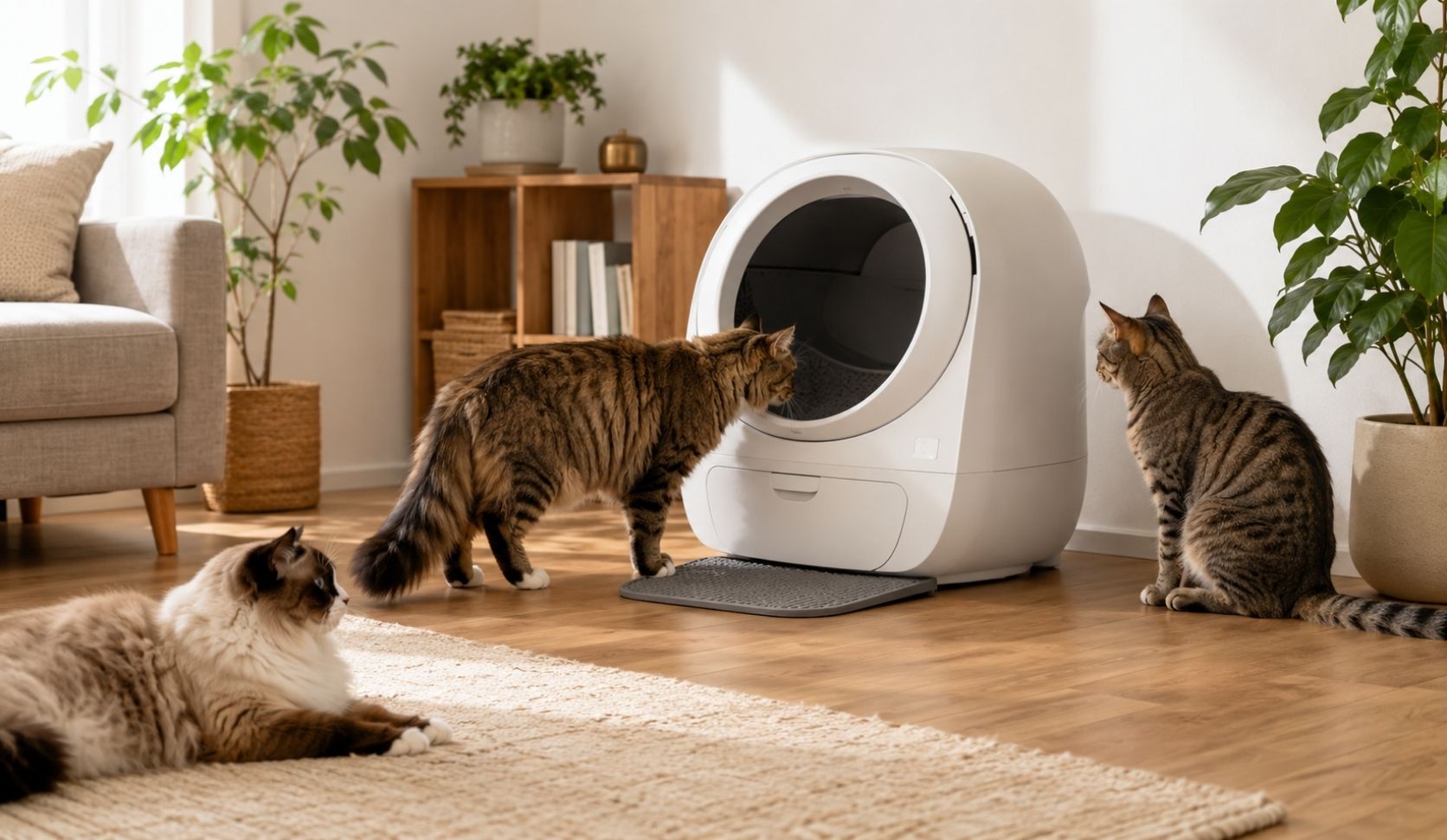
Introduce a new automatic litter box as an addition to your multi-cat home, never a replacement, and spend the first week watching who claims it rather than who uses it. Single-cat acclimation advice asks one question: will this cat trust the box? A multi-cat home has a second, more important question underneath it: will one cat decide the box belongs to them, and quietly keep everyone else out. That second question is the one nobody selling you the box will ask.
Introducing an Automatic Litter Box to Multiple Cats: The Short Answer
I went from a two-cat home to a three-cat home years ago, and I brought a new automatic box into that household exactly once. What surprised me was not whether the cats would use it. Two of mine used it within days. What surprised me was that the third cat, Deo, stopped going near it at all, and it took me weeks to understand why: Leo, the boldest of the three, had already decided it was his. Nobody fought over it. Nothing looked wrong. That is exactly the problem. A claimed resource does not look like conflict from across the room. It looks like success, right up until a cat quietly stops using any box in the house. I have written about the full five-year account of running an automatic box in our three-cat home elsewhere; this piece is about the one moment in that account I got wrong the first time.
Why a Shared Box Changes the Problem
In a single-cat home, a new litter box is purely an acclimation problem. Your cat either learns to trust the object or does not, and the process is between one cat and one machine. Add a second or third cat and you have introduced a shared resource into an existing territory, and cats do not share territory the way owners assume they do. Pam Perry, DVM, PhD, a resident in behavior at Cornell University College of Veterinary Medicine, describes resource guarding as stemming "from the normal desire to maintain access to valuable resources," involving "threatening behavior directed toward any individual, human or animal, that approaches the cat while he is in possession of or near something he does not want to relinquish." A brand-new box, the cleanest and least contested surface in the house on day one, is exactly the kind of resource that invites this.
| Single-cat home | Multi-cat home | |
|---|---|---|
| The real question | Does this cat trust the box? | Does any cat control access to it? |
| Failure looks like | The cat avoids the box | One cat uses it happily while another quietly disappears |
| What fixes it | Patience with the acclimation process | Enough locations that no single cat can guard all of them |
This is also why the number of boxes matters as much as the introduction itself. One machine, however good at keeping itself clean, is still one location, and one location can be controlled by one cat.
What Claiming Looks Like Early
Claiming rarely looks like a fight. It looks like small, quiet decisions that add up before you notice a pattern. Watch for these in the first one to two weeks, well before the automation is even switched on.
Signs to watch during that early window:
- One cat starts sitting near the new box, not using it, just present, more often than any of your cats normally lingers anywhere.
- Another cat approaches, hesitates, and turns back toward the old box instead, even though nothing visibly happened.
- One cat rubs its cheek against the new unit repeatedly in the first days, a scent-marking behavior, while the others do not.
- A cat that used to move freely through that part of the house starts taking a longer route around it.
- Only one cat's waste ever appears in the new box, while the others' output stays entirely in the old manual box or boxes.
None of this needs to involve hissing or chasing. In my own house it was Deo simply not showing up in that part of the room anymore. I mistook it for shyness around the new object for longer than I should have. It was not the object. It was Leo.
The Introduction Sequence for a Group
The base method for any single cat is the one I have written about in detail: run the new unit powered off, next to the existing box, for the first week or so, and only switch the automation on once a cat is using it calmly and unprompted. That piece, introducing an automatic litter box powered off, owns the full mechanics of that method, and nothing here changes it. What changes in a multi-cat home is what you do around that method while it runs.
Add it, do not replace anything. Every existing box stays exactly where it is, for the entire introduction period and beyond. Removing a box the moment the new one arrives forces every cat to renegotiate access at once, which is precisely the pressure that produces a guarded resource.
Place it on neutral ground. Put the new unit somewhere no single cat has already claimed as its own corner, not tucked into the space next to one cat's favorite sleeping spot or feeding station. A box that arrives inside one cat's existing territory starts the introduction already leaning toward one outcome.
Watch each cat separately, not the household as a whole. A multi-cat introduction that looks successful because two of three cats are using the new box confidently is not finished. Check that every cat, individually, is approaching and leaving the box without hesitation, without another cat's presence changing its behavior. Success is every cat, not the average cat.
When It Has Gone Wrong, and the First Correction
If a cat has stopped visiting a location, that is not a signal to give the introduction more time. Patience fixes a nervous cat that has not yet decided to trust an object. It does nothing for a cat that has decided a location is owned by someone else, because more waiting just gives the claim more time to settle in. The correction is more locations, not more patience: add a plain manual box in a different room, somewhere the cat that stopped showing up can reach without crossing the claimed unit's territory at all. The N+1 guidance on how many automatic litter boxes a multi-cat home needs exists for exactly this reason, and it does not go away because your box is automatic.
If one specific cat is the one holding out while the others adapted fine, that is its own scenario with its own fixes, and I have written a full piece on what to do when one cat refuses in a multi-cat home. And if any cat starts eliminating outside a box entirely rather than simply avoiding one location, stop treating it as a territory problem. That is a signal to have a vet rule out a medical cause first, before any behavioral fix, and I am not qualified to tell you which one it is from a description alone.
FAQ
Should I introduce a new automatic litter box to all my cats at once, or one at a time?
Introduce it to the household at once, powered off, as one new option among several. There is no need to isolate cats one by one. What matters is watching each cat's individual response over that first week or two, not managing a sequence of introductions.
How do I know if one cat has claimed the new box, rather than just liking it?
Liking a box looks like one cat using it while the others also use it or the old boxes without hesitation. Claiming looks like the other cats' behavior changing around that location: avoidance, longer routes, or waste that stops appearing anywhere near it. Watch the cats who are not using the new box as closely as the one who is.
Does adding an automatic box reduce or increase territorial tension in a multi-cat home?
It can do either, depending entirely on placement and whether existing boxes stay in place. A new box added without removing anything, placed on neutral ground, tends to reduce pressure by adding options. A new box that replaces an old one, or lands inside one cat's established space, tends to concentrate pressure onto a single location.
Should I remove the old litter boxes once the new automatic one is accepted?
Not right away, and possibly not at all in a multi-cat home. Keeping multiple locations available is what prevents any single box, automatic or not, from becoming a chokepoint one cat can guard. Removing boxes is a separate decision from whether the new one has been accepted.
Is it normal for only the boldest cat to use the new box at first?
Yes, and it is also the pattern most likely to be mistaken for success. Watch what the other cats do during that same window rather than only tracking who uses the new box first. A boldest-cat-only pattern that persists past the first couple of weeks is worth treating as an early claiming sign, not a finished introduction.