
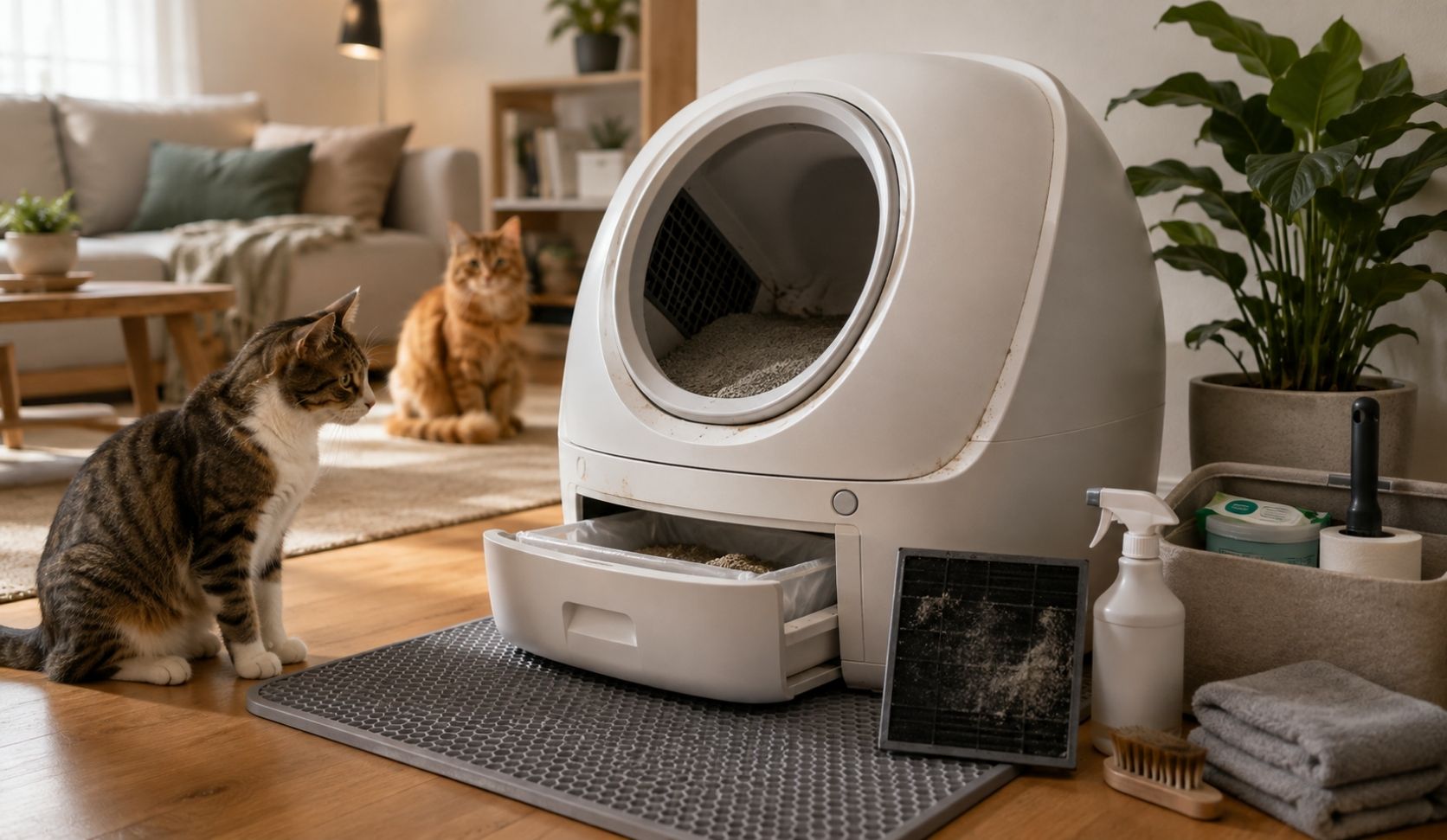
If your automatic litter box was excellent for the first few months and now smells, the cause is almost always skipped deep cleans rather than a failing machine. The mechanism keeps lifting clumps out exactly as it did on day one, but hardened residue builds up in the corners and seams the sifter never touches, the carbon filter saturates and stops absorbing, and the drawer sits a little longer between emptyings than it used to. None of that shows up as a fault. It shows up as a slope.
That slope is the part nobody writes about, so let me describe it honestly, because I walked down it myself.
The three places the smell actually lives
The drawer. The most obvious and the easiest to fix. Waste accumulates continuously, and the interval that was comfortable with two cats is not the interval that works with three. Vendor guidance generally suggests emptying every one to two days.
The seams and corners. This is the one that catches people. The mechanism is a sifter, it lifts clumps out of the litter bed. It was never designed to scrub the surfaces around it. Urine that has wicked into a corner and hardened is completely invisible to the machine, and manufacturers including Litter-Robot, Boxie and Meowant all identify this hardened residue as the source of both odor and bacterial growth.
The filter. Carbon filters work by absorption, and absorption has an end point. A saturated filter is not a weak filter, it is an inert one. It looks exactly the same as a fresh one, which is precisely why it gets left in.
The decay curve, month by month
Month one is genuinely excellent. This is not marketing, a well-running automatic box presents a cleaner litter surface at any given moment than a manual box halfway through its day, and the difference is obvious.
Month two and three, you relax. Not out of laziness. You relax because it is working. The whole promise of the machine is that it removes a chore, and the chore it removed most visibly was scooping. The deep clean was never the chore you were thinking about when you bought it, and nothing in daily use reminds you it exists.
Month four to six, residue accumulates in the places you cannot see, and the filter you have not replaced stops doing anything. There is no single day where it smells. Each day is imperceptibly worse than the one before, which is exactly the kind of change human noses adapt to rather than notice.
Then somewhere around month six or seven, a visitor arrives, or you come back from a week away, and you smell your own house properly for the first time in months.
That is the feedback loop, and it is worth naming plainly: the machine's success is what erodes the routine that keeps it successful. Knowing that is most of the fix.
What the published intervals actually say
Here the sources genuinely disagree, and I think saying so is more useful than picking one and pretending it is settled.
| Source type | Deep-clean interval |
|---|---|
| General guidance across maintenance guides | Every 4–6 weeks |
| Multi-cat or heavy daily use | Every 2–4 weeks |
| Litter-Robot, for the globe specifically | Every 1–3 months |
The spread is wide because the honest answer depends on cat count, how much litter you run, humidity, and whether your household empties the drawer on a schedule or on instinct. My own rule in a three-cat house is closer to the two-to-four week end, and I got there by finding out the hard way that six weeks was too long for us.
Pick from the range using your own load rather than treating any single figure as authoritative. What matters far more than the exact number is that it happens on a fixed day rather than when you notice a smell, by the time you notice, you are already well down the slope. The maintenance schedule covers how this fits alongside the weekly and daily jobs, and the full teardown procedure covers what to actually do when the day arrives.
One thing worth adding on cleaning agents, because it comes up constantly: warm water and mild, unscented soap is what the manufacturers recommend, with a baking-soda paste for hardened spots. Unscented is not fussiness. Cats' scent sensitivity is the reason, and a strongly perfumed cleaner is a real risk of turning a clean box into a rejected one.
When the smell is not maintenance
Most of the time this is a cleaning-interval story. Occasionally it is not, and it is worth knowing the difference.
Odor that appears suddenly rather than gradually is a different signal. So is odor that arrives alongside a change in one of your cats, using the box more or less often, straining, or going somewhere else in the house. That combination is not a maintenance problem and it is not something I am qualified to interpret. I am not a veterinarian, and a change in a cat's elimination alongside a change in smell is a reason to book an appointment rather than to buy a new filter.
There is also a much less alarming possibility: the wrong litter. A substrate that clumps poorly leaves material behind that the sifter cannot lift, and the result smells like a cleaning problem while actually being a compatibility one. If you changed litter in the months before the smell started, what these machines need from a litter is worth reading before you take anything apart.
And if the box has also started making a new noise, cycling oddly or stopping partway, treat that as a fault rather than an odor issue and start with the troubleshooting sequence instead.
Frequently asked questions
Why does my self-cleaning litter box smell after a few months?
Almost always because deep cleans have been skipped. Hardened residue builds up in corners the sifting mechanism never reaches, and a saturated carbon filter stops absorbing odor while looking unchanged.
How often should I deep clean an automatic litter box?
Published guidance ranges from every 2–4 weeks for multi-cat homes to every 4–6 weeks generally, with Litter-Robot suggesting the globe every 1–3 months. Choose from that range based on your cat count and usage, and do it on a fixed day.
What should I clean it with?
Warm water and mild, unscented soap, with a baking-soda paste for stubborn hardened spots. Scented cleaners are discouraged because cats are far more scent-sensitive than we are.
Does the carbon filter really matter?
Yes. Carbon absorbs until it is saturated, and then it does nothing at all. A used filter looks identical to a fresh one, which is why it is the most commonly forgotten part.
My box smells and one of my cats is behaving differently. What now?
That combination goes to a veterinarian rather than to a cleaning routine. A change in how a cat uses the box alongside a change in odor is not something to troubleshoot at home.