
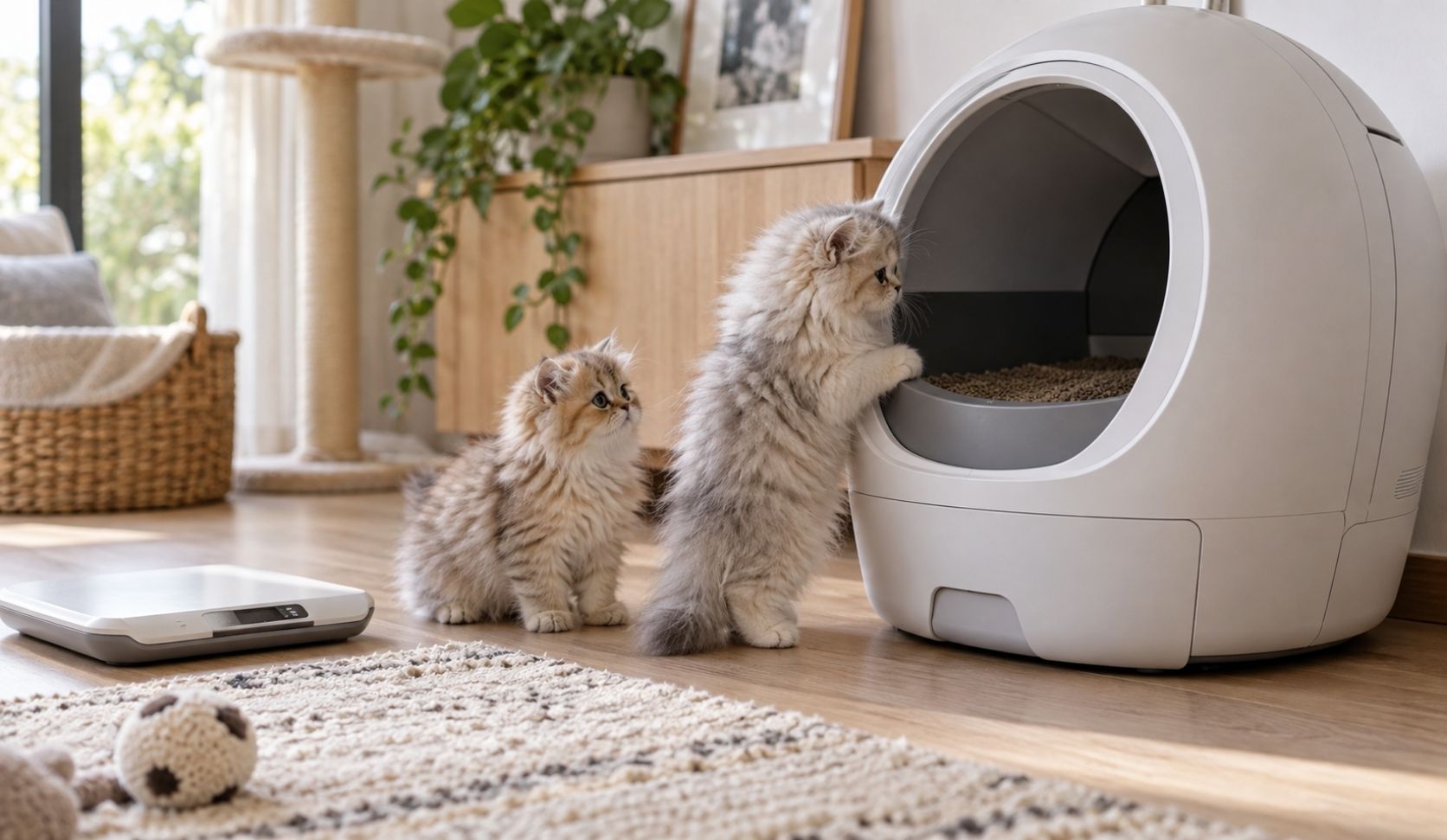
Whether a kitten can use an automatic litter box is decided by weight, not age, and the minimum depends on which model and which generation you own. Litter-Robot states that kittens of at least 3 lb can use the Litter-Robot 4, 5 and EVO in automatic mode, but the older Litter-Robot 3 requires 5 lb, and that generational difference is the single most commonly missed fact on this subject. Below your unit's stated minimum, the answer is not "supervise her." It is to run the box in semi-automatic mode until she weighs enough.
Check your own model's documentation, weigh the kitten on a scale rather than estimating, and read the more cautious figure as the real one.
What the sensor actually does
The safety system is not software cleverness. It is a set of load cells built into the base of the unit, high-precision weight sensors that register how much mass is sitting on the box.
Their job is simple and continuous. While weight is detected, a cleaning cycle cannot start. The cycle is only permitted once the sensors confirm the weight has returned to zero, meaning the cat has left.
That is why there is a minimum at all. A cat below the sensor's detection floor may not register as present, and a cat who does not register as present is a cat the machine believes has already left. The minimum weight is not a comfort recommendation or a warranty formality. It is the threshold below which the safety interlock cannot be relied upon to see your kitten.
This is also why age is the wrong variable. Kittens of the same age vary enormously in size, and the sensor does not care how old she is.
The published minimums, by model and generation
| Unit | Stated minimum for automatic mode |
|---|---|
| Litter-Robot 4, Litter-Robot 5, Litter-Robot EVO | 3 lb |
| Litter-Robot 3 (older generation) | 5 lb |
| Els Pet Orbitie | Under 2.5 lb → Kitten Mode (semi-automatic, manual clean only) |
These are the manufacturers' own published figures, and I am reproducing them rather than summarising them for a reason: this is not a topic to paraphrase. Other makers publish their own thresholds and they differ. Find the number for the exact unit in your house, not for the brand.
The generational point deserves repeating because it catches people who did their research once. If you owned a Litter-Robot 3 and upgraded, or bought a used older unit on the strength of what you read about the newer one, the figure you are carrying in your head may be nearly half what your machine actually requires.
Where the vendor minimum and cautious advice disagree
Here is a wrinkle worth knowing about. Some products advertise a minimum around 3.3 lb, while veterinary technicians and cat behaviorists are reported to favor a more conservative 3.5 to 4.0 lb before automatic operation.
I would take the conservative figure, and I would not treat that as a close call.
The reason is the shape of the risk rather than the size of the gap. Being over-cautious costs you a few extra days of pressing a button. Being under-cautious costs you an event that cannot be undone. When the downside is that asymmetric, the extra half-pound is not a meaningful sacrifice, and a manufacturer's minimum is a specification for the sensor rather than a recommendation for your particular kitten.
If your kitten is hovering right at your unit's stated threshold, wait. There is no benefit to switching to automatic mode on the exact day she qualifies.
Running semi-automatic until she's big enough
The manufacturer's own answer for an under-weight kitten is straightforward, and it is a real procedure rather than a caveat:
- Leave the unit switched off, so no cycle can begin.
- After she has used it, switch it on and press the Cycle button to run a single clean.
- Switch it off again.
Some units formalise this as a named mode, Els Pet calls it Kitten Mode, and it cleans only on a manual press, but the principle is identical across designs. The machine does the sifting; you decide when.
I will be honest about what this is: manual litter-box duty with extra steps, for however many weeks it takes. That is not a flaw in the plan, it is the plan. If you bought an automatic box specifically to stop thinking about the litter box, this period will be frustrating, and knowing that in advance is better than discovering it.
Two practical notes for the interim. Weigh her on a real scale, not by feel, the difference between 2.8 lb and 3.2 lb is invisible to a hand and decisive to a sensor. And keep a plain low-sided pan available the whole time, because a kitten who is still learning where to go benefits from an option that has no moving parts at all. That also makes the eventual switch to automatic operation a change of habit rather than a change of location, which is exactly what getting a cat comfortable with these machines depends on.
Separately: if your box is behaving oddly around a small cat, cycling when it should not, or not cycling when it should, treat that as a sensor question rather than a weight question. The troubleshooting sequence is the place to start, and a sensor coated in litter dust is a common and easily fixed cause.
Anything about the kitten herself, her growth, her weight, whether she is developing as she should, is a conversation for your vet. I can tell you what the machine needs. I cannot tell you anything about her.
The mirror image of this problem shows up at the other end of a cat's life: senior cats and entry height is the same safety question with completely different physics. And if you are weighing whether one of these machines suits your household at all, the five-year multi-cat account is the honest version.
Frequently asked questions
What is the weight limit for a kitten to use an automatic litter box?
It depends on the model. Litter-Robot states 3 lb for the 4, 5 and EVO, and 5 lb for the older Litter-Robot 3. Els Pet's Orbitie switches to a manual Kitten Mode below 2.5 lb. Check the figure for your exact unit.
Is it age or weight that matters?
Weight. Kittens of the same age vary enormously in size, and the sensor responds to mass. Weigh her on a scale rather than estimating.
What happens if a kitten is under the minimum weight?
The load cells may not register her as present, which means the interlock that prevents a cycle starting cannot be relied upon. That is why the minimum exists.
How do I use the box before she reaches the minimum?
Leave the unit off, and after she uses it, switch it on and press Cycle to run one clean, then switch it off again. Some units offer this as a named semi-automatic or Kitten Mode.
Should I go by the manufacturer's minimum or a higher figure?
Where a product advertises around 3.3 lb, more cautious guidance suggests 3.5–4.0 lb. Take the higher number. Waiting costs you a few days; not waiting is not a recoverable mistake.