
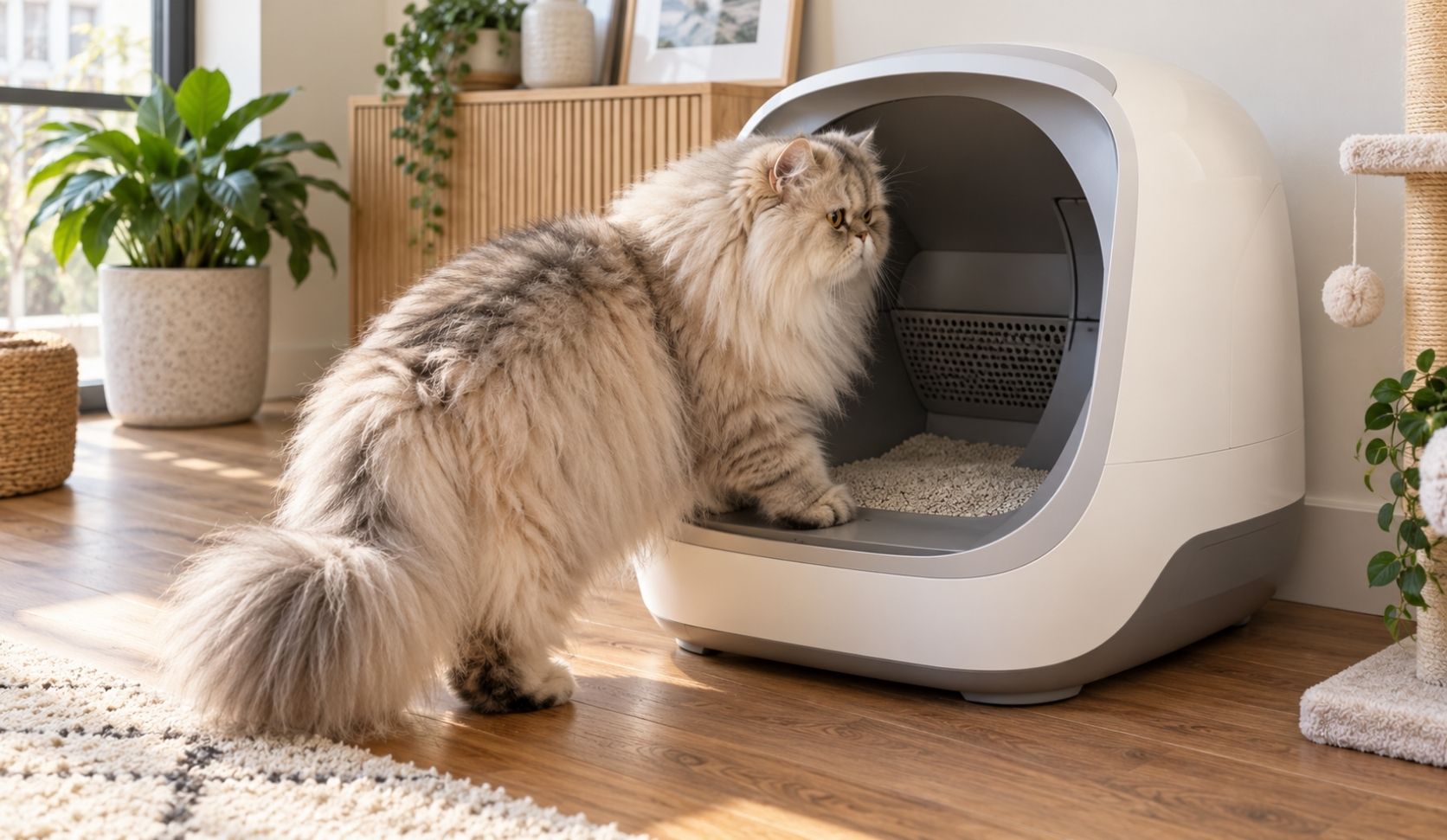
For a large cat, an automatic litter box has to pass two separate tests. The entry has to be wide and low enough that she can walk in without ducking or squeezing. The chamber has to be long enough that she can turn a full circle, dig, and bury without touching a wall. Most owners check the first and assume the second. The second is the one that causes refusals.
I have run automatic boxes for five years with three cats, and Leo is the one who taught me the difference. He got in fine. He never once used the thing properly.
Entry size and interior volume are two different constraints
These get conflated constantly, including by me when I bought my first unit. Entry height and step-in effort are an access problem, and access is mostly about mobility: arthritic hips, a bad knee, a cat who cannot lift a back leg over a lip. That is a different article, and I wrote it separately for senior cats, because the cause and the fix are different.
Body size is a volume problem. A Maine Coon, a Ragdoll, a Norwegian Forest Cat or just a long, heavy domestic shorthair passes the access test easily. Nothing about her hips is stopping her. What stops her is that once she is inside, the usable floor is shorter than she is.
| The question | What it really tests | Where to watch |
|---|---|---|
| Can she get in? | Access: entry width, step-up height, joint comfort | At the doorway. Ducking, hesitating or hopping in means access. |
| Can she turn, dig and bury? | Volume: interior floor length and standing headroom | Inside. A cut-short dig or a tail out the entry means volume. |
Before buying, measure your cat from nose to tail base while she is standing, and compare that to the interior floor of the chamber. The widely repeated behaviorist guidance is roughly 1.5 times body length. Few sealed automatic chambers are built to that, so measure the interior, not the outside shell and not the entry.
What the research says about box footprint
There is one study I keep coming back to. Guy, Hopson and Vanderstichel gave 43 households and their cats two open litter boxes at once and logged every deposit for four weeks. The regular box was about 56 x 38 cm. The large one was about 86 x 39 cm, roughly 1.9 times the surface area, and bigger than what was commercially available at the time. Cats preferentially chose the larger box in both phases of the trial (Journal of Veterinary Behavior, 2014).
Those were plain pans, not automatic units, so read it as a preference signal rather than a spec. But the implication is uncomfortable for this whole product category. Cats given a free choice picked a footprint larger than anything on the shelf, while automatic boxes are engineered in the opposite direction. They have to house a motor, a rake or a rotating drum, a waste drawer and a sensor array, and still fit next to a washing machine. The interior is what gets sacrificed. For an average cat that trade is fine. For a large one it is the whole story.
What a chamber that is too small actually looks like
You will not get a clean signal. You will get a pattern, and it builds over weeks.
The first sign is posture. She goes in front paws first and stops, with her back half at the entry or her tail sticking out. Or she stands with two feet on the lip and two inside. Or she squares up, realizes she cannot complete the turn, and reverses out to try again from the other direction.
The second sign is a shortened dig. A cat with room digs, eliminates, turns, sniffs, and buries. A cat without room does one or two scrapes, goes, and leaves it uncovered. That is not laziness. She has run out of floor to work with, so the sequence gets truncated.
The third sign is litter over the edge, because a cramped cat digs sideways into a wall instead of downward into litter, which is a mess problem I cover in litter tracking.
The last sign is that she stops using it. If refusal arrives alongside any change in how she is peeing, how often, or how she behaves outside the box, stop diagnosing furniture and call your vet. Urinary problems present exactly this way, and refusal has several causes that have nothing to do with size.
Fill level quietly steals the height you paid for
This is the free fix nobody connects to fit, and it is the one I would try first.
Every centimeter of litter you add is a centimeter of standing height you take away. In an open pan that barely matters, because there is no ceiling. In a sealed chamber it matters a lot: raise the litter bed and you lower the roof relative to your cat, and a big cat who was already brushing the top is now crouching to stay under it.
The common guidance for clumping litter is 2 to 3 inches of depth, deep enough that claws do not scrape the floor mid-dig. Automatic units also have their own maximum fill line, usually set for clump formation and sensor accuracy rather than for the cat. When those two disagree, the manufacturer's line wins, and I stay a little under it.
Overfilling is the most common thing I see people do with a new unit, on the assumption that more litter means fewer refills. With a large cat it costs you headroom, adds weight the sensors have to interpret, and makes the litter that gets kicked out worse.
When an automatic box is the wrong answer for this cat
I will say the unpopular thing. For some large cats a plain oversized pan beats every automatic box on the market, and no amount of transition training fixes a chamber that is physically too short.
The honest test is behavioral, not technical. Give her a genuinely large open box next to the automatic one, same litter, same room, and leave both for a couple of weeks. If she moves to the pan and stays there, that is your answer. She is not confused by the motor. She is choosing the one she fits in.
You can also split the difference. In a multi-cat house you do not have to standardize. Two of mine are perfectly happy in an automatic unit and one is not, so he has his own oversized pan and I scoop it. That is not a failure of the setup, it is the setup working. I have written up how I run multiple cats on one self-cleaning box and where the real limits sit.
A disciplined manual routine beats a mediocre automatic one. It always has.
Frequently asked questions
How big does an automatic litter box need to be for a large cat?
Measure your cat nose to tail base while standing, and compare that to the interior floor of the chamber, not the outside dimensions. Behaviorist guidance is around 1.5 times body length. She should be able to complete a full turn and dig downward without her body touching a wall.
My cat fits through the entry but still will not use it. Why?
Entry and interior are different constraints. Fitting through the opening only proves access. If she cannot turn, dig and bury inside, she will shorten the sequence and eventually stop going in. Watch whether she is really digging or just scraping once and leaving.
Does a bigger cat need deeper litter?
No, and deeper litter usually hurts. Standard guidance is 2 to 3 inches, kept under your unit's maximum fill line. In a sealed chamber, extra litter directly reduces the standing height available to a tall cat.
Should I try to train a large cat into a small chamber?
I would not. Transition training solves fear and unfamiliarity, not geometry. If the chamber is physically too short, training just delays the refusal and costs you the cat's trust in that spot.
When should I involve a vet?
Any time refusal appears alongside a change in urination frequency, straining, vocalizing, or blood, or any change in behavior outside the box. Size is a comfort problem. Those are medical signs, and they need a vet, not a different box.
Written by Sarowar, who has run automatic litter boxes in a three-cat home (Mao, Leo and Deo) since 2021. I write about what fails, not just what to buy. Nothing here is veterinary advice.