
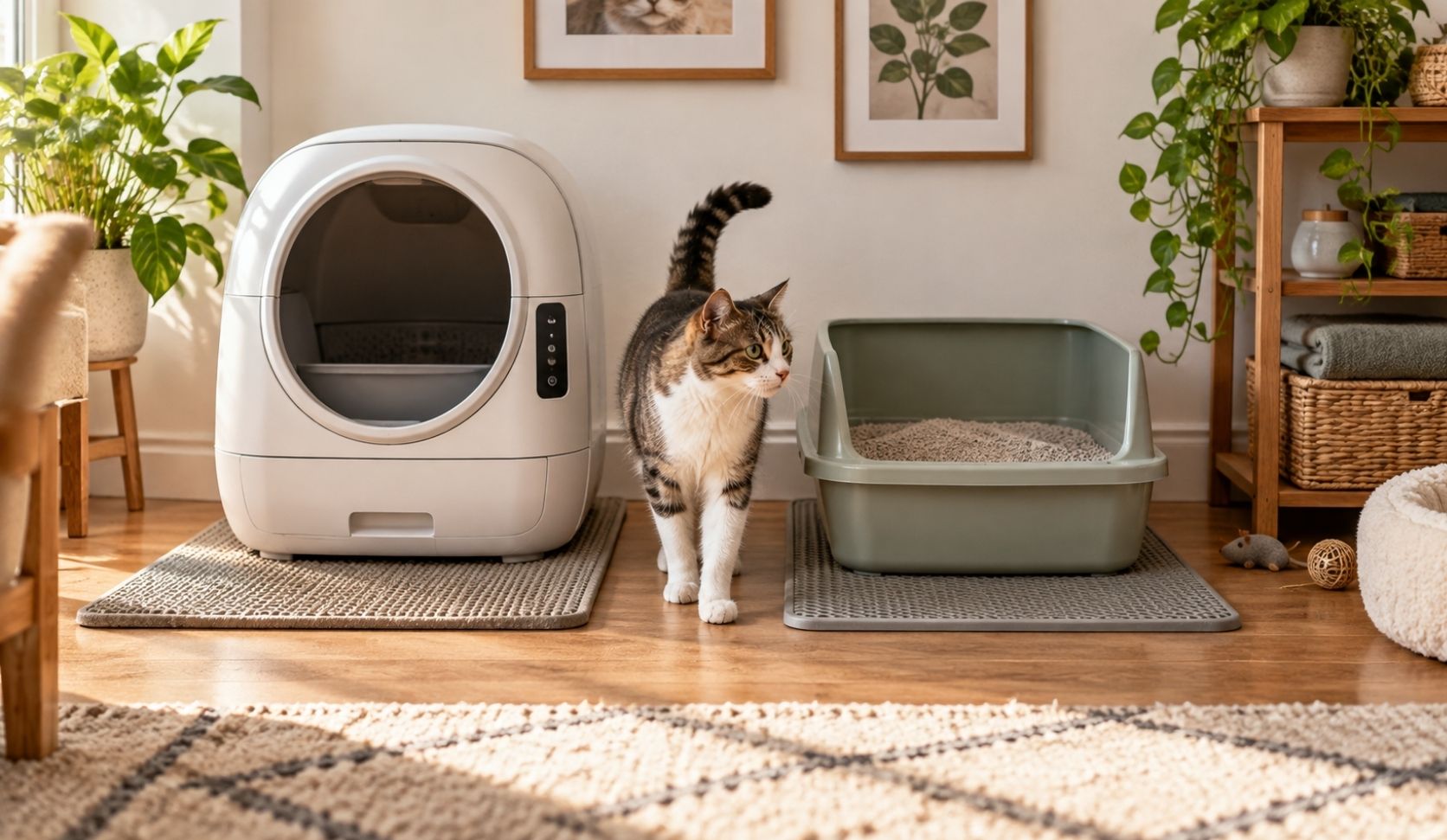
Running an automatic and manual litter box together permanently is a legitimate setup, not a transition you failed to finish. In a three cat house it is the arrangement I have ended up defending most often, because it solves three problems at once: the litter box count that veterinary guidance asks for, the machine's unavoidable downtime, and the cat who will use the object but not the cycle. The catch is maintenance discipline. A manual box kept to a lower standard than the machine becomes the reason a cat stops using either one.
Everything below assumes you already own or are buying an automatic unit. This is not a guide to manual litter box basics for a first-time owner.
Why every guide tells you to remove the old box
Search this and you will find the same sentence on every page: keep the old box for two or three weeks, then take it away once your cat is using the new one consistently. That advice is about the transition, and in that context it is correct. A manual box left standing during acclimation can become a permanent bolt hole, and there is a real point where removing it is the step that finishes the switch. I wrote up the timing and the readiness signals in when to remove the old litter box.
What none of those pages address is the household where removing it is the wrong call. That is this page.
Five households where keeping both is the right permanent answer
One cat accepted the machine, one did not. This is the most common version. In a multi-cat home you rarely get a unanimous verdict, and the holdout does not need to be converted. She needs a box. When one cat refuses and the others adapted fine goes through that scenario in detail, and the hybrid is usually where it lands.
You need the box count and you do not need a second machine. Veterinary guidance is one box per cat plus one, and that rule is about locations as much as capacity. One automatic unit is one location no matter how efficiently it cleans itself. A manual pan in a different part of the house is the cheapest way to satisfy the rule, and I work through where the arithmetic genuinely bends in the N+1 rule and automatic boxes.
A cat in the house is under the manufacturer's weight floor. Automatic boxes carry a crush and entrapment risk for animals the sensors are not built to detect. At the time of writing Whisker states that the Litter-Robot 4, 5 and EVO SmartScale will not recognize a kitten weighing under 3 lb (1.3 kg), and recommends semi-automatic operation below that. Other manufacturers publish their own thresholds and the older Litter-Robot 3 sits higher. If any cat in your house is below the published figure for your model, a manual box is not optional and the hybrid is simply the correct setup until she grows. The weight limits and the semi-automatic workaround has the details.
A senior or mobility-limited cat. A high step or a moving chamber can be too much for an arthritic cat on a bad day even when it is fine on a good one. A low-sided pan on the same floor of the house is the fallback that stops a bad day becoming an accident.
Outages, travel and jams. A machine that stops is a box that is not available. Power cuts, a stalled cycle while you are at work, or a full drawer on the wrong day all produce the same result, and what actually happens to an automatic litter box in a power outage is worth reading before you rely on a single unit.
The downtime nobody budgets for
Here is the argument I find most persuasive and least discussed.
Every automatic unit needs a periodic full teardown: taken apart, washed, dried, reassembled. Dried properly, that is not a ten minute job, and the box is out of service the whole time. If it is the only box in the house, you either rush the drying, which is how grit and odor problems start, or you leave your cats without a toilet for an afternoon.
With a manual pan standing, the teardown happens on your schedule instead of theirs. That alone has been worth the second box to me, and it is why I stopped thinking of the manual pan as a leftover.
Making it work: the discipline
The hybrid fails for one reason, and it is not the cats.
Same litter in both. One litter, in both boxes, chosen to suit the machine. Automatic units are sieves built around hard clumping clay, so the machine sets the standard and the manual box follows it. Two litters means a cat expressing a preference between boxes rather than using whichever is nearer, and it means two things to buy.
Different locations. Two boxes side by side count as one location to a cat. Put the manual pan somewhere genuinely separate, ideally a different room or a different floor, with its own quiet approach and an exit that is not a dead end.
Scoop the manual box at least daily. This is the whole ballgame. The machine cleans itself after every use, so within a week the manual pan is the dirtier of the two by a wide margin, and cats notice. A neglected second box does not just go unused, it teaches a cat that boxes in this house are unreliable, and that lesson transfers to the machine.
Deep clean the manual box on a real schedule too. Full empty, wash, dry, refill. Plastic pans hold odor once they are scratched, and a pan that smells to you is long past acceptable to a cat. My maintenance schedule for the automatic unit is easy to extend to a pan, and the point is that both boxes sit on the same calendar.
Watch who uses what. If your unit reports usage, you will know quickly which cats have adopted the machine. Combine that with what you actually see at the manual pan. If one cat has never once used the machine after months, that is settled information, and it means the manual box is now hers rather than a spare.
The failure mode: the dirty default
The way this setup goes wrong is quiet. The manual box becomes the one that only gets scooped when someone remembers, because the machine has made you out of the habit. It reaches the state where the cats will still use it, but only when they have to. Then one cat starts choosing the rug over the pan, and it looks like a behavior problem out of nowhere.
It is not out of nowhere. If a cat who was using a box stops, treat it as a medical question first, because avoidance can be a symptom before it is a habit, and in male cats a urinary obstruction is a same-day emergency. Then look at the box that has been getting the least attention. Both boxes get the same standard, or the setup does not work.
Frequently asked questions
Is it bad to have two different types of litter box?
No. Cats do not care about the category, they care about whether a box is clean, reachable, and safe to be in. Two boxes maintained to the same standard is a stronger setup than one box, whatever types they are.
Will keeping a manual box stop my cat from ever using the automatic one?
During a transition, sometimes, which is why the standard advice is to remove it once the switch is complete. As a permanent arrangement in a multi-cat house it is not really a risk, because the cats who prefer the machine keep using the machine. If you have one cat and you want her fully converted, remove the pan once she has accepted the unit.
How many boxes should a multi-cat home have if one is automatic?
Start from one per cat plus one, count the automatic unit as one box, and then adjust for locations and for how your cats actually behave with each other. The count is a floor, not a target.
Does the manual box need to be the same size as the automatic one?
It should be big enough for your largest cat to turn around in comfortably, which usually means bigger than the pans sold as standard. Size is the single most reliable predictor of whether a cat likes a plain box.