
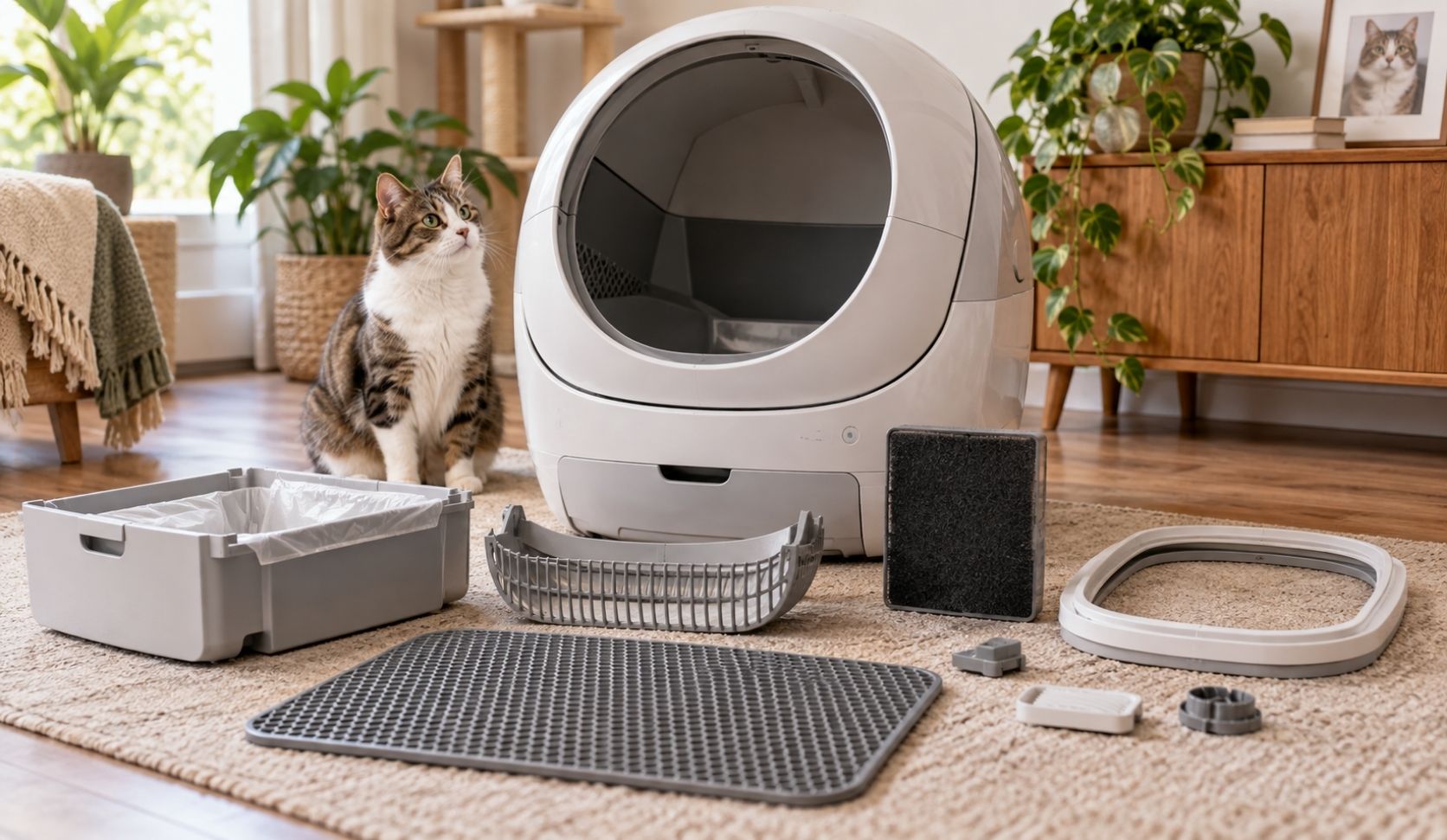
The automatic litter box parts that break are the soft ones that touch litter and moisture. The electronics rarely die, they get dirty and act dead. In my house the order has held steady: consumables get used up first, then the soft seals go, then the surfaces that meet grit, and only rarely a motor or a board.
I run these units for three cats, Mao, Leo and Deo, which is its own accelerant: more cycles, more dust and more moisture than any spec sheet assumes. I wrote about what three cats do to one unit separately. I write about what fails, not just what to buy, so this is the failure account.
Consumables, wear parts, and faults are three different things
Most of the panic I see comes from filing all three under "it is breaking." The difference decides whether you replace something, inspect something, or diagnose something.
| Category | Examples | What it means | What you do |
|---|---|---|---|
| Consumable | Carbon filter, drawer liner, step mat | Designed to be used up | Replace it, no diagnosis needed |
| Wear part | Seal strips, gaskets, chamber liner | Degrades gradually with use | Inspect on a schedule, replace on the signal |
| Fault | Dead board, stalled motor, failed sensor | Should not happen in normal use | Diagnose the cause first |
The carbon filter is the clearest case. Whisker's own Litter-Robot 4 care documentation says the charcoal filter is not necessary for the operation of the device. A saturated filter is used up, not broken: odor control stops, and the machine keeps cycling exactly as before.
The wear order: which automatic litter box parts break first
Nobody publishes an ordering, so here is mine with the caveat it deserves: one household, three cats, clumping clay litter. A dustier litter or a damper room would shuffle it. What makes me trust the shape of it is that the manufacturers' own parts catalogs point the same way. Whisker sells seal strips, filters and liners next to bases, bonnets, globes, drawers, motors, circuit boards and wire harnesses. A catalog tells you what can be replaced. It does not tell you what usually needs replacing, and reading it as a wear order is how owners talk themselves into believing the motor is next. Treat what follows as an ordering, not as a schedule. Nothing in it is a failure rate.
First: the soft parts that sit where the moisture is
Sealing material goes first, every time. It is the only part that is soft, compressed on every cycle, and parked exactly where ammonia and damp air collect. Whisker documents seal strips on the top and bottom of the Litter-Robot 4 base, and tells owners to replace them when they are worn flat or peeling off. That is a published wear signal, not my guess.
Two details there matter more than they look. It warns against getting the strips wet when cleaning the base, because they start to peel, so an enthusiastic wash-down ages your seals early. It also suggests trimming loose edges between replacements, so peeling is expected rather than defective. When odor leaks from a machine that is otherwise cycling normally, I check seals before anything electronic.
Second: the surfaces that meet grit
Litter is abrasive. Anything a clump slides across gets microscopically rougher: the chamber liner, the drawer's contact surfaces, the septum edge, the plastic where waste is pushed through. None of it looks like damage on inspection day. It shows up as behavior instead. Roughened plastic holds residue where smooth plastic released it, residue holds odor, and the odor arrives long before anything visibly fails.
This is also where the cementing problem starts. Urine that dries against a rough surface bonds harder than urine that dries against a smooth one, and hardened residue builds in corners the mechanism was never designed to reach. Left alone it becomes a physical obstruction, which is a stall, not a wear failure. Same material, two different problems.
Third, and rarely: the electrical parts
Motors, wire harnesses and circuit boards are sold as replacement parts, so they clearly fail for some owners. In my house they have not been first, second or third. When electronics do fail, the environment tends to be the story rather than the running hours: a board sitting in ammonia-laden air, often in a damp bathroom or basement, has a hard job.
I would rather be straight about the limit of my evidence. Three cats and repeated teardowns are a real sample for seals and surfaces. It is a thin sample for motor failure, which I have not had. Read the bottom of this order as "not what I would check first," rather than as a reliability statistic about these machines.
What almost never fails
The structural shell. Bases, bonnets and globes are the biggest, most visible parts, and they are the ones I have never worn out. They are rigid, they do not compress, and cycling does not stress them the way it stresses a seal. When one does get replaced, the cause is usually mechanical: a drop during a move, or someone (me) levering a cemented clump out with a screwdriver and cracking the plastic. That is damage from technique, not wear. Keypads and step mats sit near the same end of the order here, picking up cosmetic wear rather than failing. Worth saying, because the shell is what a nervous buyer studies in the product photos, and it is the part least likely to cause trouble.
Dirt that looks exactly like failure
The most common false alarm is a sensor that is not broken. Litter dust and cat fur settle on the sensor windows, readings drift, and the machine starts refusing to cycle. Every symptom of a dirty sensor reads as a dead unit, because the unit behaves like one.
I have never had a sensor genuinely fail. I have had plenty that needed cleaning. If yours is throwing errors, work through the sensor error checks first, because that piece walks the diagnosis symptom by symptom.
The other masquerade is the stall. A chamber that stops partway through is usually a cemented clump, the residue problem arriving as a jam. Clearing it has its own sequence, covered in what to do when the unit stops mid-cycle. Do not order a motor until the chamber is empty and clean.
What a teardown tells you before anything breaks
All of this is invisible unless you take the machine apart from time to time. That is the real argument for the deep clean routine: not hygiene, but inspection of parts you otherwise never see.
Four things I check while it is open. Are the seal strips standing proud, or flat and lifting at the edges? Are the sensor windows clear, or hazed with a gray film? Are the corners and joints clean, or is residue building where the mechanism cannot reach? Does the chamber interior feel slick, or chalky under a fingertip?
None of those is a failure. Each is the early state of something that becomes one, and all are easier to handle at the film stage than the crust stage. The owners I know with the fewest problems are the ones who open the machine on a schedule and look.
Frequently asked questions
Which part of an automatic litter box breaks first?
Consumables get replaced first, but that is not breakage. The first true wear part is the soft sealing material, seal strips and gaskets, compressed on every cycle where moisture collects. Whisker's documentation gives the signal: replace them when they are worn flat or peeling off.
Is a saturated carbon filter a failure?
No. Whisker's care documentation states the charcoal filter is not necessary for the operation of the device, so a used-up filter means odor control has stopped, not the machine. Replace it at the interval your manual gives; returning odor is the practical signal.
How do I tell normal wear from an actual fault?
Wear is gradual and even: odor creeps back, a seal flattens, a surface goes chalky all over. Faults are sudden and specific: it worked yesterday, today it does not. Sudden and specific is worth diagnosing. Gradual and even is usually a part reaching the end of its service, or dirt you have not cleaned yet.