
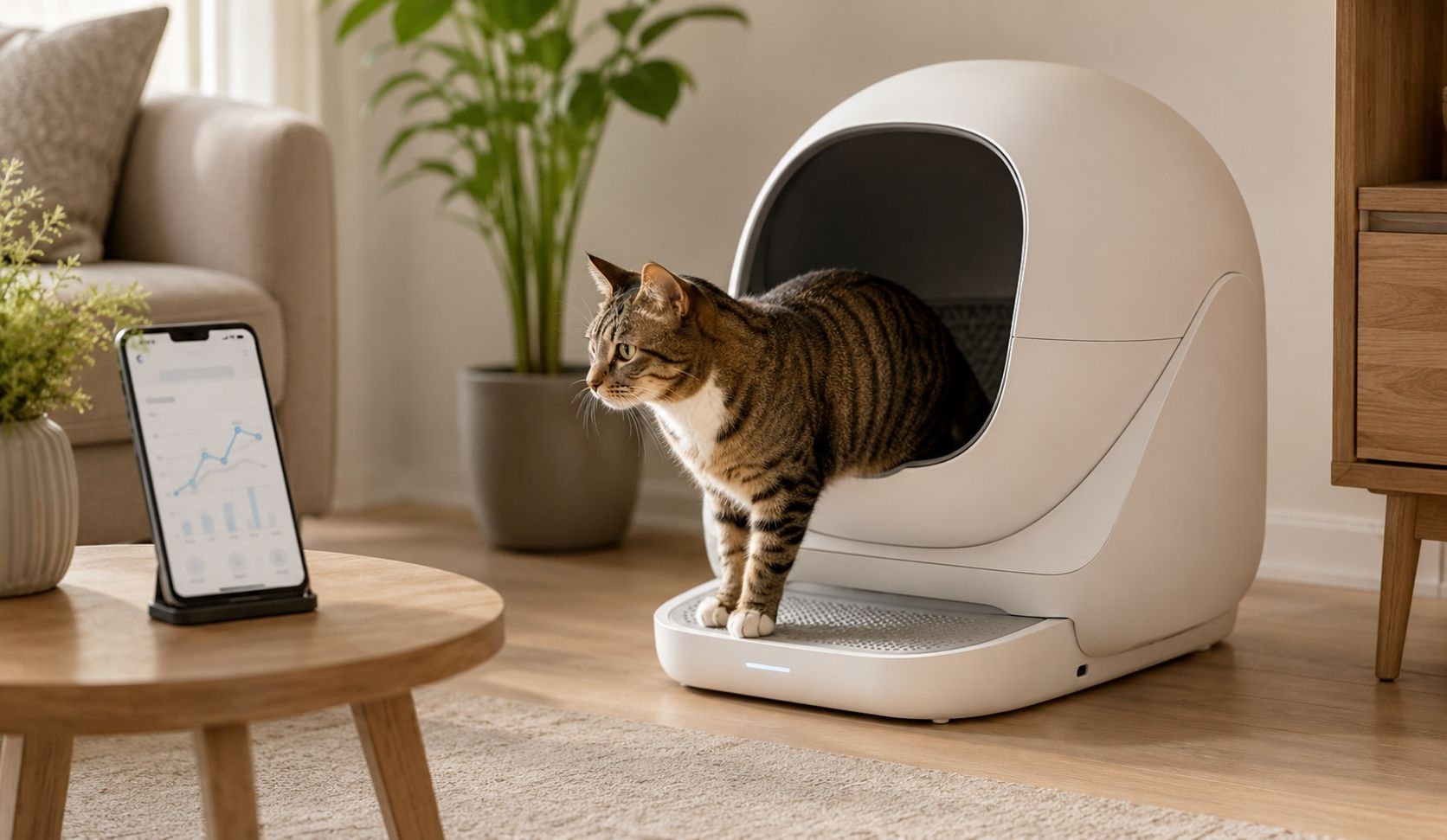
A weight-tracking litter box measures one thing: the mass of whatever steps onto it, logged over time and assigned to a cat by weight band. That is genuinely useful, and it is not a diagnostic instrument. The honest description of what it gives you is a trend line, a record of whether a number is drifting, and a drift is a reason to look more closely. What you are actually looking at is a question for a veterinarian, not for an app.
I am not a veterinarian and CatVerge is not a medical resource. I am writing this because the product pages ranking for this question say something quite different, and I think the gap matters.
What the product pages claim, and why that framing is a problem
Search this topic and you will find manufacturer and retailer pages, Purina's Petivity, CATLINK, and various review sites carrying the same messaging, describing weight tracking as early detection for named conditions. Urinary tract disease, kidney disease, diabetes and hyperthyroidism come up repeatedly.
Here is my objection, and it is not that weight matters less than they say. Weight change genuinely is clinically meaningful in cats, which is exactly why vets weigh them at every visit. The problem is the leap from this device records a number to this device finds a disease. A scale under a litter box cannot distinguish between a cat who has lost weight because of illness, a cat who has lost weight because the household changed food, and a reading that was never that cat in the first place.
Presenting the sensor as a screening tool invites two failures, and the second is worse than the first. An owner may act on a wobble in a chart that means nothing. Or, and this is the one that worries me, an owner may see a flat line and feel reassured enough not to book an appointment when something else is telling them to.
The device is not qualified to provide reassurance. Neither am I.
Where the data is genuinely useful
Strip out the diagnostic claims and something real remains.
A cat that is weighed at the vet twice a year has two data points. A cat using a weight-tracking box has hundreds, gathered without stress, without a carrier, and without the well-documented tendency of cats to behave differently in a clinic. That density is the actual value. It is not that any single reading is precise; it is that the shape over weeks is visible in a way it simply is not otherwise.
In my house that shape once mattered. A trend shifted, I noticed it because it was a trend and not a number, and it prompted a vet visit I would not otherwise have booked at that moment. I want to be careful about what that story does and does not prove. The box did not diagnose anything. It told me to look, the vet did the rest, and I would tell it the same way if the appointment had turned up nothing at all.
That is the whole use case: a prompt to look closer, not a diagnosis. Take the chart to the appointment. It is genuinely useful information for the person who is qualified to interpret it.
Where it quietly fails: multi-cat attribution
This is the limitation nobody selling the feature leads with, and in a multi-cat home it is the one that matters most.
The sensor measures mass. It does not know which cat is standing on it. Attribution works by weight band, the app decides that a reading of a certain mass is probably Cat A because Cat A weighs roughly that much. In a house with one cat, that is trivially reliable. In a house with cats of clearly different sizes, it works acceptably.
In a house with cats of similar size, it is guessing. My three are close enough that I treat individual attribution as a hint rather than a fact. And the failure mode compounds in exactly the wrong direction: if two similar cats get mixed up, one cat's genuine change can be averaged into the other's line and disappear from both.
There is a second attribution problem worth knowing about. Some readings are not a cat at all, a cat entering and leaving quickly, two cats in the same window, or a cat that pauses at the entrance can all produce readings that are noise. This is also, incidentally, why cycle queuing and weight data are related problems: a busy multi-cat box produces messier data as well as fewer completed cycles, and the same capacity questions sit underneath both.
One practical note: sensors sit under a machine that is full of litter dust. A sensor that has not been wiped in months is not reading what it thinks it is reading, and that belongs in the ordinary maintenance rhythm rather than being treated as a data problem.
How to use it without over-reading it
- Watch the shape, not the number. A single day means nothing. Several weeks in one direction is the only pattern worth reacting to.
- Do not chase daily variation. Cats fluctuate. A chart that wobbles is a normal chart.
- Treat attribution as provisional if your cats are similar sizes. Confirm on a real scale before you act on an app's opinion about which cat changed.
- Take the chart to the vet rather than interpreting it. Months of data is genuinely valuable to a clinician and genuinely misleading to the rest of us.
- Never let a flat line stop you booking an appointment. If a cat is behaving differently, the behavior is the signal and the chart is not a second opinion.
That last point deserves its own emphasis. Changes in how a cat uses the box, going more or less often, straining, or going elsewhere in the house, are worth taking seriously on their own terms, whatever the weight data says. Some of those signs are an emergency rather than an observation, and the medical red flags to rule out first sets out which ones, with named veterinary sources. Straining with little or no urine produced is the one to know by heart. I have written about what it looks like when one cat in a multi-cat home stops using the box, and the first thing that piece says is the same thing this one does: rule out the medical possibilities with a vet before treating it as a behavior puzzle.
The line this site will not cross
CatVerge will not tell you that a litter box detects, screens for, indicates or rules out any medical condition, because it does not. I will write about what the sensor measures, how reliable the attribution is, and what the data is good for. I will not write a threshold, a percentage, or an "if your cat loses X, then Y," because publishing one would be inventing clinical guidance I have no standing to give.
If that makes this page less exciting than the ones selling the feature, that is the trade, and I would rather be the site you can trust on the limits than the one that got you to buy faster. The five-year account of running these machines takes the same position throughout.
Frequently asked questions
Can an automatic litter box detect illness in my cat?
No. It measures weight over time and, on some models, visit frequency. Those can reveal a trend worth investigating, but interpreting a trend is a veterinarian's job. Treat any product claim about detecting specific diseases with skepticism.
How accurate is litter box weight tracking?
The mass measurement is reasonable for trend purposes. The weaker link is attribution, deciding which cat produced a reading, which works by weight band and becomes unreliable when cats are similar sizes.
Is weight tracking worth having in a multi-cat home?
It is useful for spotting household-level trends, but individual attribution should be treated as provisional if your cats weigh roughly the same. Confirm on a real scale before acting on it.
What should I do if the trend changes?
Book a veterinary appointment and take the chart with you. Do not try to interpret it yourself, and do not wait to see whether it corrects.
My cat seems unwell but the weight line is flat. Should I be reassured?
No. Behavior is the stronger signal and a flat chart is not a second opinion. If a cat is behaving differently, that warrants a vet visit regardless of what the app shows.