
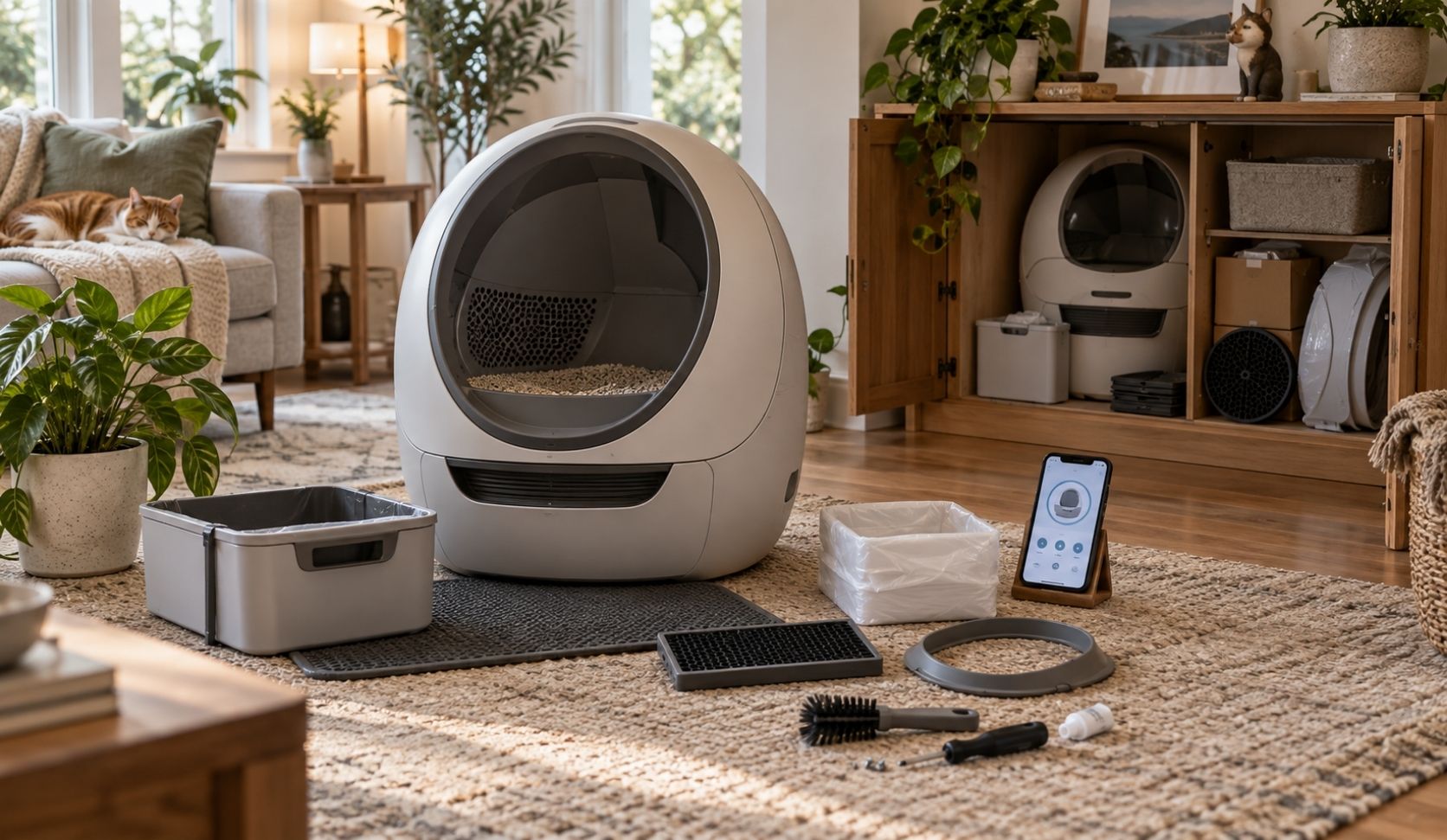
How long do automatic litter boxes last depends on which clock you are asking about, and there are three of them running at once. There is the mechanical clock, which is how long the moving parts survive. There is the support clock, which is how long the manufacturer sells the parts and keeps the app working. And there is the tolerance clock, which is how long you are willing to keep fixing it. In practice the unit rarely dies. Support for it ends, or your patience does, and the machine goes in a cupboard while it still runs.
How long do automatic litter boxes last, according to the pages that rank
Search this question and you get confident ranges. Two to seven years. Three to seven years. Five to seven for premium models. Every page has a number, none of them shows where the number came from, and several of them are published by companies that sell the boxes. I am not going to add another unsourced range to that pile, and I am deliberately not publishing my own units' service life as a benchmark, because a sample of one household is an anecdote, not a lifespan.
What I can give you is the thing those pages skip: what determines the answer for your unit, and how to tell which clock is closest to stopping.
Clock one: the mechanical life
This is the one people mean when they ask, and it is the least interesting of the three, because almost nothing that wears out on these machines is fatal.
Automatic boxes fail in small, replaceable ways long before they fail structurally. Seals stop sealing. A rake or drum edge goes abrasive. Sensor windows get a film on them and start misreading. A waste drawer cracks at the hinge because it gets carried when it is full. None of that is the end of a machine that has parts available. I have set out which components go first, and roughly in what order, in the parts that break, and that article is the failure catalog so this one does not have to be.
The genuine mechanical determinants are boring: cycles per day and how consistently the unit is cleaned. A box serving three cats runs several times the cycles of a box serving one, and cycles are what wear the moving parts. Grit is the other one. Litter dust that is never washed out works like a mild abrasive on every surface it touches, which is why a skipped teardown schedule costs more life than a heavy cat ever will. The maintenance schedule and the full teardown are the two things you control here, and they are most of what separates a unit that ages well from one that does not.
Clock two: the support life, which is the one that actually ends things
This is the clock nobody shops on and it is the one that decides when your box becomes scrap.
An automatic litter box is only repairable while somebody sells the part. The day the manufacturer stops stocking a rake assembly, a sensor board or a drawer for your model, a small failure becomes a total loss. That is not a hypothetical for a category where models are refreshed every few years and companies come and go.
Two questions answer this before you buy, and they are worth putting to a seller in writing:
- Which components are sold individually as replacement parts today, for this exact model?
- Are parts still available for the model this one replaced?
The second question is the real test. A company that still sells spares for its previous generation will probably still sell spares for this one. A company whose older models have no parts listed at all is telling you what your repair options will look like in three years.
Warranty terms are the other half of this clock, and they are published, so use them. At the time of writing, Whisker covers the Litter-Robot with a one year standard warranty and sells a longer protection plan separately. Terms differ between manufacturers, between regions and between the standard and extended plans, and they change, so read the current terms on the manufacturer's own page rather than trusting a summary anywhere, including this one. What a warranty term tells you is not how long the machine lasts. It tells you how long the company is willing to be responsible for it.
Clock three: the connected parts, which age differently
The plastic and the motor age slowly. The connected features age at the speed of the company's software roadmap.
An app can lose support, a cloud service can change, and a companion feature you paid for can quietly stop being maintained while the machine itself is fine. This is why I keep saying that the most important thing to know about any smart device is what it still does with no internet at all. A unit whose sensor and motor work independently of the cloud is a machine that survives its own app. A unit that needs the service to run a cycle has a lifespan set by a company's business decisions. I tested this the boring way and wrote up what happens when the Wi-Fi drops, and it is the single most useful thing you can check before you buy.
How to tell where your unit actually is
Age in years tells you very little. These four signals tell you a lot.
It needs the same repair twice. One failed part is wear. The same part failing again in months is a symptom of something upstream, usually grit or a misalignment, and it means the unit is now consuming your time.
Errors survive a proper clean. A sensor fault that clears after you wipe the sensor is dirt. A fault that survives a full teardown is a component. Sensor errors and what they actually mean covers the check order before you conclude anything has died.
The part you need is not sold anymore. This is the end, regardless of how the machine looks. Check availability before you order anything else.
You have started working around it. Emptying early because the drawer sticks, running cycles manually because the sensor is unreliable, keeping a manual box beside it as insurance. When the workarounds are permanent, the unit has already been retired in practice.
Repair or replace
The decision is not really about money, and it is not about age. It is about whether the failure is a wear part or a system.
Replace the part if it is a consumable or wear item, it is available, and this is the first time it has gone. That is normal ownership and it is cheap relative to the machine.
Replace the machine if the part is unavailable, if the same failure has come back after a correct repair, or if the fault is in something that is not sold separately. And be honest about the third case: if the unit still works and you have simply stopped trusting it, that is a legitimate reason to move on, but note it as a preference rather than a failure. The running cost side of that decision, including what a replacement actually commits you to, sits in the cost comparison worksheet.
What actually extends the life
Nothing exotic. Wash the grit out on a schedule instead of when it smells. Keep the litter at the manufacturer's fill line rather than above it, because an overfilled bed loads the mechanism on every cycle. Use the litter the machine was designed for. Empty the waste drawer before it is heavy enough to stress the hinge. Support the drawer from underneath when you carry it.
That is the whole list. It is unglamorous, and it is worth more than build quality claims, because the two units that fail differently in the same house are usually the ones that were maintained differently.
Frequently asked questions
Is there an average lifespan I can plan around?
Not one I would trust. The published ranges are wide and unsourced, and they mix single cat and multi cat households, well maintained and neglected units, and very different designs. Plan around parts availability and warranty terms instead, because those are facts you can verify before you buy.
Do more cats shorten the life of the box?
More cats means more cycles, and cycles are what wear the moving parts, so mechanically yes. It also means the maintenance schedule matters more, because grit accumulates faster. A well maintained box in a busy house often outlasts a neglected one in a quiet house.
Does a longer warranty mean a longer lasting machine?
No. A warranty is a statement about the manufacturer's liability window, not a durability rating. It is still useful information, because it tells you what the company is willing to stand behind, and an extended plan is worth comparing against the cost of the parts it covers.
My unit is out of warranty and broken. Is it worth repairing?
Check part availability first, before anything else. If the component is sold and this is the first time it has failed, a repair is usually the right call. If the part is not sold, or the same failure has already come back once after a correct repair, the machine is telling you its support clock ran out.