
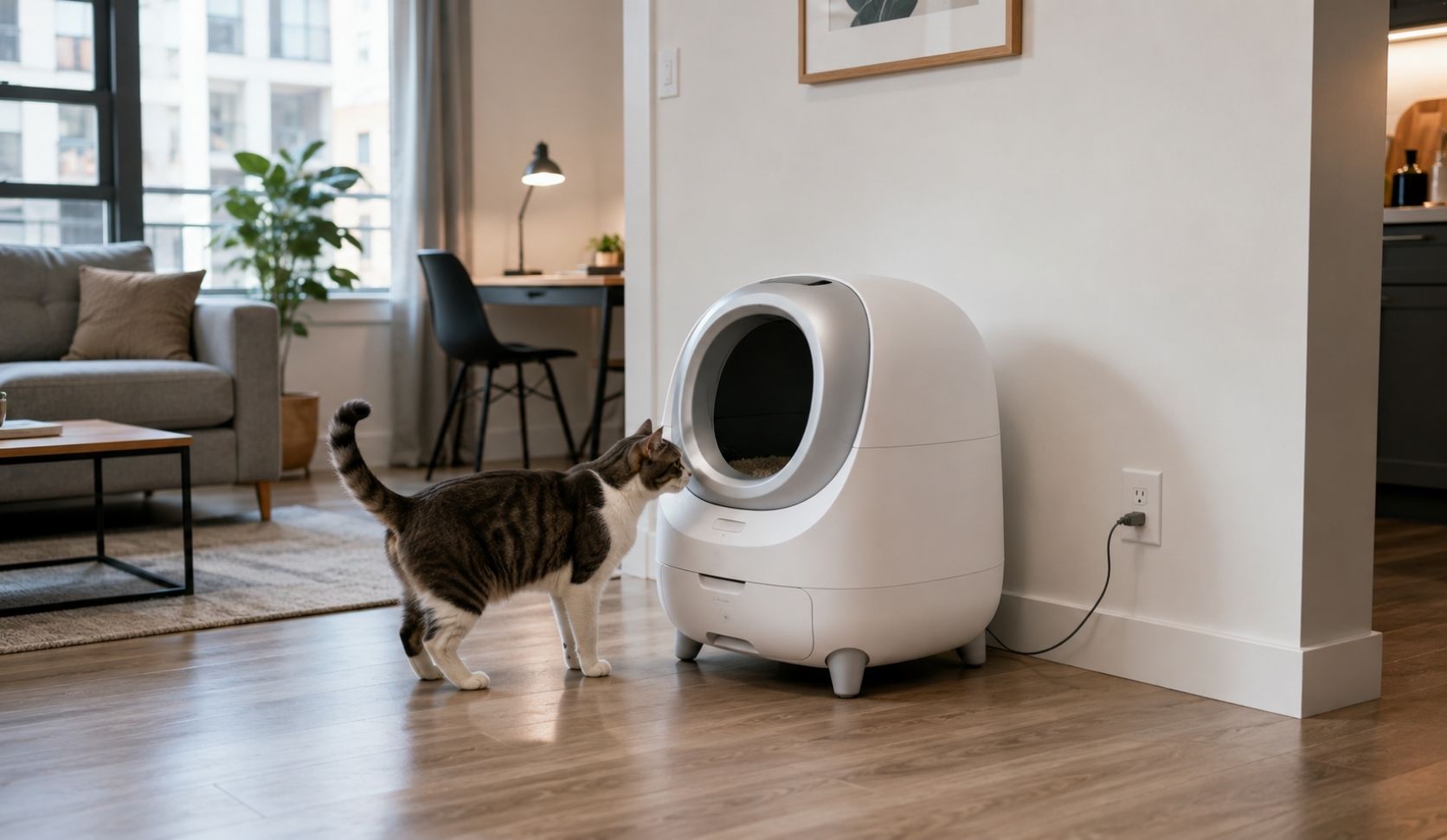
Rank your candidate spots in this order: power, clearance, noise, then the cat. Power is absolute. No outlet in cord reach, no spot. Clearance comes next: the unit needs a level floor, feet sitting free, and room to open without touching a wall. Noise separates whatever survives. Then the cat gets the last word, and the cat's veto overrules the other three.
Almost every article on this question hands you a list of rooms: bathroom, laundry area, hallway, spare room. That list is written for someone who has rooms to spare. With three cats in a small home, I never had a choice of rooms. I had two or three possible spots, all compromised, and what I needed was an order of operations. Which constraint kills a spot outright, and which one can I work around? This is the order that has held every time I have moved my unit in five years.
| Rank | Constraint | The question | Verdict if it fails |
|---|---|---|---|
| 1 | Power | Does a wall outlet reach without the cord crossing where people walk? | Hard fail, no workaround |
| 2 | Clearance | Level floor, feet free, nothing touching the unit, room to kneel? | Hard fail, occasionally fixable |
| 3 | Noise | Can the household hear a cycle from where it sleeps or works? | Tiebreaker only |
| 4 | The cat | Will the cat actually use it there? | Final veto, overrules 1 to 3 |
Work down that table with each candidate in turn. Most people find their spots separate at row two, not row one, which is exactly why this gets decided badly.
Power comes first, because it cannot be argued with
An automatic litter box runs on household power. There is no battery mode to fall back on, so the outlet map is the real floorplan of your home, and every other decision here is a negotiation with it. Walk the room and note which outlets are genuinely free, not the one behind a cabinet you would have to drag out to reach the plug.
Then think about the cord, because the cord is a placement decision in its own right. It should not cross a doorway, sit where a foot lands, or run under a mat. If you need an extension cord so the unit sits where the cats want it, that is fine (I do exactly that), but route it around the unit's footprint, never underneath. Whisker's troubleshooting guidance for the Litter-Robot is explicit that none of the four feet should end up resting on a cord, which turns a tidy-looking cable run into a mechanical fault waiting to happen.
Clearance is the constraint people discover last
This is the row where small-home spots actually get eliminated, and nobody warns you about it, because the tempting spots are exactly the tight ones: the gap beside the toilet, the alcove at the end of a hall, the corner behind a door.
Whisker's support documentation for the Litter-Robot sets the requirements out plainly: a firm, level surface; the unit not pushed against a wall or into a corner; all four feet clear of litter and debris; no foot resting on a cord or sitting in a grout line; and no side of the unit touching a wall or anything else. On carpet or uneven flooring, the company notes that weight readings become inaccurate, and sells a rigid tray to sit underneath for that reason. These are not fussy preferences. A unit that is out of level or physically obstructed is a common reason one stops part-way through a cycle, and in a tight spot you will blame the machine long before you blame the floor.
Measure with the drawer open, not closed
The footprint on the spec sheet is the unit standing still. The footprint you need is the unit in use, which is a different number.
The waste drawer has to open fully, and you have to be able to lift a full bag out without dragging it against a wall. You have to kneel in front of it, genuinely kneel rather than crouch sideways, because you will be doing that every few days for years. You also need to reach the back of the unit for the periodic strip-down, so it cannot be wedged in permanently.
A cabinet with the door shut fails this row twice over: no clearance, and no ventilation, which is its own problem in a small home where litter dust has nowhere to go.
Noise ranks third, not first
Most placement guides put noise at the top, which is why they produce a room list rather than a decision. In a small home every spot is near every other spot, so noise rarely eliminates anything outright. It separates the two candidates that already survived power and clearance.
Two things are worth knowing. A cycle is short but not silent, and the common advice to keep the unit away from where people sleep exists because the cycle usually fires some minutes after the cat leaves, so it goes off at unpredictable hours rather than on your schedule. I have written the full account of what these machines actually sound like at night, so I will not repeat it here.
The practical test: run a manual cycle from each surviving spot, stand where you sleep or work, and listen. Do it on the floor surface you actually plan to use, because a hard floor and a rug behave very differently.
The cat's veto is final
You can satisfy the first three rows perfectly and still be wrong, because none of them is the party that has to use the thing. Mao, Leo and Deo have all vetoed spots I was quite pleased with.
Dead ends lose. Cats avoid places where they can be cornered, so a spot with a single approach (a narrow alcove, the far end of a galley kitchen, a unit facing into a corner) is a spot one cat can block by sitting down. In a multi-cat home this is the most common quiet failure of the lot.
High-traffic routes lose too. A machine that moves, sitting in the path everyone walks, asks a cat to be startled twice: once by the household and once by the cycle.
Keep it away from food and water. This is old, near-universal litter box guidance, and it does not stop applying because the box has a motor in it.
What a veto actually looks like
Rarely a dramatic refusal. Usually it is hovering at the entrance without going in, going beside the unit rather than in it, a sudden preference for one box over another, or a cat who used the machine happily and stops after you move it.
Two things to do with that. Treat a move as a reintroduction rather than a relocation. It takes the same patient approach as getting a cat comfortable with a self-cleaning box in the first place, because to the cat it is a new object in a new place. And if a cat is going outside the box at all, that is a vet conversation before it is a placement one. I am not a vet, and elimination changes have medical causes that no amount of repositioning will fix.
If the veto holds after a proper reintroduction, the spot is dead. Not "workable with effort". Dead. Move to the next spot on your shortlist, and if the shortlist is empty, the answer may be a second location rather than a better single one. For the longer view of running these machines in a crowded home, my five-year account with three cats is the unvarnished version.
Frequently asked questions
Where should I put an automatic litter box in a small apartment?
In the spot that clears four tests in order: a wall outlet within cord reach, a level floor with the feet free and nothing touching the unit's sides, acceptable cycle noise where you sleep or work, and a cat willing to use it. Rank your candidates against that order rather than hunting for the "right" room.
Can an automatic litter box go against a wall?
No. Whisker's troubleshooting guidance for the Litter-Robot states the unit should not be pushed against a wall or into a corner, and that no side should touch another surface. In a small home this is usually the constraint that kills your favorite spot.
Can I put an automatic litter box in a cabinet?
Not with the door closed. You lose the clearance the mechanism needs, you lose the access required for the waste drawer and cleaning, and you lose ventilation, which invites refusal and leaves litter dust with nowhere to go.
My cat stopped using the box after I moved it. What now?
Treat the new position as a reintroduction, not a relocation, and give it time. But if the cat is eliminating outside the box, book a vet appointment first. That symptom has medical causes, and placement troubleshooting should not delay it.