
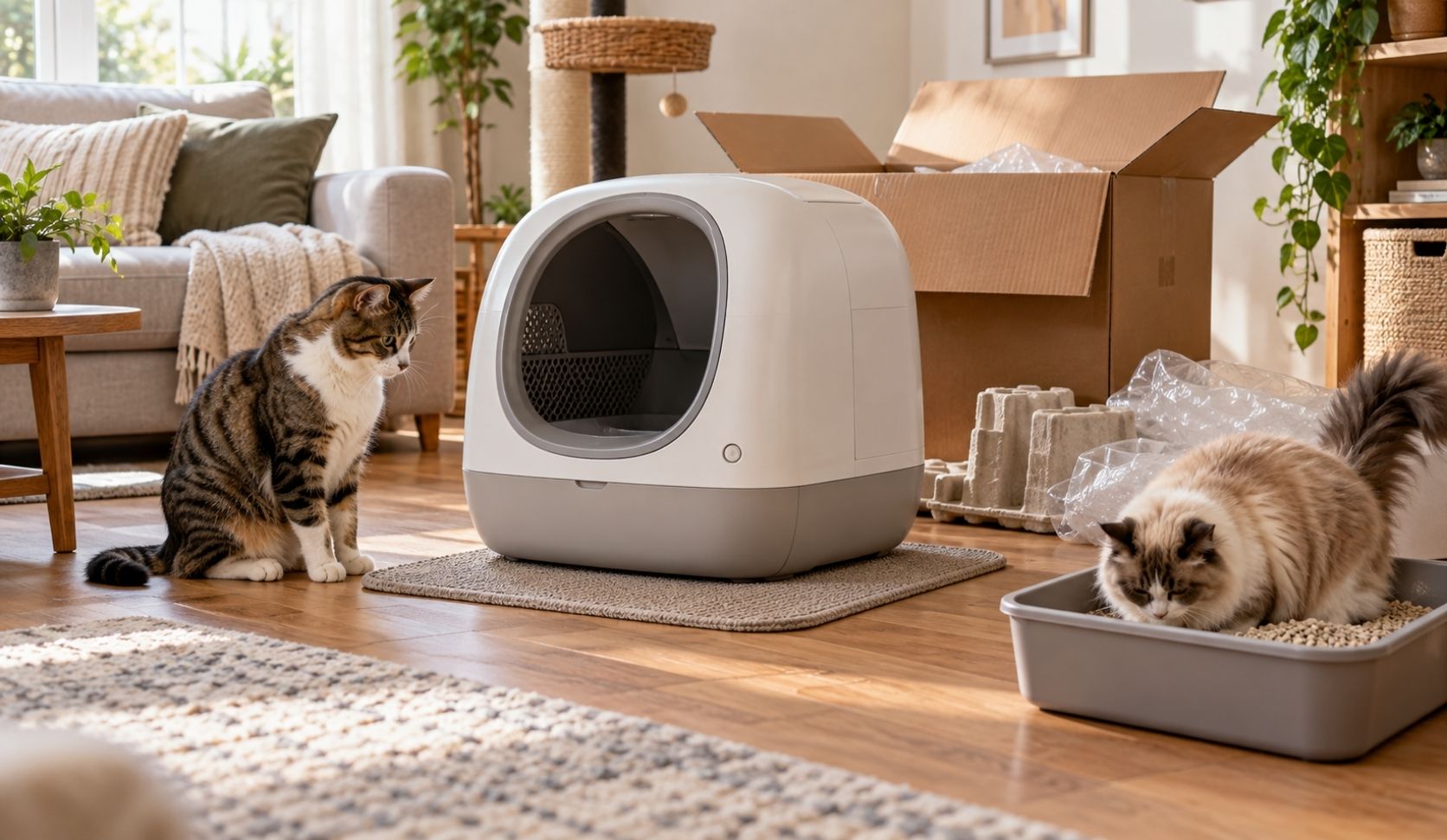
If you need to return an automatic litter box your cat won't use, you have four exits and they are worth very different amounts. In order: return it inside the window, sell it used, donate it to a rescue, or keep it and run it as a plain manual box. Check the return clock first, before you do anything else, because it is the only one of the four with real money attached and it is the only one that expires. Everything else can wait a week. That cannot.
This page is the logistics after the decision. The decision itself, whether this unit is genuinely never going to work for this cat, is a different question and I answer it in when to give up on an automatic litter box.
Two checks before you pack anything
Has a vet seen her? A cat refusing a litter box may be avoiding pain rather than the box. Straining with little or nothing produced, repeated trips to the box, crying in it, or blood in the urine mean you call a vet the same day, and in a male cat a suspected urinary obstruction is an emergency. The medical red flags to rule out first covers the signs and how urgent each one is. Returning hardware does not treat a cat.
Was it the box, or the introduction? Most rejections I hear about are a switched-on machine introduced too fast, or a box moved to a location the cat had already rejected. Both are fixable without returning anything, and both are worth ruling out while the window is still open. The week-one, powered-off rule and placement mistakes that cause rejection are the two to check.
If she is medically clear and the setup was right, carry on.
Exit one: the return window
This is where the money is, and the terms are published, so read them rather than guess.
Two things decide your position. Where you bought it, and how long ago. If you bought direct from the manufacturer, their policy applies. If you bought from a retailer, the retailer's policy applies and the manufacturer will usually send you back to them.
As a worked example of what these terms look like in practice, at the time of writing Whisker publishes a 90 day in-home trial on Litter-Robot: return it within 90 days of receipt for a refund of the purchase price, with the customer paying return shipping, or take Whisker's own FedEx label for a stated $60 deduction from the refund. Whisker also states that units returned in unclean condition may be subject to a $75 cleaning fee deducted from the refund, and that a return authorization number is required before shipping anything back. Products bought through third party retailers must go back to that retailer.
I quote those figures as an illustration of the shape of these policies, not as a universal. Every manufacturer sets its own, terms differ by region, and they change. Find the current policy page for the company you actually bought from, and write down three things: the deadline, who pays the shipping, and what condition the unit has to be in.
Then act on the deadline. The most expensive mistake in this whole article is spending six weeks patiently retrying a machine and discovering the window shut in week five.
How to return one without losing more than you have to
Clean it properly, not quickly. A cleaning fee is the easiest money to lose here. Empty it, take it apart as far as the manual allows, wash what the manual says can be washed, and dry it completely before it goes in a box. My full teardown walkthrough is the same procedure I would use before shipping one back.
Keep the packaging from day one. If you have a cat who might reject the unit, do not break down the carton until she has used it happily for a fortnight. Original packaging is the difference between a straightforward return and an argument.
Photograph it clean, before it ships. Every side, the interior, the serial label. This costs two minutes and settles any later dispute about condition.
Get the authorization first. Most policies require a return number before shipping. A parcel that arrives without one can sit unprocessed.
Exit two: reselling it
If the window has closed, the private market is the next best outcome, and you should go in with clear eyes.
Used automatic litter boxes do sell. They sell at a discount that reflects what they are, a plastic appliance that has been used by someone else's cats, and hygiene is the buyer's first question. Before you decide between resale and donation, look up completed sales rather than asking prices on whatever marketplace you would use, for your exact model and generation. Asking prices tell you what sellers hope for. Completed sales tell you what the thing is worth. I am not going to publish a resale figure here, because it varies by model, condition, generation and region, and a number I invented would be worse than no number.
Four things make a used unit sellable:
- A genuine deep clean, with the waste drawer emptied and washed, and no litter left anywhere in the mechanism.
- Honest disclosure. State that it was used with cats, how long, any part that was replaced, and any fault. A buyer who finds a problem you did not mention becomes a refund request.
- Everything in the box. Manual, power supply, any liners, filters or trays that came with it. Missing parts cost you more than they are worth.
- A factory reset and app unlink. This one gets forgotten constantly. If the unit is connected, remove it from your account and reset it to defaults before it leaves the house, or the next owner cannot pair it and you are still holding a device on your account.
Exit three: donating it
A working unit with all its parts is genuinely useful to a rescue, a foster network, a small shelter or a trap-neuter-return group, and those organizations often run on donated equipment.
Ask before you deliver. Some will want it, some have no space or no volunteer to maintain it, and a broken unit becomes a disposal cost they have to carry. Offer the model name, its condition and whether it is complete, and let them say yes or no. If they say yes, clean it as thoroughly as you would for a resale.
Exit four: keep it and stop automating it
The option people forget is that the machine you cannot return is still a litter box. Powered off, filled with her usual litter, it works as an ordinary large tray, and for some cats that is the ending: they will use the object, they will not tolerate the cycle. That is not a failure, it is a setup. Running one automatic unit alongside one manual box, permanently, is a legitimate arrangement rather than a stalled transition, and I set out how to make it work in the permanent hybrid setup.
Before you sell, it is worth asking whether keeping it in this mode is worth more to you than the private sale price, especially if there is a second cat in the house who did accept the machine.
Frequently asked questions
Can I return an automatic litter box after my cat has used it?
That depends entirely on the seller's policy. Some manufacturers run an explicit in-home trial precisely because the cat is the deciding factor, and those policies expect the unit to have been used. Others do not accept opened or used returns at all. Read the policy of the company you bought from before you assume either way.
Will I be charged for returning it dirty?
You can be. Manufacturer policies commonly allow a deduction for units returned in unclean condition, and Whisker publishes a specific cleaning fee for Litter-Robot returns. Clean and dry the unit fully before it ships and photograph it, and you remove the risk.
Is it legal to sell a used litter box?
Yes, private resale of used pet equipment is ordinary and marketplaces are full of it. The obligation is disclosure. Describe the condition and the history accurately, and do not present a used unit as new or unused.
Should I sell it or donate it?
Check completed sales for your model first. If the realistic sale price is meaningful to you and the unit is complete and working, sell it. If the price is low, or the unit has a known fault, a rescue that can use it will get more value from it than the private market will give you.