
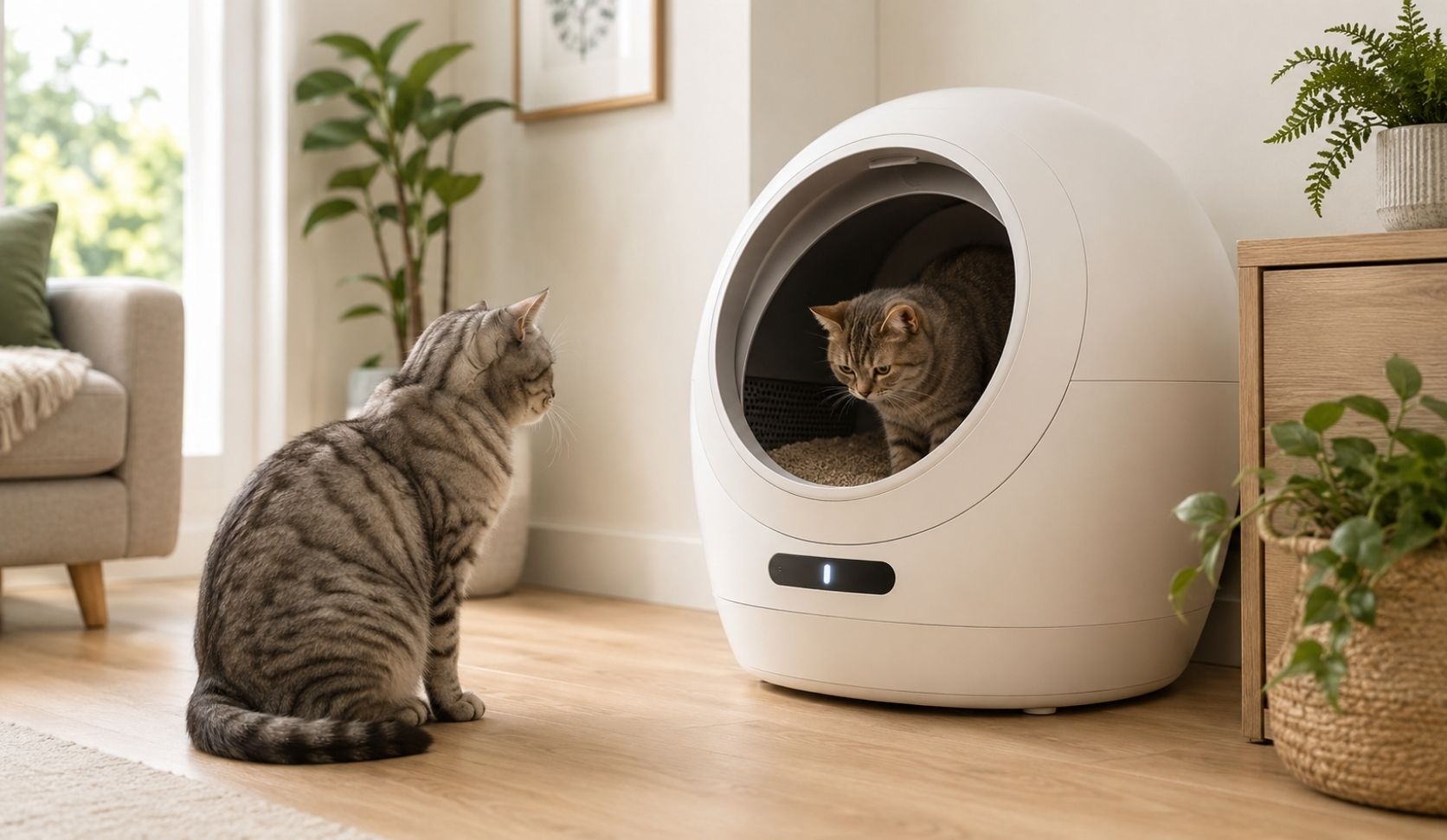
If your automatic litter box sometimes seems not to clean itself, the most likely explanation is not a fault. These machines wait a set period after a cat leaves before they cycle, and on the units I know best that wait restarts from zero if another cat enters during the countdown. In a busy multi-cat house that means the box can go through a whole evening without completing a single cycle, while behaving exactly as designed.
I lost an embarrassing amount of time to this before I understood it. I was checking sensors and reading troubleshooting pages when what I actually had was a queue.
The numbers, and whose they are
Litter-Robot's support documentation is the clearest published source on this, so I will use its figures and say plainly that they are one manufacturer's, not an industry standard. Its cycle delay, the time from when the cat leaves until the clean cycle begins, defaults to seven minutes, and can be set to 3, 7, 15, 25 or 30 minutes. The countdown can be canceled manually with a short press of the Reset button on the Litter-Robot 3 and 4, or Cancel on the Litter-Robot 5.
Other makers implement the same idea with different timings and different names. The principle is universal even when the numbers are not, and the reason is safety: the mechanism must not begin moving while a cat is still inside or immediately at the entrance. A delay is not padding. It is the margin that makes an automatic box safe to own.
The part that matters for multi-cat homes is buried in the same documentation: if the wait is interrupted by another cat entering, the timer resets for another full delay period. Waste can therefore sit in the litter considerably longer than the nominal figure suggests.
How a queue forms in a multi-cat home
Picture seven in the evening in my house. Mao uses the box and leaves. Seven-minute countdown starts. Four minutes later Leo goes in, the countdown stops and restarts. Three minutes after Leo leaves, Deo arrives, and it restarts again.
That is three cats across roughly fifteen minutes, which is not an unusual evening, and the box has not cycled once. Everything in the globe from the first visit is still there. If I walk past at that moment, what I see is an automatic litter box full of waste that is not doing the one thing it was bought to do.
Multiply that across the two clusters most cat households have, early morning and early evening, and you get the complaint that shows up all over review sites: it does not clean when I need it to. The box is not underperforming. It is being interrupted, and the design says interruption wins.
This is also why the problem scales so badly with cat count. Two cats rarely collide inside a seven-minute window. Three cats collide constantly. It is the same reason one unit sits right at its ceiling with three cats rather than comfortably below it.
Shortening the delay: what it buys, and what it costs
The obvious response is to drop the delay to its minimum. That does help, a shorter window is a smaller target for a second cat to hit, so fewer cycles get interrupted.
It also costs you two things, and neither is trivial. The first is safety margin. The delay exists so the mechanism does not start while a cat is nearby, and a cat who lingers at the entrance, or a cat who tends to come back, is exactly the animal that margin is protecting. The second is clump quality: fresh urine needs time to bind before it can be lifted out cleanly, and a mechanism that sifts too early can break the clump and leave residue behind, which becomes an odor problem later.
I am not going to tell you which setting to use, because it depends on how many cats you have, how they behave at the entrance, and what litter you run. What I will say is that if you are reaching for the minimum delay to solve a queue, you are treating a capacity signal as a settings problem, and it usually is not.
When queuing is telling you something else
A queue that appears occasionally at the busiest hour is normal. A queue that is your default state is information.
Persistent interruption means the number of visits your household generates has outgrown what one box can absorb, and no delay setting fixes that. The answer is a second location, not a faster cycle. That is a capacity conversation rather than a configuration one, and it is worth having honestly rather than tuning around it for another six months as I did.
Two things this is not, and both are worth ruling out before you go further. A box that stops mid-rotation, or that reports an error, is not queuing, that is a genuine fault, and the troubleshooting sequence is the right place to start rather than this page. And a box that cycles normally but still smells is a cleaning-interval issue; the maintenance rhythm covers what actually needs doing and how often.
Frequently asked questions
Why does my automatic litter box wait before cleaning?
For safety. The delay gives the cat time to leave and stay clear before the mechanism moves, and it also gives fresh waste time to form a clump the sifter can lift out cleanly.
How long is the delay?
On Litter-Robot units the default is seven minutes, selectable between three and thirty. Other manufacturers use different values, so check your own model's documentation rather than assuming these figures apply.
Does the timer really restart when a second cat goes in?
Yes, Litter-Robot's own documentation states that an interruption during the wait period restarts the countdown, which means waste can remain in the litter longer than the nominal delay.
Should I set the shortest possible delay in a multi-cat home?
It reduces interruptions, but it also reduces the safety margin and can break clumps before they have set. If you need the minimum setting just to get a cycle to complete, the real issue is capacity rather than timing.
How do I tell queuing apart from an actual fault?
Queuing looks like a box that never gets around to cycling during busy periods but works fine when the house is quiet. A fault looks like a box that stops partway through a rotation, throws an error, or fails to cycle even with no cats around.