
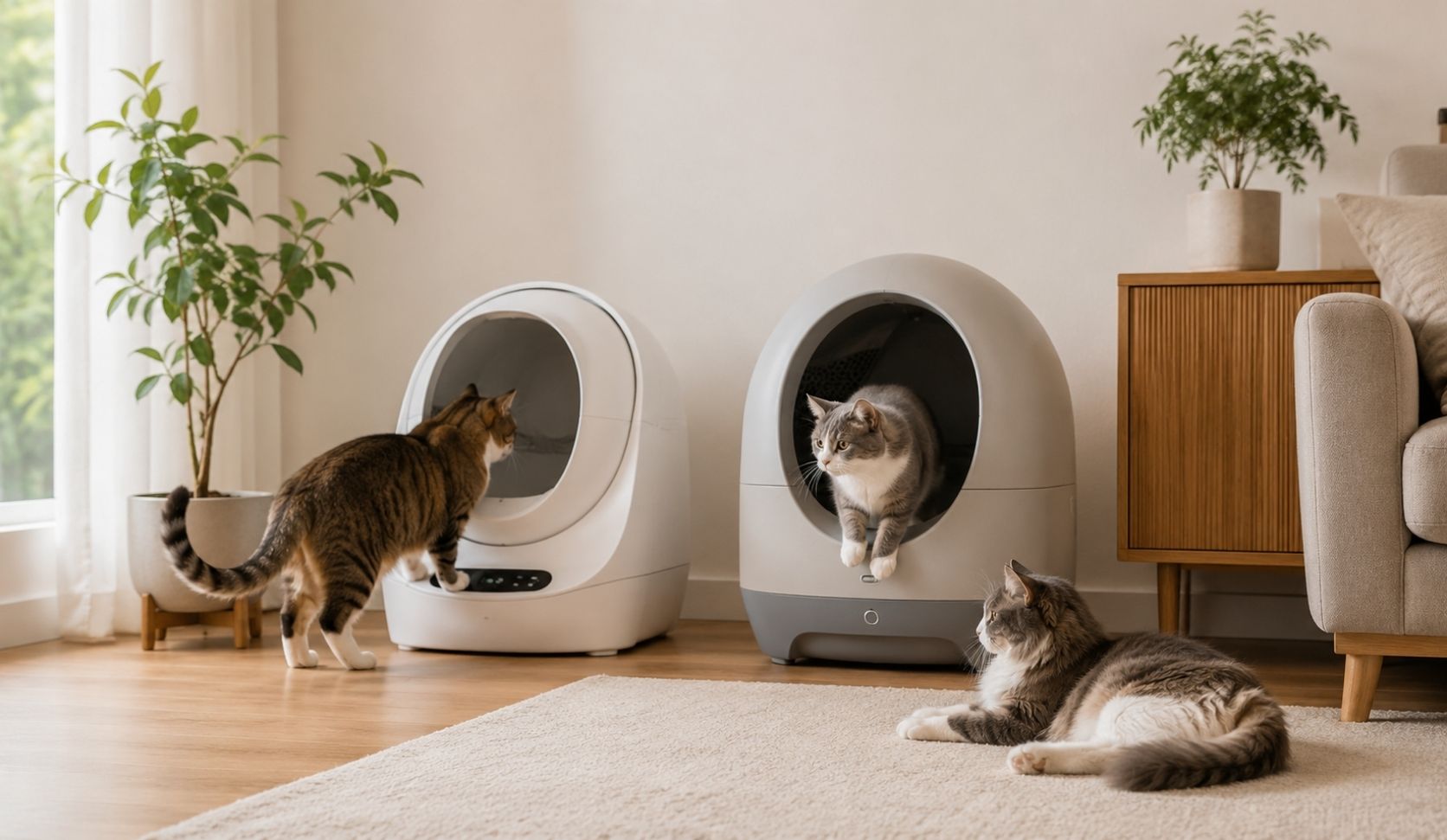
If you have decided one automatic box is not coping with your household, the thing that should trigger a second box is behavior, not drawer volume, cats queuing at the entrance, one cat guarding it, or anyone going outside the box. And the second box does not have to be another automatic unit. What a third cat needs most is a second location, and a plain manual pan provides a location exactly as well as a machine does, for a fraction of the attention.
That last point is the one nobody selling these things will tell you, so it is where I want to spend most of this piece.
The three signals that mean "add one"
I have written elsewhere about whether one box can handle three cats at all. This piece assumes you have already concluded it cannot. These are the three observations that justify that conclusion.
Queuing at the entrance. A cat waiting, hovering, or sitting near the box while another is inside, repeatedly, at your busiest hour. This is the most common signal and the most reliable one. It is also mechanically worse with an automatic box than a manual one, because the unit's own wait timer restarts when a second cat arrives, which is a genuinely confusing behavior until you know about it; I have explained how that delay works separately.
Guarding. One cat positioning itself so that another does not comfortably approach. There is often no hissing, no swiping and nothing you would describe as a fight. Guarding a single entrance is quiet, and it is the behavior most likely to be missed and most likely to matter.
Any elimination outside the box. This one is different from the other two, and I want to be careful with it. Going outside the box can absolutely be a capacity or territory problem. It can also be medical, and the medical possibilities are not things to work through at home. If this is your signal, book a vet appointment before you buy anything. A second box bought instead of an appointment is a delay, not a solution.
A full drawer, on its own, is not on this list. A drawer that fills faster than you expected means you empty it more often. It is a rhythm problem, and rhythm is cheaper to change than hardware.
A second automatic unit, or a plain manual pan?
Here is the section the SERP does not have, because both honest answers cost somebody a sale.
What the second box is actually for. In a three-cat house, the spare box in the N+1 rule, the long-standing veterinary and behaviorist guidance that boxes should equal cats plus one, is not there to add capacity. It is there so a cat who is blocked, startled, or simply particular has somewhere else to go. That function is about geography. It is satisfied by the box existing in a different room. The mechanism inside it is irrelevant to that job.
What a second automatic unit buys you. Genuinely cleaner presentation at both locations at any given moment, and no scooping at either. If your household's real constraint is that nobody has time to scoop, a household where everyone works away from home, for instance, then two automatic units solves the actual problem, and I would not talk anyone out of it.
What a plain manual pan buys you. The second location, immediately, with no acclimation risk, no new noise, no new power requirement, no new sensor to keep clean, and nothing to go wrong. It also gives you a fallback the day the automatic unit needs a deep clean or develops a fault, which, if you have ever taken one apart, you will recognize as a real convenience rather than a theoretical one.
My honest position after five years with three cats: most three-cat households adding a second box should add a manual pan first, run it for a month, and see whether the queuing and guarding resolve. If they do, you have solved the problem for the cost of a plastic tray. If they do not, you have learned something specific about your cats before spending on a second machine, and you will place the second machine better for having watched where they actually go.
The one case where I would go straight to a second automatic unit: when the reason you bought the first one was time rather than smell, and adding a pan just recreates the chore you were escaping.
Where the second box goes
This gets decided badly more often than the buy-or-not question does.
A second location means a different room, or at least a genuinely different part of a room. Two boxes side by side is one location with two doors. It does very little for a cat who is being guarded, because the guarding cat is standing in the same place either way.
Think about where the excluded cat actually spends time and put the box there, not where it is convenient for you to plumb in a power socket. If the new box is automatic, the socket constrains you and you will have to compromise, which is another quiet argument for the manual pan taking the harder location.
Avoid dead ends. A box in a corner with one approach is a box that can be blocked by one cat sitting down, which recreates the problem you are solving.
What changes when you have two
Less than you would expect in some ways, more in others.
Maintenance does not double. Waste is split across two boxes, so each fills more slowly, the total work is similar, spread over more surfaces. What does double is the number of things to remember, and that is where multi-box households actually slip. A second unit is a second filter, a second set of sensors and a second deep-clean date, and none of that is difficult, only easy to forget.
The new box also needs introducing, whether or not it is automatic. Cats do not automatically adopt a new box because you have decided they need one, and a machine in an unfamiliar place is a bigger ask than a tray, the same rules as getting a cat comfortable with an automatic box in the first place apply here.
One thing I am deliberately not doing in this piece is comparing what any of this costs. The cost side of running these machines is a separate question and it deserves real figures rather than guesses, so it is not something I will hand-wave here. The decision above is answerable without it, because it turns on where your cats are and how they behave rather than on money.
If you want the wider picture of what running these machines in a multi-cat home is actually like before you commit to a second one, the five-year account is the honest version.
Frequently asked questions
When do I need a second automatic litter box?
When you see queuing at the entrance, one cat guarding it, or any elimination outside the box, the last of which should go to a vet first. A drawer that fills quickly is a rhythm problem, not a reason to buy a second unit.
Does the second box have to be automatic?
No. The spare box in the N+1 rule exists to provide a second location for a cat who is blocked or particular, and a plain manual pan does that job just as well. Add the pan first unless your real constraint is that nobody has time to scoop.
Can I just put the second box next to the first?
That is one location with two doors. It does very little for a cat who is being guarded, because the guarding cat occupies the same spot either way. Use a different room, or a genuinely different part of one.
Does having two boxes double the maintenance?
Not the work, waste splits across both, so each fills more slowly. What doubles is the number of things to remember: two filters, two sets of sensors, two deep-clean dates.
How long should I trial a manual pan before buying a second unit?
About a month. If the queuing and guarding settle, you have solved it cheaply. If they do not, you will at least know where your cats actually go, which makes placing a second machine much easier.