
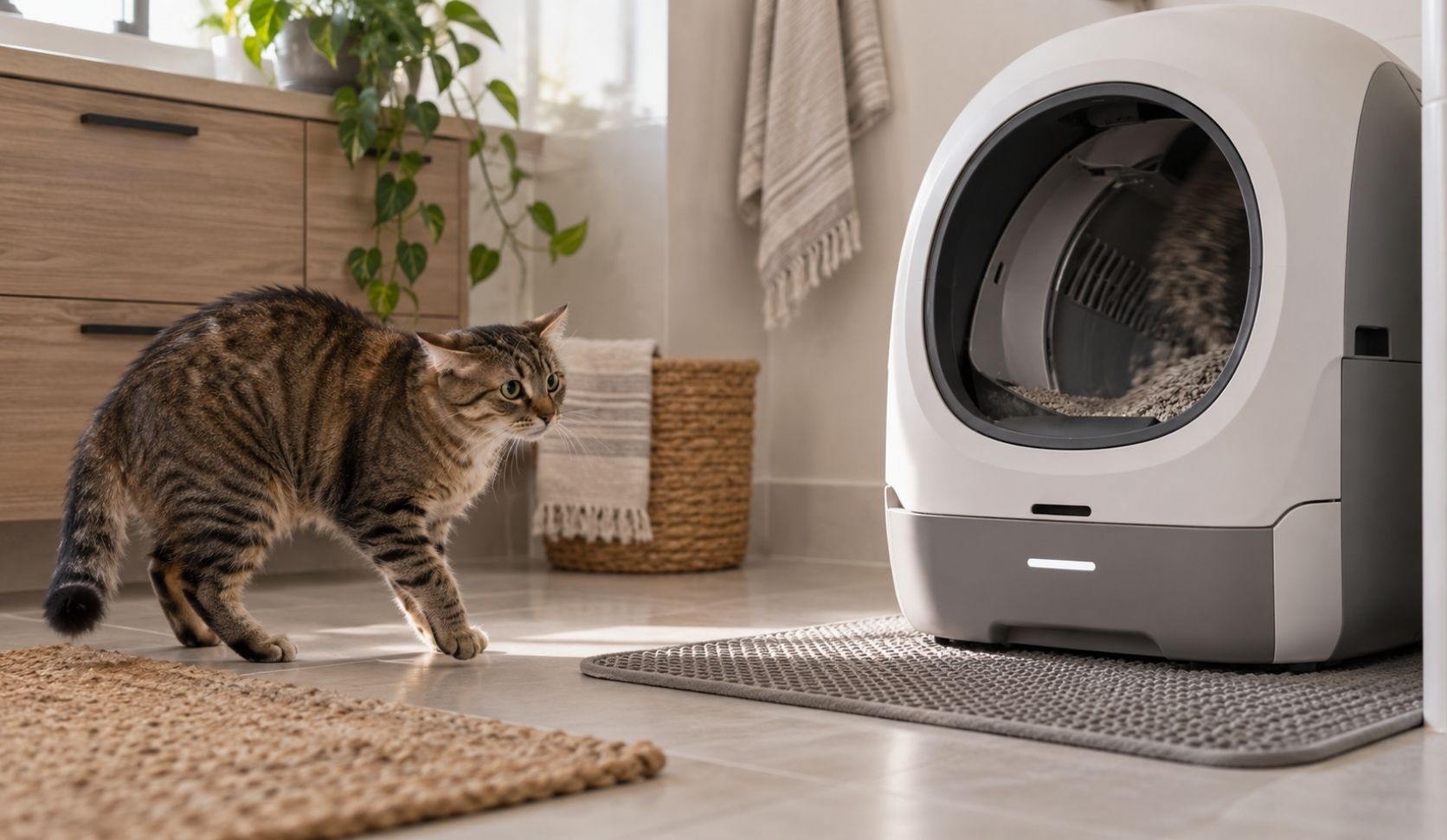
When I first plugged in my Litter-Robot, Leo paced the bathroom, then bolted. He refused to go near it for days. I assumed he hated the box, so I tried every gradual-introduction tactic I could find. Nothing worked until I realized I was solving the wrong problem.
The core diagnostic is simple: a cat frightened by the box's noise reacts after the cleaning cycle starts, because the sound and motion startle him. A cat frightened by the movement reacts to the machine even when it is switched off, because he has already learned what the shape means and what it might do. This single observation separates two different problems that need entirely different solutions. Guessing wrong cost me weeks of failed attempts.
The Two Triggers and Why They Need Different Fixes
Every piece of pet advice I'd read said "cats can be scared of automatic litter boxes" and recommended going slow. That advice was not wrong, but it was incomplete. It treated all fear as the same thing.
The machine has two separate elements your cat might react to: the sound it makes, and the shape and motion of something unfamiliar doing something unpredictable in their space.
Noise-triggered fear centers on the motor, the mechanical whirring, the sifting cycle, and the moment the waste drops into the drawer. These are sudden events tied to automation. If your cat is bothered by noise, the fear happens because of the cycling process itself.
Movement-triggered fear is different. It stems from the sheer presence of a large, strange, motionless object that a cat has learned will suddenly move. Even with the unit powered completely off, a cat with this kind of fear will avoid it, circle it, or show other avoidance behavior. The shape itself has become threatening.
This distinction matters because it changes everything about how you help your cat recover from the fear.
How to Tell Them Apart: The Diagnostic
The test is simple and requires just careful observation of when, exactly, your cat reacts.
First, power off the unit entirely. Leave it off for one full day while you watch your cat's behavior around it. Does your cat approach the box at all? Does he show signs of fear, like flattening ears, tucking his tail, or crouching away from it? Or does he investigate it like any other object?
If your cat shows fear or avoidance of the silent, still machine, he is reacting to the movement or shape. Your cat has already learned what this thing does, or what he expects it might do, and the knowledge itself frightens him.
If your cat acts normal or curious around the powered-off unit, but reacts badly once you turn it on, his fear is tied to the noise or motion of the cycle. He did not fear the box itself until the automation started.
This one observation tells you which path to take. If your cat starts eliminating outside the box entirely, paired with signs of fear, do not diagnose this at home. Route to a veterinarian. That combination can be anxiety, but it can also be a physical problem, and your vet needs to rule that out first. Read scared or just cautious, reading the signs for the body-language comparison that tells fear apart from ordinary caution.
If It Is Noise: Placement, Surface, and Timing
Noise-triggered fear is the easier of the two to manage, because you have several tools.
Placement is the first lever. Move the unit away from any space where your cat sleeps or rests most of the day. If the bedroom wall is where all three of my cats nap in rotation, I do not put the litter box on the other side of that wall. Distance and barriers matter. Cats startle less at a sound they do not expect to hear where they sleep.
The surface under the unit absorbs or amplifies the cycle noise. A hard floor transmits vibration; a thick mat or rug dulls it. This is not about decor or hiding the unit. It is pure physics. I found a rubber mat under my original box cut the perceived volume noticeably.
The delay setting is a third option, and this is where brief 08 digs deeper into the mechanics. Your automatic box likely has an adjustable delay between when your cat leaves and when the cycle begins. Longer delays shift the cycle away from the moment your cat is still in the room.
Check how loud these machines actually are for the full breakdown of cycle noise and placement strategies. That piece handles the sound itself and decibel ranges; I am only addressing the fear response to it.
If It Is Movement: The Powered-Off Acclimation Period
Movement-triggered fear is slower to resolve because it rests on your cat's learned association with the machine itself.
Your cat has seen this thing move, heard it do something unexpected, or formed an expectation that this specific object will do something unpleasant. The shape alone now carries threat. That requires a different approach.
The answer is a longer powered-off period than you might expect. When I introduce a new unit to Mao or Deo in my three-cat home, I run it beside the existing manual box, keep it switched off for the first full week, and let them use it as an ordinary, silent litter box. But if your cat already has movement-triggered fear from a cycle he has already experienced, he may need two weeks or more in the powered-off state. Do not rush this. Every time you turn the cycle on before he has fully rebuilt his trust in the box as a safe place, you reset his progress.
Line of sight matters too. If your cat can see the unit from his favorite resting spot, he has a constant visual reminder of the thing he is learning to fear. Temporarily placing the box where it is less visible, or where your cat has distance from it, helps. You can move it back to your preferred location once his comfort returns.
The full write-up of this method is the week-one powered-off rule. That piece covers the week-one protocol in detail. For the broader context of how automatic litter boxes fit into a multi-cat home, see the five-year multi-cat account.
FAQ
Q: Can my cat be afraid of both noise and movement?
A: Yes, in theory, but it is rare as the primary issue. Start with the diagnostic test: power off the unit for a day and observe. Most fears fit more clearly into one category. If your cat shows fear of both the silent unit and the running cycle, the movement-triggered plan is usually the better starting point, since it is slower and more conservative.
Q: Does this only apply to Litter-Robot models, or all automatic boxes?
A: The trigger distinction applies to any self-cleaning unit, whether it is a sifting style, a rotating drum, or a raking mechanism. All of them have noise and all of them have motion. Your cat's response to one of those elements determines the solution, not the specific brand.
Q: How long should I wait before concluding this approach is not working?
A: If you are addressing the right trigger, you should see small signs of progress within 7 to 10 days. Your cat does not need to love the box immediately, but he should show less avoidance. If you see zero progress after two weeks, and you are confident you have diagnosed the trigger correctly, talk to a vet. Something else might be in play.
Q: Can I use these approaches alongside the standard gradual introduction?
A: Yes. The diagnostic just clarifies which part of the problem you are solving. Many cats benefit from both going slowly and having the placement or acclimation strategy aligned with their specific fear type. They are not competing fixes; they work together.
Q: My cat only uses the old box now and ignores the new one completely. Is there a point of no return?
A: No. As long as he is still using at least one litter box and eating normally, you have time to re-approach the new unit. The powered-off period is a proven restart: run both boxes, leave the automatic one off, and let his fear extinguish on his own timeline. This works even after weeks of rejection.