
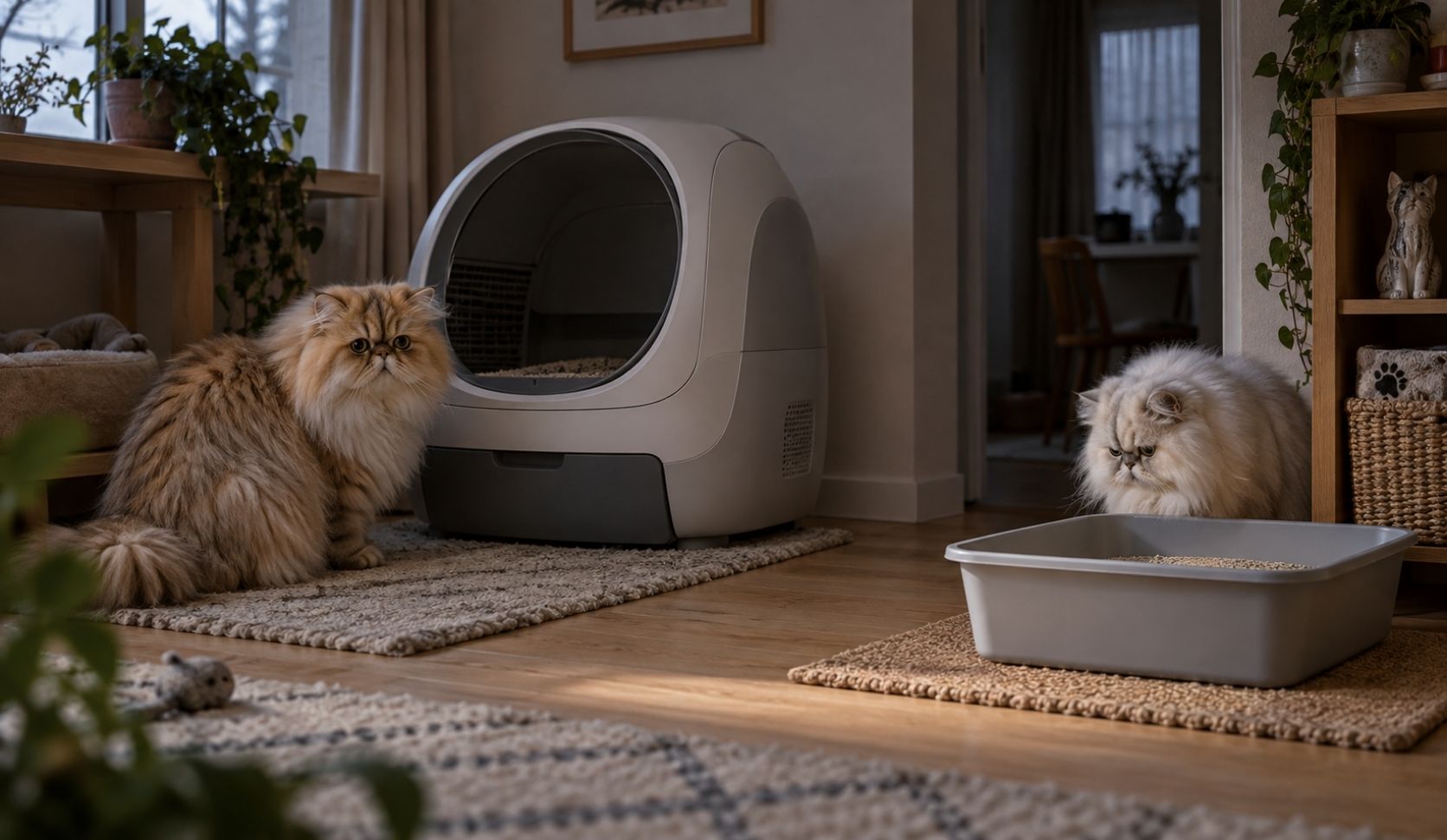
No. An automatic litter box needs mains power to cycle, so during an outage it stops where it is and stays there. Your cats keep using it, and the bed stays dirty until power comes back. For most households the answer to this is not a battery and not a generator. It is a plain manual pan, kept clean and ready in a cupboard.
I am Sarowar. I have run automatic litter boxes for five years in a house with three cats, Mao, Leo and Deo, and outages have taught me that the machine is never the casualty. The litter bed is.
One scoping note first, because these three failures get muddled. Losing power is not losing Wi-Fi, and it is not a jam. An offline unit keeps scooping while the app goes quiet. A stalled cycle means the motor has power and something is blocking it. An outage is the third case: unpowered, unblocked, frozen wherever it stopped.
What actually happens when the power cuts mid-cycle
Nothing dramatic. An unpowered motor has nothing to move with, so the mechanism simply stops. The problem is not the stopping. It is where it stopped.
If the outage lands while the unit is resting, you are lucky. The bed is level, the waste is in the drawer, and the box is now an ordinary litter box that nobody is scooping. If it lands mid-cycle, you get the state nobody writes about. On a globe unit, the litter sits halfway up the side of the chamber or partway into the waste port. On a rake unit, the rake is stranded across the bed with soiled litter piled in front of it.
That second state is worse than owning no automatic box at all, because your cats still need to go and the surface you are offering them is a slope with a metal bar across it. Every page I read while researching this jumped from "the power is out" to "it works like a normal box." Mid-cycle, it does not.
If it stopped partway through
PetSafe's own ScoopFree support article for a rake stuck outside the home position gives a documented recovery: unplug the box for 30 seconds and plug it back in, then press the manual rake button to bring the rake home, and only as a last resort lift the box, work the rake out and reinsert it with the horizontal bar facing the back.
That is PetSafe's procedure for PetSafe's hardware. Button names and unplug windows differ by maker, so a recovery written for someone else's box is not a recovery for yours. If your own documentation has no equivalent step, do not improvise one. And do not force a globe or rake past resistance to help it home, which is how a power-interrupted cycle becomes a real mechanical fault. Unplug before you reach inside, always.
The fallback that works is a plain pan, not a battery
Here is the whole plan, and it is deliberately boring. One open manual pan. A scoop. Enough of the litter you already use to fill it once. That is the entire kit.
Store it somewhere you can reach in the dark, and when the power goes, set it down beside the automatic unit rather than in a new room. Cats navigate by location. The corner they already use is the corner they will use, and moving the box during an emergency stacks a rejection problem on top of an outage problem.
The reason I argue for the pan over a battery is that the pan has a second job. It is the same pan you need on deep-clean day, when the unit is in pieces on a towel for an hour. Something that earns its shelf space a dozen times a year is easier to justify than something that earns it once a winter.
What a backup battery actually buys you
Some units do offer one. Whisker sells a Backup Battery listed as compatible with the Litter-Robot 4, Litter-Robot 5/Pro and Litter-Robot EVO, with a separate kit for the Litter-Robot 3. Whisker states the 12 VDC, 1.3 Ah sealed lead acid battery provides up to 48 hours of operation if power is interrupted, based on an estimate of 10 cleaning cycles per day. The unit switches to Backup Battery Mode automatically and recharges once mains power returns.
Now the part worth reading twice, in Whisker's own words: some functions, such as Wi-Fi, are disabled during Backup Battery Mode. The battery keeps the scooping and takes away the remote visibility, which is the exact reverse of what most people picture when they buy one.
Most brands sell no battery accessory at all. If yours does not, the answer is the pan, and no improvised power source belongs anywhere near it.
Why three cats lose their margin fastest
With one cat and one unit, an outage costs you a few scoops. With three cats sharing one automatic box, the bed fills roughly three times as fast, and no second box is absorbing the overflow while the first one sits dead.
That is the same arithmetic behind running one automatic box for three cats. Three is the ceiling in my house, so one unit at that ceiling means an outage removes all of my automation at once. My spare pan lives one shelf above the litter.
The real cost is never the scooping. It is a cat that finds the box unacceptable, goes somewhere else, and decides somewhere else is now an option. Rebuilding a habit takes far longer than any outage lasts.
Coming back from an outage: what to check first
Restore behavior varies by maker, and this is one place where you genuinely have to read your own manual. Some units come back and sit waiting for a manual cycle. Some want a reset first. Even the unplug windows differ: Litter-Robot's hard reset article for the Litter-Robot 4 says unplug for 15 seconds, while PetSafe's ScoopFree articles say 30. Do not carry a figure from one brand to another.
Three states, three different responses.
| What you find | What it means | What to do |
|---|---|---|
| Unit at rest, bed dirty | Outage hit between cycles | Empty the drawer, run one cycle, watch it |
| Mechanism stopped partway | Outage hit mid-cycle | Follow your maker's reset or home-position step, unplugged |
| No lights at all after power returns | Possible supply or base fault | Manufacturer support, not a teardown |
What the outage might actually have broken
That last row is the one I would not have predicted. Whisker's own no-power article for the Litter-Robot 4 lists power fluctuations, outages and brownouts among the reasons you may need to replace your power supply or your base. The genuine risk of an outage lands on the electronics, not on the cat.
Whether your schedules and settings survive is something I could not confirm on any manufacturer support page I checked, so treat it as unknown for your unit until you have looked. Open the app once power returns. Then, before you trust the box again, empty the drawer, level the litter by hand, and stand there for one full cycle. This unit is one spoke of a larger setup for multiple cats that has to keep working when nobody is watching.
Frequently asked questions
Is my cat in danger if the power cuts while it is inside?
An unpowered mechanism has nothing driving it, so it stops rather than continuing. What matters afterward is the state of the litter bed, not a moving part. Your model's manual is the authority on its own behavior.
Do my settings and schedule survive a power cut?
I could not verify this on the manufacturer support pages I checked, which is worth knowing in itself. Open the app as soon as power returns and confirm your cycle delay and schedule are still what you set.
Can I run it from a power bank or a car inverter?
Do not improvise a supply. These units specify a rating, and Whisker's Litter-Robot 4 troubleshooting states 15V DC 2000mA for that model. Use the manufacturer's own power supply, or its own battery accessory if one exists for your unit.
Is a backup battery worth buying?
It depends on your outages. If your area loses power for a day or more several times a year, a documented 48 hour reserve is a real answer. If you lose power twice a winter for three hours, the pan wins and costs you nothing extra.